
Simplify the procedures for registering individual businesses.
On May 28th, the National Assembly discussed the draft Law on Enterprises (amended), the Law on Management and Use of State Capital in Production and Business, and the draft Law on Notarization (amended).
Simplify business registration, but tighten post-registration checks.
On the morning of May 28th, the National Assembly held group discussions on the draft Law on Enterprises (amended). According to the Ministry of Planning and Investment (the drafting agency), one of the important changes in the draft Law on Enterprises (amended) is the innovation of the State management method for enterprises based on the principle that enterprises have the right to proactively conduct business in all sectors and professions that are not prohibited or restricted by law.
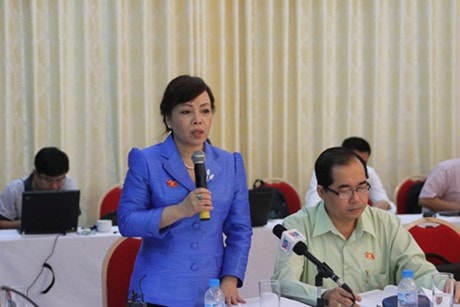 |
| Minister of Health Nguyen Thi Kim Tien believes that the current Enterprise Law provides flexible regulations for establishment. |
To implement this principle, it is necessary to clearly define, update, and publicly announce the list of prohibited and conditionally permitted business sectors and the corresponding business conditions so that all businesses can easily identify and comply with them.
Therefore, the amended Enterprise Law added Clause 4 to Article 7 to clearly define the responsibilities of relevant ministries and agencies in compiling, publishing, and updating the list of prohibited business sectors, conditional business sectors, and corresponding business conditions as prescribed by laws, ordinances, or decrees in areas under their state management authority.
Regarding business establishment and startup procedures, the drafting agency's explanation acknowledges that, in reality, the reforms simplifying business establishment procedures under the 1999 and 2005 Enterprise Laws have created a breakthrough in improving the business environment, mobilizing capital, developing the economy, creating jobs, and increasing contributions to the budget. However, according to international standards and practices, the level of ease in establishing and starting businesses remains lower than the international average.
Therefore, the Ministry of Planning and Investment believes that the Law needs to be amended to further simplify administrative procedures, reduce paperwork, reduce procedures, and reduce the time for registering and starting businesses; and to combine business registration procedures with procedures related to taxes, labor registration, and social insurance.
However, during a discussion on this issue this morning, Minister of Health Nguyen Thi Kim Tien stated that while the current Enterprise Law provides favorable conditions for establishing businesses, poor "post-inspection" procedures lead to commercial fraud, failure to fulfill commitments, and especially businesses operating under specific conditions that cause environmental pollution and waste, affecting people's lives.
Agreeing with the above viewpoint, delegate Truong Trong Nghia (Ho Chi Minh City) suggested that there should be strict sanctions against businesses that cause negative consequences for the community.
Standing Committee member of the Law Committee, Do Van Duong, argued that regulations on business establishment are too lenient, especially in the commercial sector. He noted that many businesses are established for profit, such as printing invoices, claiming VAT refunds, engaging in unscrupulous business practices, and harming legitimate businesses.
Based on that, Representative Duong proposed strict regulations from the "pre-inspection" and "post-inspection" stages to identify and prosecute "ghost" businesses, thereby promoting the development of legitimate businesses.
In addition, Representative Duong also suggested that state-owned enterprises should only focus on areas where the private sector cannot operate, because leaving public services to state-owned companies leads to monopolies, negligence, and inefficiency. Therefore, it is necessary to socialize the sectors where the private sector can operate.
Representative Le Trong Sang (Ho Chi Minh City) pointed out the phenomenon of many social enterprises exploiting the State's preferential policies to establish social or public service enterprises for personal gain, in order to benefit from preferential policies, investment, and loans... These are issues that this revised draft law must anticipate and regulate more strictly.
However, according to preliminary investigations by the Ministry of Planning and Investment, the number of social enterprises in Vietnam has been increasing recently and operating in many sectors and industries of the economy. These are enterprises whose profits are primarily reinvested to address social or environmental issues.
Currently, in Hanoi, Ho Chi Minh City, and Da Nang, there are several hundred social enterprises operating mainly in the fields of healthcare, vocational education and training, care for vulnerable groups, addressing environmental issues, environmental protection, and poverty alleviation.
Further promote the socialization of notary services.
In the afternoon, the National Assembly discussed and gave opinions on the draft Law on Notarization (amended) before finalizing it for official adoption during this session.
Of the 21 opinions expressed, the majority of delegates supported amending the law to promote the socialization of notary activities. The mixed public-private nature of the current activities is expected to change in the future; therefore, the "non-profit" principle stipulated in the draft law did not receive the approval of many delegates.
"Currently, notary services face fierce competition, with offices investing heavily and prioritizing professional responsibility towards clients. A non-profit model is only suitable for notary offices established by the State to ensure the provision of notary services to people in disadvantaged areas," assessed Representative Ho Thi Thuy (Vinh Phuc).
The scope of notarization is proposed to be further expanded compared to the Draft Law, and based on these opinions, the drafting agency will incorporate and revise the regulations to include provisions allowing notaries to notarize translations of documents from foreign languages into Vietnamese and vice versa.
Simultaneously, they can certify copies from originals and authenticate signatures on documents, but this is limited to documents related to contracts and transactions that they have notarized or are in the process of notarizing.
Along with creating more "flexible" authority for notarization activities, the National Assembly also focused on suggesting ways to further tighten the principles of practice in this rather "sensitive" field.
Accordingly, the Law must include provisions stipulating that notary offices are subject to certain controls and restrictions from state agencies, such as limitations on their operating areas and organizational forms, and that they are only allowed to collect fees as prescribed by the State.
Regarding the standards for notaries, many opinions support the new regulation that, in addition to professional qualifications, notaries also need practical experience in the legal field and that the required length of legal work experience is a mandatory standard for notaries. This aims to further improve the quality of notaries because, at a certain age, with sufficient experience and practical expertise, notaries will be better able to practice their profession.
Similarly, additional regulations extending the training period for notaries, as stipulated in the Draft Law, are needed to address shortcomings in training over the past period, further improve the quality of notary services, and align with the training duration for other judicial positions such as judges, prosecutors, and lawyers as prescribed by current law.
The delegates also focused on discussing and proposing clearer regulations on the mandatory purchase of liability insurance for notaries, in order to protect the rights of those requesting notarization and reduce the burden of responsibility on notary offices and notaries during their practice.
At the same time, regulations should be clearer, even establishing a separate clause, regarding the liability for compensation of notary offices and the liability for reimbursement of notaries in cases where a notary from a notary office causes damage to the person requesting notarization during the course of their practice.
According to chinhphu.vn


