
Celebrating the New Year amidst the vast forest.
(Baonghean.vn) - Celebrating New Year's Day in the mountains is not a bad idea. However, it took me a long time to have such an opportunity.
It was the day we tore off the last page of the old year's calendar. My younger brother was on a trip to visit his wife, a teacher in Ky Son district, nearly 200 kilometers from home. I was given a ride on his rickety motorbike, traveling up the winding, hilly National Highway 7A. Trips to the mountains were all too familiar to me. But I had never experienced a holiday that seemed so "unconventional."
These days, people tend to travel to cities or newly emerging tourist destinations during holidays. This is why offices, government agencies, and schools, which are usually the busiest centers, leave villages and hamlets, which are usually quite quiet and peaceful, deserted.
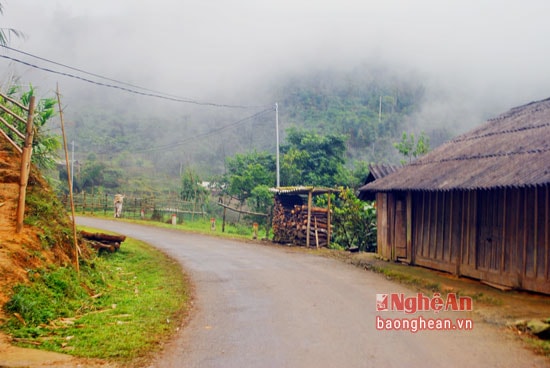 |
| The Hmong village of Pha Bun, perched precariously on the mountaintop, seemed quieter during the holiday. |
Along the quiet road through Pha Bun village, perched atop a mountain in the Huoi Tu plateau, the Hmong houses are shrouded in mountain mist. At this time, the village returns to its inherent tranquility. Children are engrossed in endless games in front of their closed houses, enduring the biting cold. Their parents have no holidays; they are out in the fields or in some corner of the forest. The men of Pha Bun village may be traveling to distant villages to buy lean cattle to fatten. On holidays, only the children of the village get to rest.
The fog gradually thinned as we traveled along the Phà Bún pass through Bắc Lý. Reaching Mỹ Lý commune felt like stepping into a different world. The frost and biting cold seemed to vanish. From a geographer's perspective, the difference in altitude is a fascinating experience. In just a moment, the temperature changes completely. Two distinct climate zones exist: the Hmong community at the mountaintop and the Thai villages deep in the valley below.
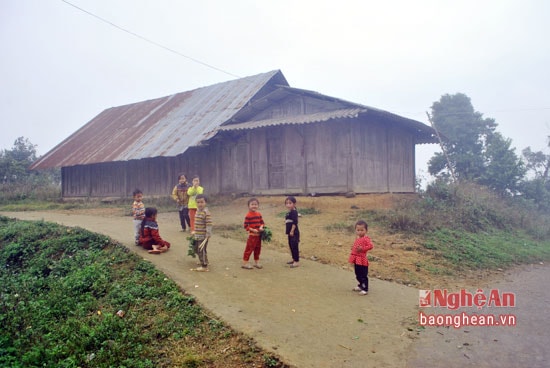 |
| Adults are all busy making a living, only children get a holiday. |
During these holidays, both in the high mountain villages of the Hmong people and in the villages of the Thai people in the valleys, there is a common atmosphere of quietude. For the highlanders, New Year's Day is just another ordinary day. The heavy baskets still weigh on the shoulders of the Thai women as they walk along the rough, steep dirt road to Xang Tren village.
In a brief conversation, I overheard people talking about a girl who weighed only 39kg but carried a basket weighing nearly sixty kilograms on her back. These days, the villagers go into the forest to carry a strange type of wood back to sell to traders. Large or small trees, fresh or nearly rotten wood, are all bought at 5000 VND/kg. The villagers usually travel by boat up the Nậm Nơn River, transporting the wood to a collection point by the riverbank, then carrying it back to the village on their backs. Each day, a strong person can carry about 100kg. That's an income of about half a million dong. Those who diligently go to the forest will surely have plenty of money to spend and buy things for Tet (Lunar New Year).
The last day of the year in the border village passed peacefully and quietly like that.
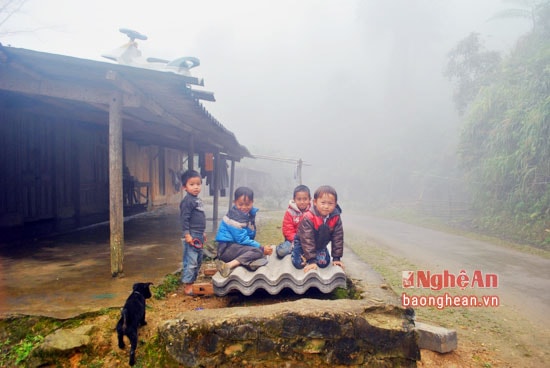 |
| The Hmong children were engrossed in endless games in the biting cold. |
Xang Tren village is home to a kindergarten and a primary school. On weekdays, it's bustling with the sounds of children studying. On holidays, a few little students race out to practice riding bicycles – a rare sight in remote villages like Xang Tren. This is because a dirt road, dug with an excavator, has reached the village.
For almost a year now, all the roads and alleys have been paved with concrete. People are starting to buy motorbikes to replace motorboats. Whether going to school near or far, the children can now use bicycles. In the hesitant turns of the children's bicycles, I see the dream of "escaping the mountains" – a long-held effort of the people in these remote villages.
Mr. Luong Van Nam, a teacher at My Ly 2 Primary School, opened a coffee shop next to the school for his wife to run. On holidays, he stays home to help his wife look after the children and cook. Teachers who live far away and don't go home for the holidays choose this place as a gathering spot. On the morning when people tore off the first page of the calendar in 2017, he also slaughtered a duck to share with friends for the New Year's celebration. The meal included a duck soup and a few local dishes.
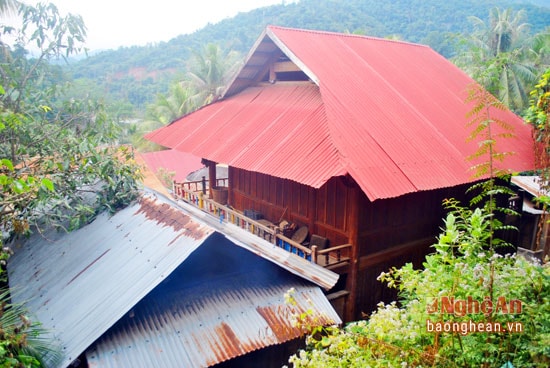 |
| The Thai people living deep in the valley also become more subdued during the holidays. |
During the meal, teacher Lau Ba Thong, who has spent 23 years in My Ly village, recounted the changes in the community. Lau Ba Thong began his teaching career in 1993 and has taught in 12 out of the 13 villages in My Ly commune. Many of his colleagues now work under the same roof. He said, "From the days when it took two days to travel by backpack to reach a school, things have changed dramatically. Now, only a few villages remain inaccessible by motorbike."
Recalling the bumpy, winding roads I've traveled on my motorbike for the past two days, I suddenly realize that difficulties still abound in this region. But for the people here, this land is transforming. In just a few years, a new hydroelectric power plant will be built.
The villagers are less interested in the hydroelectric power plant and more interested in the road leading to it passing through their village for easier access. Some families have already hired excavators to prepare the foundations for their houses so they can move closer to the road. Many might think that the people in the highlands are too pragmatic. But I see it as a long-standing, persistent desire for convenient transportation.
The village seemed quieter during these holidays. Only Luong Thi Thu Hoa, a high school student, had returned home for Tet (Lunar New Year) to visit her sick mother. Hoa was the pride of the village. Despite her poverty, she was a diligent student. Whether at the district school or her own school, she was a shining example of overcoming adversity. This was truly something to be happy about in a place where the drug epidemic was raging. In Xang Tren village alone, there were dozens of addicts. She said: "I don't know what the future holds, but I will choose a different future than many young people in this mountainous region."
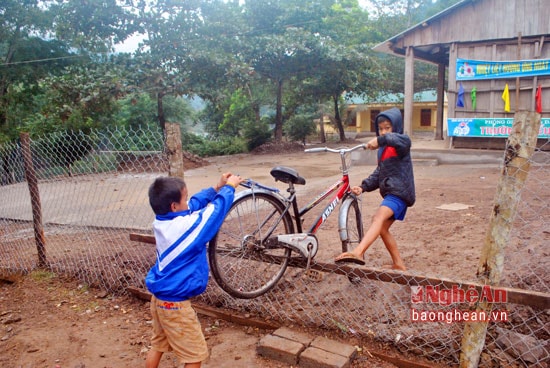 |
| For the first time in their lives, the children of Xang Tren village are learning to ride bicycles. |
My holiday passed with many small, joyful stories. On the last day of the holiday, the boys in the Hmong village of Nhọt Lợt, near the Vietnam-Laos border, began riding their bicycles loaded with rice back to school. Thus, the sacks of rice, carried on their bent backs for so many years, were transferred to bicycles. It was a change, indeed. Teachers from distant areas were beginning to return to school. In just a few hours, the highland schools would return to their usual bustling atmosphere.
The sky above remains covered with white clouds, like something out of a dream. These millennia-old clouds continue to drift aimlessly over the mountaintop, even as human life continues to change.
Huu Vi


