
Cleaning up space debris
Japan is about to test a magnetic grid for clearing space debris to prevent threats to satellites and space research programs.
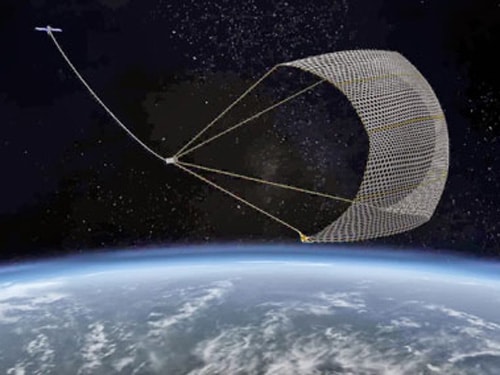 |
| Magnetic nets for cleaning up space debris - Photo: dvice.com |
According to Japan's Mainichi newspaper, space debris consists of fragments from defunct rockets, spacecraft, or satellites. These fragments travel through Earth's orbit at speeds exceeding 28,000 km/hour and pose a serious threat by potentially colliding with active spacecraft or satellites. Therefore, the Japan Aerospace Exploration Agency (JAXA) has collaborated with Nitto Seimo, a manufacturer of fishing equipment, to create magnetic nets to help clear space debris.
Space debris removal devices
In late February, JAXA will conduct its first test of the magnetic net's functionality, launching a rocket to put a satellite built by researchers at Kagawa University into orbit. Once in Earth orbit, the satellite will deploy a 300-meter-long net capable of emitting a powerful magnetic field to attract space debris. After completing its mission, the magnetic net and debris will fall back into Earth's atmosphere and burn up completely.
Engineer Koji Ozaki, head of Nitto Seimo, said, “We started this project five years ago and are excited to see the results of this test.” According to Ozaki, the magnetic grid is made of tough metal wires capable of withstanding significant force. Last year, NASA reported that the amount of space debris in Earth's orbit had reached an alarming level. Therefore, JAXA will continue testing the space debris cleanup grid over the next few years. The complete device is expected to be operational by 2019, helping to eliminate the dangers posed by space debris to humanity's space program.
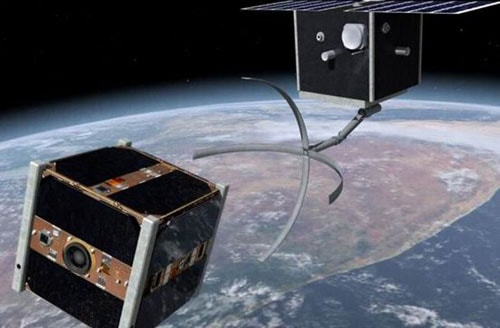 |
| CleanSpace One will collect space debris and throw it back into Earth's atmosphere. |
Not only is Japan producing magnetic levitation nets for collecting space debris, but Switzerland has also announced it will launch a special type of satellite in an effort to clean up space debris. Switzerland says it will launch the CleanSpace One satellite, which can collect space debris and throw it into the Earth's atmosphere, where it will burn up.
Researchers at the Swiss Space Centre of the Federal Institute of Technology (EPFL) in Lausanne have designed CleanSpace One, a robotic arm capable of picking up pieces of space debris measuring 10 cm on each side. Weighing 30 kg, CleanSpace One's mission is to propel defunct satellites back to Earth. It is expected to be launched into space in 2018, and the project is estimated to cost around $16.4 million.
According to the Voice of Russia, the small space shuttle satellite will be placed on top of an Airbus A300 aircraft to be launched into space. CleanSpace One uses robotic arms to collect space debris, and when its payload is full, the satellite will complete its mission. Afterward, the satellite will re-enter Earth's atmosphere and be burned up along with other space debris.
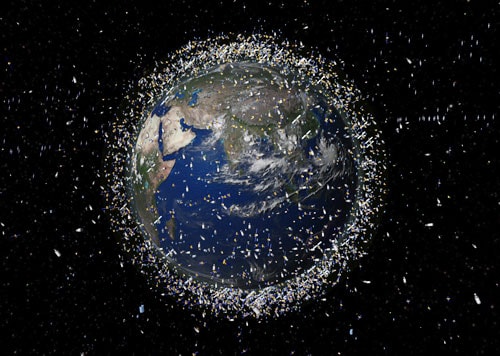 |
| Hundreds of millions of pieces of space debris are orbiting the Earth - Photo: Daily Mail |
A serious threat
The risk of satellites colliding with space debris has worried scientists for years. A collision could create thousands of flying fragments, potentially destroying other satellites. Furthermore, television signals, weather forecasts, global positioning systems, and international telephone connections are also at risk. Therefore, the space environment around Earth will become extremely dangerous if space debris is not removed.
According to the BBC, most pieces of space debris are located at an altitude of 700-1,000 km above the Earth's surface. NASA estimates that approximately 100 million pieces of space debris are floating aimlessly in space, of which 22,000 pieces are 10 cm or larger in diameter and can be detected by radar. However, radar cannot detect smaller pieces of debris.
Over the next 200 years, the amount of space debris with a diameter of 10 cm or more will increase by 30%. Therefore, scientists warn that the number of collisions between satellites or spacecraft and space debris will increase in the coming years.
If space debris is not removed promptly, a collision between a satellite or spacecraft and space debris will occur in Earth's orbit approximately every 5-9 years. Experts also say that space will become unstable due to debris in the next few decades, and to avoid this risk, the amount of debris in space must be reduced each year. In addition, scientists are urging owners of satellites in Earth orbit to take measures to ensure that their equipment, once decommissioned, will fall from the sky within 25 years.
Space debris has also forced the International Space Station (ISS) to shift to avoid collisions. In 2012, a piece of debris from the US Iridium telecommunications satellite flew close to the ISS, coming within less than 1,600 meters. Astronauts on the space station were forced to evacuate urgently to the escape pod of the Soyuz spacecraft as the massive piece of space debris hurtled towards the ISS.
According to AP, since 1998, the ISS has had to move 13 times to avoid debris. Space debris travels at high speeds, so it can puncture the space station.
According to Baocongthuong.


