
Donald Trump: Rationality comes from the 'crazy' facade.
(Baonghean) - The world seems to have grown tired of the criticism and negative views of Republican presidential candidate Donald Trump. But the statements and policies that Trump clarified at the Republican National Convention last week show that this basic direction has a basis, or at least inspires confidence in a segment of American voters.
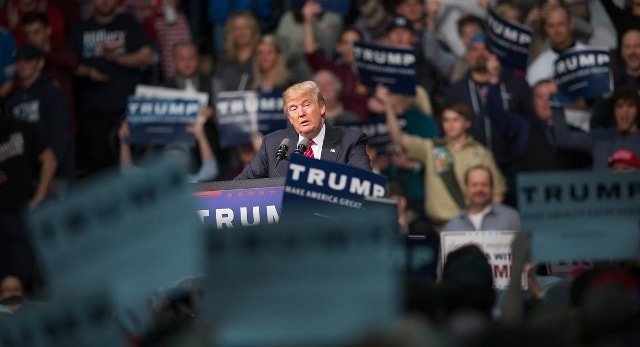 |
| Billionaire Donald Trump is popular with many, but he is also described as "crazy" and harmful to America in the eyes of some voters. Photo: Politico. |
From Trump's "extremism"
The "political portrait" of billionaire Donald Trump, constructed by many Americans and the majority of world public opinion, focuses on negative aspects, shocking rhetoric, and policies that go against traditional political models. In reality, Donald Trump has successfully polished his image with his unconventional strategy to surpass seasoned Republican political players.
In a recent statement on July 24th, Republican presidential candidate Donald Trump publicly expressed several views on foreign policy, international trade, and national security. Among them, he left open the possibility of withdrawing the United States from the World Trade Organization (WTO). Answering a question on NBC's "Meet the Press," Trump suggested that if he becomes the next US president, he might renegotiate or dismantle the North American Free Trade Agreement (NAFTA) and withdraw from the WTO. When pressed by host Chuck Todd about the WTO, the Republican presidential candidate stated that trade agreements within the WTO framework are a "disaster," and that the WTO itself is also a "disaster."
The real estate billionaire also mentioned his stance of saying "no" to international obligations and responsibilities when discussing the role of the United States in the North Atlantic Treaty Organization (NATO). Trump reiterated his intention to force allies to bear the defense costs that the U.S. has covered for them for many years. In an interview with The New York Times on July 20th, the real estate mogul Trump stated that under his term, the United States would not necessarily have to provide aid to NATO in the event of an attack. Whether the U.S. would provide material or moral support would depend on the level of contribution of each NATO member state to the alliance. Trump's idea here is quite clear: the U.S. will only help those who "fully fulfill their obligations to Washington."
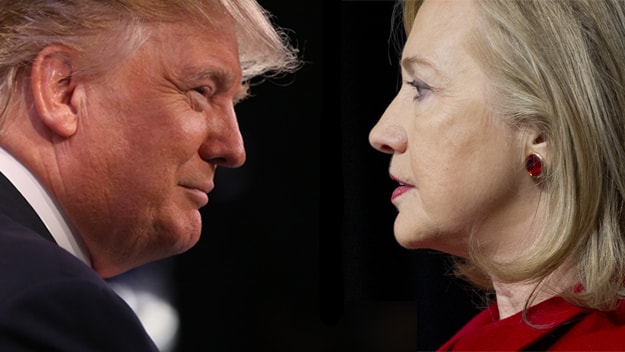 |
| The confrontation between Trump and former Secretary of State Hillary Clinton is predicted to be fierce, with so many opposing viewpoints. Photo: CBS. |
To Trump's logic
Billionaire Trump's decisive strategy is causing unease among America's allies around the world. But this is what a segment of the American population is expecting, behind his campaign platform, "Make America Great Again." In Trump's eyes, America is riddled with internal and external problems, persistent flaws and shortcomings, and therefore needs to be addressed rather than continuing down the traditional path.
According to Trump, the biggest domestic issue is the national debt, which is approaching $21 trillion, and the annual trade deficit exceeding $800 billion. Therefore, this was a recurring theme throughout Donald Trump's campaign, along with the messages "Strengthen America First" and "Make America Great Again." Donald Trump argued that if America is weak and cannot solve its own problems, it should never dream of becoming a "pillar" for the "free" world.
In the eyes of businessman Trump, America has become more pragmatic and "humble" in its relationship with the world. For example, the US needs to ask its allies, Japan, South Korea, and Europe, to contribute more and share the burden of common defense spending. Trump argues that the US should ask the wealthiest and most capable countries to contribute to common security commitments. Ensuring security is a win-win situation, not just for the US; and why should only the US be asked to fulfill its obligations to allies, and not the other way around? In the current relationship pursued by the Obama administration, and also the approach of Democratic candidate Hillary Clinton, the US's position is clearly one of dependence. No ally wants to open their wallet if they know America's weakness: its inability to abandon its bases in Asia and Europe. This framing of the issue is a very unfavorable premise for negotiations in Trump's eyes.
Obviously, a decline in contributions to global security costs also means the United States will "fall behind" in its role. But according to Trump, that's not a terrible loss while America still has lingering pains. Instead of pressuring other countries on human rights and promoting democracy, civil liberties, and American values, Trump doesn't hesitate to point out America's problems. Low minimum wage, widening wealth gap, racial discrimination, police shootings of innocent people, and attacks on law enforcement officers are always shocking to Americans. And instead of lecturing, America should set an example.
Politics is brutally honest.
Despite many people using billionaire Donald Trump's limited political capital to attack him, it cannot be denied that he has his own strengths. Trump is not a politician with the eloquence and extensive political experience of his opponent, Hillary Clinton. Therefore, his statements are mostly direct and honest, without embellishment; he says what he thinks. The key is that the stories he presents delve into issues facing America, issues that many American voters care about. Trump's less-than-ideal image stems from the fact that his words are not well-received by intellectuals and elites, leading to misinterpretations, and portrayals as "crazy" and bizarre.
The road to victory for Trump remains very challenging, but his "madness" has pushed the boundaries of American politics to new heights.
Thanh Son
| RELATED NEWS |
|---|


