
New impetus from land consolidation and reallocation.
(Baonghean) - Thanks to strengthened guidance and support for communes in promptly addressing difficulties and obstacles during implementation, the land consolidation and exchange movement in Do Luong district has seen positive changes, creating an important impetus for the implementation of the new rural development program. The total area of agricultural land undergoing land consolidation and exchange in Do Luong district is 8343.8 hectares. Before consolidation, there were 235,272 plots (an average of 5.9 plots/household), and after consolidation and exchange according to Directive No. 08-CT/TU, there are 76,877 plots remaining (an average of 1.93 plots/household).
Successfrom point models
In the hamlets of Phu Tho, Dien Bien, Dien Hong, Dien Tien… or anywhere in Luu Son commune (Do Luong district), people are excitedly talking about the 2014 winter crop. Mr. Dao Van Hai from Dien Bien hamlet said: “Following the land consolidation and exchange policy initiated by the commune, my family has strictly complied and has now received 4 sao (approximately 0.4 hectares) of agricultural land. This area is very suitable for winter crop production, so my family focuses on investing in this crop with a new method: planting early to harvest first, making it easier to sell and get a higher price. On those 4 sao of land, my family divided the land into zones to grow four types of crops: cucumbers, climbing beans, green squash, and gourds (for both shoots and fruit). Because we had products to sell from the beginning of the harvest season, cucumbers and green squash sold at the field for 5,000 VND/kg, climbing beans for 11,000 VND/kg… After 3 months of winter crop cultivation, we earned more than 20 million VND, and compared to rice cultivation, growing vegetables yields a much higher income.”
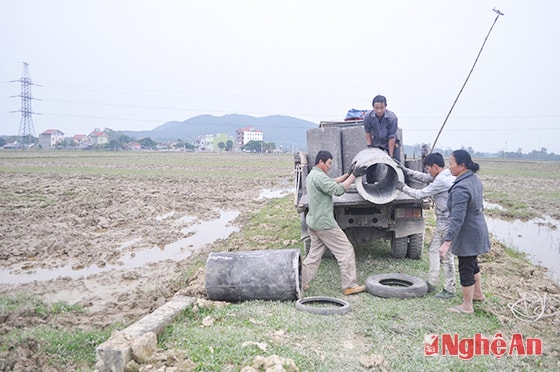 |
| People in Da Son commune are investing in transportation and irrigation infrastructure within the fields after land consolidation and reallocation. |
Mr. Tran Thanh Trung, Chairman of the Farmers' Association of Luu Son commune, said: “A crucial factor contributing to the success of the winter crop is the land consolidation and exchange program. Previously, the fields were fragmented, and farmers growing vegetables received many plots of land far apart, making it difficult to care for and harvest them. However, in the 2014 winter crop season, households received contiguous plots of land and were very confident in investing in intensive farming. Especially after land consolidation and exchange, Luu Son has created concentrated specialized farming areas, such as in Dien Bien hamlet, where a concentrated vegetable farming area of 28.2 hectares has been established…”
Luu Son commune was selected by the district as a pilot area for land consolidation and exchange because it is a flat area, bordered on three sides by the Lam River, and its residents are primarily engaged in agriculture. To effectively implement the land consolidation and exchange policy, the commune established a Steering Committee and developed an implementation plan. Simultaneously, it intensified propaganda and mobilization efforts to encourage cadres, Party members, and residents to participate through monthly meetings, Party branch activities, public meetings, voter outreach before council sessions, and the commune and village public address systems. This successfully attracted widespread participation from cadres, Party members, and residents in completing the conversion plan. According to Mr. Dao Van Tai, Chairman of the People's Committee of Luu Son commune: "The land consolidation and exchange plan, agreed upon by the people, is based on hamlets and regions, ensuring production for the 2013-2014 winter-spring crop. All seven hamlets organized a lottery for each household and group of households, then proceeded to allocate land so that people could start winter crop production on their plots."
Before land consolidation, the commune had 3,225 plots of land, and after consolidation, it remained at 2,580 plots (a reduction of 645 plots), with an average of 2 plots per household. Thanks to the successful implementation of land consolidation and exchange, Luu Son commune integrated the project to complete the construction of irrigation and transportation roads within the fields, linked to the new rural development plan (the area reclaimed for irrigation and transportation roads within the fields was 8.63 hectares, and the volume of excavation and embankment was 72,860 m3). After land consolidation and exchange, Luu Son developed a specialized area for high-value winter vegetable crops, creating fields for growing climbing beans, cucumbers, bitter melons, gourds, and pumpkins, yielding incomes of 60-90 million VND/hectare.
With the active involvement of relevant authorities, sectors, and the people, land consolidation and exchange were successfully implemented in the three pilot models in the communes of Luu Son, Trung Son, and Thuan Son. In Trung Son commune, the area of agricultural land consolidated and exchanged was 202 hectares, with 1,101 households receiving land. The number of plots before consolidation was 5,493, and after consolidation, only 1,872 plots remained (a reduction of 3,697 plots). Through land consolidation and exchange, people voluntarily donated land for the construction of internal field roads. Similarly, in Thuan Son commune, the area of agricultural land consolidated and exchanged was 167.17 hectares, with 1,233 households receiving land. The number of plots before consolidation was 6,781, and after consolidation, only 1,664 plots remained (a reduction of 5,117 plots). As a result, people have found it much easier to invest in intensive farming and introduce mechanization into production...
Expand to a wider scale.
Following the success of the three land consolidation and exchange models in Luu Son, Trung Son, and Thuan Son communes, Do Luong district organized a supplementary conference on land consolidation and exchange to implement and expand the model. Accordingly, the district assigned the remaining 29 communes to develop land consolidation and exchange plans for agricultural land, submitting them to the District People's Committee for appraisal and approval in May 2014. The communes then assessed the coefficients and yields, exchanged land, and assigned the task to the village subcommittees for implementation in July 2014. They also planned to develop land allocation schemes, organize lotteries, and allocate land on maps to the people in August. After the summer-autumn harvest, they planned to build internal roads and irrigation systems and allocate land on-site to the people...
Along with developing specific land consolidation and exchange plans suitable for each region, Do Luong district also issued a reward policy of 50 million VND for communes that complete the plan on schedule, and will discipline the Party Secretary and Chairman of the People's Committee of the commune that fail to complete the land consolidation and exchange work. Mr. Hoang Quoc Viet - Vice Chairman of the People's Committee of Do Luong district said: "One of the practical measures to accelerate the progress of land consolidation and exchange in Do Luong is that the District Steering Committee and the cluster and point leaders regularly visit the grassroots level to inspect and promptly supervise the communes in implementing land consolidation and exchange, especially directing the timely resolution of difficulties and obstacles at the grassroots level." For example, in Giang Son Tay commune, which is considered an area facing many difficulties in land conversion because the farmland there is very fragmented and small, and some people are not enthusiastic about this movement. In response to this situation, the district organized study tours for the commune to visit model farms and sent officials directly to the commune and hamlets to carry out propaganda and mobilization work, conduct surveys, develop plans, mark boundaries according to the plan, and conduct lotteries… With this approach, Giang Son Tay commune became a unit that successfully completed the land consolidation and exchange work.
Recognizing that land consolidation is a difficult and complex task, Do Luong district has strictly followed the process, ensuring transparency and objectivity. In particular, the subcommittees at the hamlet level have played a crucial role in the land consolidation process. The large-scale land consolidation and exchange work has received timely support from all levels and sectors, and most importantly, widespread public consensus and support, resulting in the rapid completion of land allocation to the people. Mr. Hoang Quoc Viet, Vice Chairman of the People's Committee of Do Luong district, stated: “According to the guidance of the Department of Natural Resources and Environment in Document 2387/STNMT, the hamlet was used as the unit for land consolidation. However, after implementation in Trung Son, Thuan Son, and Luu Son in 2013, the People's Committee of the district directed the remaining 29 communes to use the commune as the central unit for transferring agricultural land between hamlets, ensuring convenience between residential areas and production.”
Also during the implementation process, based on agricultural land allocated according to Decree 64 (1994) and land conversion according to Directive No. 02 (2002), the People's Committees of communes were tasked with gathering and reviewing households that had arbitrarily encroached on, expanded, or converted land use purposes without authorization, so that the district could handle them promptly, ensuring consensus among the people and creating fairness among households allocated agricultural land; some communes performed well, such as Trang Son, My Son, Nam Son, and Thuong Son. During the process of allocating land to the people for field improvement and reorganization, many communes developed plans for the relocation and consolidation of graves within agricultural land areas, thus facilitating the land conversion process.
Currently, in some hamlets, there are still difficulties in handling the situation of land use for improper purposes, and the land allocation to people on the ground has not been completed. The district is focusing on directing the resolution of these issues to complete the land consolidation and exchange work according to the plan, thereby focusing on investment in structural transformation and increasing productivity per unit area.”
Focusing intensely on land consolidation and exchange will be one of the key factors helping communes in Do Luong district meet the criteria for transportation and irrigation. Currently, only Thinh Son commune in the district has been recognized as achieving the New Rural Area standard; therefore, prioritizing investment in land consolidation and exchange is a crucial driving force for Do Luong to accelerate the implementation of the New Rural Area construction program.
Text and photos:Hoang Vinh


