
Dong Vinh on the path of reform
(Baonghean) - Over the past 20 years, from a ward with virtually no infrastructure, underdeveloped culture and society; unstable political security and social order, especially with the complex problem of drug abuse… the Party Committee and people of Dong Vinh ward (Vinh City) have overcome many difficulties to achieve what they have today: a ward considered to have developed quite comprehensively, and twice awarded commendations by the Prime Minister.
(Baonghean) - Over the past 20 years, from a ward with virtually no infrastructure, underdeveloped culture and society; unstable political security and social order, especially with the complex problem of drug abuse… the Party Committee and people of Dong Vinh ward (Vinh City) have overcome many difficulties to achieve what they have today: a ward considered to have developed quite comprehensively, and twice awarded commendations by the Prime Minister.
Dong Vinh in the past
Before the August 1945 Revolution, Dong Vinh belonged to Yen Truong district; the land of Yen Due village also belonged to Yen Truong district. When the revolutionary government was established, Yen Due belonged to Xuan Yen commune (Hung Dong). In 1946, Xuan Yen was renamed Thuong Xuan commune. In 1947, Thuong Xuan merged with Hung Cai (Hung Tay) to form the new Hung Thanh commune. At the end of 1953, it was again separated into two communes, Hung Tay and Hung Dong (Hung Nguyen). On December 20, 1970, the Prime Minister issued Decision 80/CP approving the merger of Hung Hoa, Hung Loc, Hung Dong, Hung Vinh communes and a portion of land north of Cau Duoc River belonging to Hung Chinh commune (Hung Nguyen) and Nghi Phu commune (Nghi Loc) into Vinh City.
In April 1979, in the spirit of transforming small-scale production into large-scale socialist production, which included expanding the scale of agricultural cooperatives, and with Vinh City facing the requirement to build a large, industrial city and a food and agricultural belt, the two communes of Hung Vinh and Hung Dong were merged into Dong Vinh commune. Dong Vinh commune has an area of 1,095.24 hectares and a population of 20,827 people.
After 16 years of consolidation, it was found that such a large scale was not suitable for the local situation. Following a proposal from Vinh City and Nghe An Province, the Prime Minister issued Decision No. 54/TTg on June 28, 1994, dividing Dong Vinh commune into two administrative units: Dong Vinh ward and Hung Dong commune. The specific administrative boundaries of the new Dong Vinh ward are defined along Nguyen Truong To street, from the 220 KV power station towards the North-South railway line; the remaining adjacent land is the land that existed in Hung Vinh commune before its merger with Hung Dong commune in 1979.
Today, Dong Vinh Ward is one of the inner-city wards of Vinh City – a Class I urban area. The ward has 14 residential blocks, a small-scale industrial zone, and 27 agencies and businesses located within its boundaries.
On the path of reform.
In Dong Vinh these days, wherever you go, you see an atmosphere of excitement and enthusiasm. The people are excited because over the past 20 years, along with the ward's development, they feel they have contributed a small part to that overall development. Visiting Vinh Thinh block – one of the blocks that recently received the title of "Cultural Block" in 2014, coinciding with the ward's 20th anniversary – at the newly inaugurated, spacious block cultural center, built with over 500 million VND from residents' contributions, Mr. Le Ba Trac – the block leader – said: "In implementing the movement 'All people unite to build a cultural life in residential areas,' the people in the block have been united and in agreement on policies, guidelines, and implementation methods. Through this process, we have realized one thing: When the people's hearts are united and in agreement, everything succeeds." For example, regarding the support for building the community cultural center, after the plan was approved, we immediately implemented it in meetings from the hamlet level to the block level, and disseminated information through loudspeakers to the people. In a short time, the block received many generous donations and enthusiastic contributions from the people. And on the occasion of the block receiving the title of "Cultural Block," the community cultural center was officially inaugurated. To date, Vinh Thinh block is the 12th out of 14 blocks in Dong Vinh ward to achieve the title of "Cultural Block."
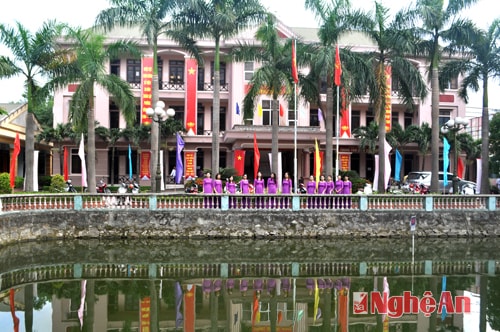 |
| The headquarters of the Dong Vinh Ward People's Committee is brightly decorated on the occasion of its 20th anniversary. |
In a conversation with Mr. Le Truong Thanh – Deputy Secretary of the Party Committee and Chairman of the People's Committee of Dong Vinh Ward, it was learned that: Although it is called a ward, the economy is still mainly based on agriculture, accounting for over 65%; industry, construction, and services are negligible. Tax revenue from industry and trade in the area is only 30 million VND per year. The budget is insufficient to cover even the most basic needs, let alone invest in construction, even small welfare projects. The poverty rate is still nearly 20%; the wealthiest households only reach 3.2%. The rate of malnourished children is as high as 30.8%. The poor cannot mobilize contributions for infrastructure development, so overall, the basic infrastructure ("electricity, roads, schools, health stations") is not synchronized and does not meet the minimum living needs of the people.
These difficulties stemmed from both low production capacity and a rapid population growth rate (1.8%), resulting in low average per capita income. Part of the problem was also due to unemployment, leading some young people in the ward to fall into gambling, alcoholism, and other social vices. A segment of officials, Party members, and residents, upon being upgraded to a ward, still harbored a mindset of waiting for and relying on city investment. However, after 20 years of overcoming numerous difficulties, Dong Vinh ward has transformed into an inner-city ward, standing alongside established wards and possessing better conditions for development. Currently, the average per capita income reaches 22.5 million VND/year. The poverty rate is only 0.73%. The rate of well-off and wealthy households is 72%, and the rate of malnourished children is only 11.2%.
Infrastructure such as electricity, roads, schools, and health stations have been gradually and comprehensively invested in. Many emulation movements, such as donating land and contributing labor and money, have opened up many more asphalt and concrete roads, making the unit a leader in successfully implementing Directive 31 of the Standing Committee of the Vinh City Party Committee. Welfare facilities such as cultural centers have been invested in and are well-equipped. Schools have been built and equipped with complete and synchronized teaching and learning equipment, creating an increasingly developed educational environment. Primary schools, kindergartens, and health stations meet national standards. The infrastructure system has received hundreds of billions of dong in investment (of which the people contributed tens of billions of dong and donated over 50,000 square meters of land to open roads). Security in each neighborhood has become truly stable, with 92% of families achieving the "Cultural Family" standard. Currently, 12 out of 14 neighborhoods have achieved the "Cultural Unit" title.
This achievement is thanks to the shift in the economic structure towards reducing the proportion of agriculture and increasing industry, construction, trade, and services. The total value of production has now reached 437,900 million VND. The growth rate is 12.14%. Total annual budget revenue reaches 8,076 million VND, ensuring a balance of revenue to cover regular expenses and fulfill the local political tasks.
These achievements stem from the spirit of unity, the ability to revive the revolutionary traditions of the former Lang Vang and Yen Due villages, and the promotion of patriotic emulation movements among the people. They stem from the successful implementation of the "All People Unite to Build a Culturally Rich Life" campaign and administrative reforms by the leadership. The Party Committee, People's Council, People's Committee, Fatherland Front Committee, and mass organizations from the ward to the block level, along with the cadres, Party members, civil servants, and the entire population, have effectively utilized internal strengths and external resources, with the support and favorable conditions provided by the city's various levels and sectors.
Unity and consensus among the people are the decisive factors for all victories. It is essential to leverage the coordinated efforts of the entire political system. Timely grasping the Party's guidelines and policies, and the State's laws, and creatively and effectively applying them to the specific socio-economic situation of the locality, is crucial for proactively developing and implementing plans for each period, clearly defining key tasks with breakthrough potential. The implementation process must ensure a high degree of democracy, prioritizing the interests of the people, and ensuring that movements are closely linked to the people's practical lives to truly inspire their participation in building their homeland.
Thanh Thuy


