
Breakthroughs in the field of resources and environment
(Baonghean) - During the 2010-2015 term, the Department of Natural Resources and Environment of Nghe An province overcame difficulties and challenges, successfully completing the programs and objectives set forth, contributing to the successful implementation of the province's socio-economic development tasks, and improving the effectiveness of state management of natural resources and environment in the area. The progress in areas such as land consolidation and exchange, issuance of land use right certificates, and implementation of the 2013 Land Law... demonstrates the efforts of all officials and staff in the department.
The land consolidation and reallocation revolution.
Among the positive achievements of the Natural Resources and Environment sector during the 2010-2015 term, the first breakthrough to mention is the land consolidation and exchange program. Implementing Directive 08-CT/TU of the Provincial Party Committee on promoting the mobilization of farmers to consolidate and exchange land plots and encouraging land accumulation for large-scale agricultural production, almost all localities participated with great enthusiasm. Land consolidation and exchange has been likened to a "revolution"...
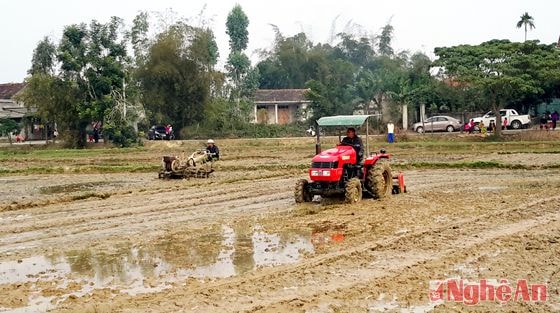 |
| Farmers in Thanh Chuong are introducing mechanization into production after land consolidation and reallocation. |
Visiting Thanh Lien commune (Thanh Chuong district) in the early days of 2015, one can feel the bustling atmosphere of farmers and the machinery preparing the land for planting and sowing the spring crop on the vast fields, further highlighting the effectiveness of land consolidation and reallocation. Taking advantage of the warm sunshine, Mr. and Mrs. Le Van Thuy from Lien Thanh hamlet, Thanh Lien commune, went to the field to prepare the land for sowing corn. With the invaluable "support" of a tractor, in just one morning, the couple finished preparing the land and sowing more than 2 sao (approximately 2,000 square meters) of corn. Mr. Thuy said: "Previously, our family had 2 sao of land for growing crops scattered across 3 areas. During the production season, fertilizing and spraying pesticides required moving from place to place, and the process of intensive farming, monitoring pests and diseases, and harvesting was very arduous. Now, all that land has been consolidated in one place, making production much more convenient."
In 2014, after completing land consolidation, reducing their three plots to one large one, the couple decided to pool their resources to buy a tractor for over 100 million VND to improve their production. This is the second season he has used the machine for land preparation, saving a lot of labor compared to manual methods. “With a large plot and convenient internal road access, the family decided to buy machinery. Having the machine has solved the seasonal labor shortage, and the family is always proactive in all stages from harvesting to land preparation. Besides working on our own farm, I also do plowing for hire, earning over ten million VND each season,” Mr. Thuy said.
Thanh Lien is a semi-mountainous commune (a mountainous commune in Zone 2), with unfavorable land conditions. After the first land redistribution under Directive 02 of the Nghe An Provincial Party Committee, the average land per household decreased from 9.5 plots to 5 plots. The second redistribution under Directive 08 involved 1,939 households with 8,345 plots. As a result, over 10% of households received one plot and nearly 90% received two plots, averaging 1.89 plots per household. Significantly, the previously scattered 5% land has now been centrally planned, making it suitable for the construction of family farms and large-scale farms. Eighty households have already received land under contract, totaling 25,569 square meters. Internal field roads have been upgraded, with a total length of 82 km and a maximum width of 8 meters. With improved internal field roads, mechanized machinery has been utilized in production. While in 2013 the entire commune only had 10 machines, now there are 100 plows and transplanters of various types, allowing people to have less work in the fields while increasing production efficiency.
Thanh Chuong is considered a bright spot in the province in land consolidation and exchange, with all 38 communes having completed the process. Besides Thanh Chuong, many other localities such as Yen Thanh, Anh Son, and Do Luong have also achieved good results after land consolidation and exchange. In Do Luong, implementing Directive 08 of the Provincial Party Committee, the entire district has allocated 7,861 hectares of land to nearly 39,500 households, reducing the average number of plots per household from 5.9 to 1.7, and increasing the average plot size from 350 m2 to 1,000 m2. Nearly 4 million cubic meters of earth and rock have been excavated and filled. The basic completion of land consolidation and exchange has created favorable conditions for intensive farming and the introduction of mechanization into agricultural production.
Land consolidation throughout the province is considered a "revolution," with 331,321 households participating. The area of agricultural land eligible for consolidation is 83,017 hectares. The average plot size after consolidation is 1,214.19 m2. The results of land consolidation on the ground are generally consistent with the objectives and progress of the approved land consolidation project. Public land has been consolidated into concentrated areas to facilitate the planning of infrastructure projects. The construction of internal field transportation and irrigation systems after land consolidation is in line with the approved plan and planning. Overall, the internal field transportation and irrigation systems meet the practical requirements well. After consolidation, localities have also proceeded with the restructuring of crop and livestock production to improve efficiency per unit area, contributing to the successful achievement of the new rural development goals. The rural landscape in the villages has truly transformed, and the material and spiritual lives of the people have improved.
Mr. Nguyen Van Chat – Head of the Land Management Department, Department of Natural Resources and Environment, shared: "We believe that the success we have achieved stems from the fact that the policy was correct and in line with the people's wishes. Therefore, when the people trust and agree with the policy, it creates great consensus in the implementation. In implementing the province's policy, the Department of Natural Resources and Environment was identified as the 'main force,' from building procedures and guiding the implementation of land consolidation and exchange to providing professional training. As the Standing Agency of the Steering Committee, the department has issued many guiding documents and organized inspections in all districts and cities to urge and resolve difficulties and obstacles in professional work; at the same time, every month, officials are sent to inspect and monitor the progress of implementation in localities."
To date, 320 communes in the province have the potential for land consolidation and exchange, of which 248 have completed land consolidation and exchange on the ground, 52 are currently implementing it, and 19 have not yet implemented it (according to the plan from 2012-2014, 213 communes should have been completed). 300 out of 320 communes have implemented land conversion; some districts have basically completed it, such as: Yen Thanh (39/39 communes); Dien Chau (35/37 communes); Quynh Luu (29/29 communes); Do Luong (26/32 communes); Anh Son (20/20 communes); Thanh Chuong (38/38 communes), Nam Dan (23/23 communes), and Thai Hoa town (5/5 communes). Districts with slow implementation include: Quy Hop, Nghi Loc, Con Cuong, and Hung Nguyen. Agricultural production is reaching a new stage of development, requiring the replacement of small plots of land with larger ones, large-scale, organized farming practices, and industrialization models. More than ever, agriculture, rural areas, and farmers are being considered. Looking back at the past term, we can see the involvement of the Nghe An Department of Natural Resources and Environment in land consolidation and exchange, and the collective efforts of the department in solving the current challenges of modernizing agriculture, rural areas, and farmers.
Expedite the issuance of land use right certificates.
Following the directives of the Prime Minister and the Provincial People's Committee, during the past term, the Department of Natural Resources and Environment has directed and organized the implementation very closely, decisively, and uniformly from the provincial to the local level, thus contributing to accelerating the issuance of land use right certificates throughout the province. The issuance progress has been accelerated, with the average issuance rate across the province reaching 90% of the area requiring certification, achieving the target set in the Resolution of the 17th Provincial Party Congress.
One of the leading localities in the issuance of land use right certificates is Vinh City. With a total natural land area of nearly 105 km2 and 25 wards and communes, land management in Vinh City has seen many positive changes during the 2011-2015 period, making a significant contribution to the city's socio-economic development. To date, the issuance of initial land use right certificates in the city has reached 95% of the required area for residential land (89% at the beginning of the term) and 89% of the required area for agricultural land (68% at the beginning of the term). This rate is higher than the requirements of the 13th National Assembly and the People's Committee of Nghe An province (over 85% of the required area).
Vinh City has implemented many effective solutions and methods. The People's Committees of wards and communes are tasked with completing dossiers and transferring them to the City Land Use Rights Registration Office for processing in a staggered manner, not accepting dossiers on demand at the Center for Receiving and Returning Results. After the City People's Committee signs the land use right certificate, the registration office is responsible for notifying citizens to receive the results. In cases where a ward or commune has more than 10 certificates, the registration office staff will directly go to the People's Committee office of that ward or commune to distribute the certificates to the people. The People's Committees of wards and communes organize dossier review sessions at least twice a week (for cases without land use right documents) following the principle of "easy cases first, difficult cases later,"... Periodically, on the 22nd of each month, they report the results of their tasks, difficulties, obstacles, and proposed recommendations, along with a self-assessment form, to the City People's Committee.
Mr. Nguyen Tat Son, Deputy Head of the Department of Natural Resources and Environment of Vinh City, said: "During the past term, the City People's Committee has focused on implementing many comprehensive solutions to strengthen state management of land in the area, from the city to the wards and communes. We have strengthened the dissemination of land law policies to organizations and individuals in the area; deployed and completed the cadastral mapping for newly merged wards and communes such as Nghi An, Nghi Duc, Nghi Lien, and 4 hamlets in Vinh Tan ward to serve the issuance and renewal of land certificates. To facilitate management, we have implemented the project to establish and complete cadastral records and build a land database for Vinh City…"
To date, the progress of issuing land use right certificates has been accelerated, and the average issuance rate across the province has increased. According to reports from the districts, the total area requiring land use right certificates in the province is 1,027,847.60 hectares, of which 489,018.34 hectares belong to organizations and 538,829.26 hectares belong to households and individuals. The area of aquaculture land decreased by 2,057.07 hectares compared to the land statistics due to the conversion of land use from aquaculture land to other purposes (urban residential land, rural residential land, specialized land...). Some cases remain pending due to: land users encroaching on land, illegal land use conversion inconsistent with land use planning, land allocation exceeding authority; and land disputes.
According to the plan, the target for issuing land use right certificates in the province by 2014 was to achieve a minimum rate of 85% of the total area of land requiring certificates. By December 30, 2014, the entire province had issued 1,344,697 initial land use right certificates covering an area of 925,087.32 hectares, reaching nearly 90% of the total area requiring certificates. Of these, 644,163 certificates were issued for agricultural land, reaching 90% of the total area requiring certificates. 700,534 certificates were issued for non-agricultural land (rural residential land, urban residential land, and specialized land), covering a total area of 39,013.30 hectares, reaching over 89% of the total area requiring certificates. Thus, during the 2010-2015 term, up to this point, the percentage of land area for which land use certificates have been issued has increased significantly, most notably for forest land, urban residential land, and rural residential land, all of which have reached over 90% of the area requiring certification.
A highlight of the implementation across the province is the mobilization of the entire political system, assigning and appointing leading officials and specialized personnel to guide the district and commune People's Committees in proactively organizing the simultaneous registration of land use by land users, instead of passively waiting for land users to register as before. Simultaneously, coordination with commune-level People's Committees is ensured to facilitate the simultaneous and efficient review of applications, preventing delays beyond the stipulated time. The focus is on deploying consulting units to conduct surveying and mapping to support the process of surveying and preparing applications for land use certificates, especially in areas without existing cadastral maps, to facilitate the initial issuance of certificates and to build cadastral databases in the districts of Kỳ Sơn, Tương Dương, Quế Phong, Quỳ Châu, and Con Cuông.
Putting the 2013 Land Law into practice.
Another area showcasing the efforts of the Department of Natural Resources and Environment is the implementation of the 2013 Land Law in the province. From July 1st, 2014 to the present, more than six months have passed since the 2013 Land Law came into effect. While the implementation period is relatively short, it can be affirmed that the results achieved in the process of implementing the 2013 Land Law in the province are a significant milestone in the past term. From the end of 2013, the Department of Natural Resources and Environment identified the implementation of the 2013 Land Law as a crucial political task for the department in 2014. On March 24th, 2014, in Decision No. 1077/QD-UBND.DC, the Provincial People's Committee also directed the Department of Natural Resources and Environment and other relevant departments and agencies; The authorities of districts, cities, and towns must focus on implementing many tasks to effectively carry out the 2013 Land Law. With the close guidance of the Provincial People's Committee, the tasks set out in Decision 1077 have basically been and are being implemented by the Department of Natural Resources and Environment and related agencies according to plan.
After the 2013 Land Law came into effect, all localities focused on implementing it at the grassroots level. Cua Lo Town was recognized as one of the units that acted early, decisively, and effectively in disseminating information and putting the law into practice. According to Mr. Le Dinh Sam, Head of the Department of Natural Resources and Environment of Cua Lo Town, the law came into effect on July 1, 2014, but before that, in May and June 2014, we invited officials from the Ministry of Natural Resources and Environment, the agency that drafted the law, to train staff from the Department of Natural Resources and Environment, the Land Use Rights Registration Office, the Land Fund Development Center, the chairmen, land administration officials, and block leaders of the seven wards in the town to understand the contents of the law.
In addition, we advised the People's Committee of the town to issue legal documents within the local authority on land use planning and plans; land allocation, land leasing, and land use conversion; land acquisition, compensation, support, and resettlement; basic land surveys, land registration, issuance of land use right certificates, ownership certificates for houses and other assets attached to land, construction of land information systems and land databases; land valuation; inspection and supervision of compliance with land laws; and handling of complaints and denunciations regarding land management and use… To date, it can be affirmed that the implementation of the Land Law has been in accordance with the plan, and the application of the law in practice has been basically smooth and without any obstacles.
In general, across the province, numerous documents related to the initial issuance of land use right certificates, ownership certificates for houses and other assets attached to land for households and individuals using land; land leasing, land use conversion; registration and issuance of land use right certificates, ownership certificates for houses and other assets attached to land for households and individuals to implement production and business investment projects… were issued in 2014. These are all important legal documents within the provincial authority. With these achievements, Nghe An was assessed by the Ministry of Natural Resources and Environment as one of the localities nationwide that implemented the Land Law most promptly, being the first province in the country to complete the issuance of documents implementing the Land Law with 7 documents.
For the Land Law to be effectively implemented, it is crucial that individuals enforcing the law, especially at the local level, are well-versed in and strictly adhere to its regulations. Discussing lessons learned from the leadership work, Comrade Vo Duy Viet, Provincial Party Committee member and Director of the Department of Natural Resources and Environment, emphasized: During the implementation of the 2013 Land Law, the Department of Natural Resources and Environment coordinated with districts, cities, and towns to organize numerous training sessions for grassroots officials; thereby, disseminating information widely to all segments of the population. In addition, the department drafted detailed guidance documents on important aspects of the law that land administration officials and chairmen of commune-level People's Committees need to pay special attention to during implementation. In the guidance document, the department also pointed out limitations and shortcomings, and particularly emphasized the causes, including human factors. It affirmed that a segment of land management officials are still weak in capacity and lack responsibility. Therefore, in addition to studying and researching to thoroughly understand the regulations of the law, they need to further cultivate and improve their public service ethics, thereby effectively implementing the 2013 Land Law and contributing to the socio-economic development of the province.
Thu Huyen


