
Public opinion will always support what is right!
(Baonghean) - Despite international law and domestic and international public outcry, Chinese leaders continue to insist on the rhetoric: "China has indisputable sovereignty over the South China Sea, China has ample historical evidence...". Although some mainstream Chinese newspapers have published this information, the arguments presented are unconvincing. The Chinese government also blames other countries for the current tensions in the South China Sea. However, many Chinese people have recognized the true nature of the issue and the facts, so many opinions supporting Vietnam and criticizing China's expansionist policies continue to appear on Chinese social media.
When the Chinese speak up
A Chinese citizen with the nickname Miyami wrote on Tianya.com: "The nine-dash line is just a figurehead from the government, merely a pawn to implement the government's policies. If we were to base it on the UN Convention, we would certainly have to abandon the nine-dash line." Another Chinese citizen, Xiaotuan, wrote on Weibo.com: "The nine-dash line is drawn right up to someone's doorstep, yet it's weak and heavily influenced by authoritarianism and hegemony." Another user, Zhizhi, wrote on Sina.com: "We bully others; that's not the style of a great power. Just look at the nine-dash line; if we truly based it on sovereignty, how would people live? Entering the sea would be considered crossing the border illegally. We shouldn't bully smaller countries; we should negotiate together to avoid conflict."
A reader with the nickname Friend1986 wrote on Fyjs.cn: "Regarding the recent disputes in the South China Sea, I would like to say that if we talk about historical grounds, Vietnam has more solid historical evidence than we do."
These opinions from Chinese citizens show that although the Chinese government is trying to make its people and the world understand that its placement of the Haiyang 981 oil rig in Vietnamese waters is beneficial to China, Chinese public opinion is quite discerning. Voices refuting the government's viewpoint have emerged on social media. Clearly, many Chinese citizens have recognized the truth and what is right.
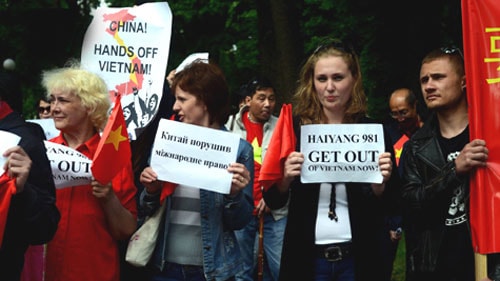 |
| Ukrainian citizens participate in protests against Chinese aggression in Vietnamese waters. |
When governments speak out
Globally, the international public's reaction condemning China's behavior has also become stronger and more intense. The administration of US President Barack Obama has once again urged resolving tensions in the South China Sea through dialogue. At a press conference yesterday, White House spokesman Jay Carney emphasized that tensions in the South China Sea surrounding China's placement of the 981 oil rig 193 km off the coast of Vietnam must be resolved through dialogue, not through intimidation. "Our position is that it needs to be resolved through dialogue, not intimidation. We continue to call for dialogue to find a solution to this issue."
Earlier, US State Department spokesperson Jen Psaki affirmed that China's provocative actions and escalation of tensions in the South China Sea are the view of many countries and are part of Beijing's strategic actions to annex disputed waters.
The French Foreign Ministry also voiced its opposition to China's aggressive and belligerent policies in the South China Sea on May 14th. At a press conference at the Quai d'Orsay, the headquarters of the French Foreign Ministry, commenting on the tense developments in the South China Sea following China's deployment of the Haiyang-981 oil rig in Vietnam's exclusive economic zone and continental shelf, the spokesperson expressed concern about the current situation.
Also at the press conference on the afternoon of May 14th in Hanoi, French Rear Admiral Pascal Ausseur, Deputy Director for the Asia-Pacific region – International Development Department, General Directorate of Armaments of France, during his visit to Vietnam, stated: "The recent incidents are a matter of great importance to Vietnam in controlling its coastal areas. The European Union has issued a statement expressing concern about the situation in the South China Sea, and France is one of the leading countries in drafting this document.” Mr. Ausseur added: “France wants to emphasize the need to resolve this complex issue peacefully. The South China Sea region is becoming increasingly important, and stability there will bring security and stability to Asia and the world.”
In an interview with the Russian press, Dr. Grigori Lokhshin, a historian and expert at the Institute of Far Eastern Studies of the Russian Academy of Sciences, stated: “Russia has strategic partnerships with both China and Vietnam, and we absolutely do not want trouble in our relations with our partners. Russia’s foreign policy is to maintain independence and self-reliance. Russia may have channels of influence or impact that don’t require public declaration or propaganda, and there are many other measures Russia can take in the current situation. I believe that Russia will do everything in its power to prevent the conflict from escalating.”
A serious and complex threat to regional security.
International press reports on May 15th continued to quote the opinions of many international scholars opposing China's encroachment on Vietnam's maritime territory. The website of Italy's most prestigious geopolitical magazine, "Limes," published a lengthy article on the ongoing tensions in the South China Sea. After recounting recent developments and Vietnam's response, the author asserted that Beijing is increasingly escalating its claims and employing threatening diplomatic tactics, arguing that its actions are creating a dangerous precedent.
The British newspaper Financial Times stated that, regardless of China's intentions, this action has sparked strong international reactions. Australian experts Malcolm Cook and Elliot Brennan argued that this move by China is deeply concerning, lacks goodwill, and is disappointing.
In this context, expert Malcolm Cook – Dean of the School of International Studies at Flinders University in Adelaide, and senior fellow at the Institute of Southeast Asian Studies based in Singapore – emphasized that China's deployment of the oil rig in the South China Sea is the latest evidence of China's uncooperative approach to complying with signed agreements or engaging in constructive dialogue to resolve disputes. Meanwhile, Vietnam has not taken any actions that China could consider "provocative" in recent times. Elliot Brennan, a Southeast Asian security expert at the Australian Institute for Development and Security Policy, affirmed that China's deployment of the Haiyang-981 oil rig in the South China Sea is extremely worrying and disappointing, especially given that it occurred amidst ongoing and positive bilateral dialogues and negotiations.
Amidst escalating tensions in the South China Sea, in an interview with the German newspaper "Delta 981" on May 15th, Dr. Gerhard Will, a Southeast Asia expert at the Institute for Science and Politics (SWP) in Berlin, stated that China's placement of an oil rig near the Vietnamese coast was surprising, given that regional experts have confirmed there are no significant oil reserves there. Therefore, it can be argued that this action by China is politically motivated. Dr. Will asserted that China's deployment of the Haiyang-981 rig represents a serious setback to efforts to de-escalate conflict in the South China Sea, as well as to the implementation of the Declaration on the Conduct of Parties in the South China Sea (DOC), signed by ASEAN countries and China. The German doctor also suggested that this action by China is not the first attempt to assert its territorial claims, encompassing nearly 80% of the total area of the South China Sea, with Beijing's so-called "nine-dash line." He emphasized that China's placement of the oil rig in Vietnam's exclusive economic zone clearly violates international maritime law regulations that China itself has signed, as well as the DOC signed by ASEAN countries and China in November 2002.
With these reactions and analyses, it is clear that the world is very aware of China's dangerous escalating actions. These outrageous actions violate international law and are unacceptable.
H. Diep


