
Draft roadmap for increasing tuition fees at public schools starting in 2015.
The roadmap for pricing education and training services using state budget funds from 2015 to 2018 is clearly outlined in the Draft Decree stipulating the operational mechanism, autonomy mechanism, and accountability in performing tasks, organizational structure, staffing, and finances for public non-business units in the field of education and training of the Government.
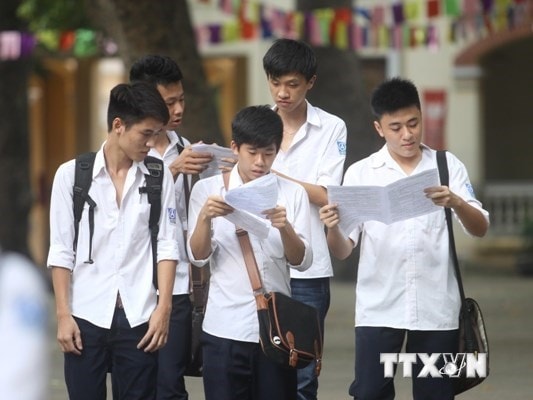 |
| Illustrative photo: VNA |
The draft Decree was just announced by the Ministry of Education and Training this morning, October 27th.
Accordingly, the roadmap for pricing educational services using state budget funds from 2015 to 2018 is divided into three phases.
Specifically, by 2015, the price was calculated to fully cover the salaries of all staff, lecturers, and employees of the unit; direct costs of teaching, learning, or service provision activities (including costs of supplies, stationery, tools, electricity, water, raw materials, fuel, and other costs directly related to teaching or service provision). In 2015, the price of educational services did not include depreciation costs of fixed assets.
By 2016, in addition to the costs calculated as in 2015, the price of state-funded educational services included general administrative costs of the unit (including costs of supplies, stationery, tools and equipment, electricity and water, and other costs serving the board of directors and the administrative departments within the unit). The depreciation costs of fixed assets were also not included in the 2016 figures.
By 2018, the price level will reflect all costs and a reasonable profit margin.
The draft also states that, based on proposals from the education and training sector and the actual situation, ministries, central agencies, and localities (or authorized agencies) will decide which public service units meet the conditions to implement the plan ahead of schedule.
The State shall regulate specific prices or price ranges appropriate for each type of educational and training service using State budget funds in accordance with the law on pricing.
Educational institutions are classified into three categories: fully autonomous units (self-financing both recurrent and development investment expenditures), autonomous units (self-financing recurrent expenditures), and non-autonomous units (those that do not self-finance recurrent expenditures or whose recurrent expenditures are guaranteed by the State according to the educational and training tasks assigned by competent authorities).
The draft regulations specify how tuition fees are calculated for each type of educational institution.
For fully autonomous educational institutions, tuition fees can be determined independently, but the maximum average tuition fee must be equal to the tuition fee ceiling set by the State plus the average recurrent expenditure from the state budget allocated to each public university student nationwide.
Tuition fees for specific majors may be higher or lower than the maximum average tuition fee, depending on student demand and training quality, but ensuring that the average tuition fee within the school does not exceed the maximum tuition fee limit.
Training institutions publicly disclose tuition fees to prospective students before enrollment. The government provides support up to the maximum tuition fee stipulated by the government for students from disadvantaged backgrounds.
For autonomous educational institutions, tuition fees are within the price range for educational services as stipulated by competent state agencies. The educational institution decides the specific price for each type of service. If a competent state agency specifies the price of educational services, then the fees collected will follow the rates stipulated by the state agency.
For non-autonomous educational institutions, if the State stipulates specific prices, the institution shall collect fees according to the rates issued by the competent state agency. If a price range is stipulated, the Ministry of Education and Training and the People's Committees of provinces shall decide on specific prices according to the roadmap for calculating public service prices in the field of education and training, as per the Government's decentralization, for uniform application.
For educational and training services that do not use state budget funds, units are allowed to determine service prices in accordance with the law on pricing.
Along with regulations on pricing, the Decree also stipulates related matters such as revenue and expenditure in public educational institutions.
In addition, the issue of autonomy and accountability in task implementation, organizational structure, and staffing levels is also one of the important contents of the Draft Decree.
This draft has been publicly released by the Ministry of Education and Training on its electronic portal to solicit broad public feedback, with the aim of further refining the contents of the Decree before its official promulgation. Comments should be sent to the Planning and Finance Department, Ministry of Education and Training, 49 Dai Co Viet Street, Hanoi, email: ptthuyen@moet.edu.vn.
According to Vietnam+


