
Cantaloupe - "Grow it for fun, eat it for real"
(Baonghean) - Nghi Thach is the only commune in Nghi Loc district that grows muskmelon in both the spring and summer-autumn seasons. This is a short-term crop with simple production, but the product is popular with consumers and brings high economic value to farmers.
Visiting Nghi Thach at the beginning of summer, if you go to the hamlets of Trung Khanh, Xuan Tien, Xuan Lac, Xuan Thinh, and Xuan Hoa, you will surely be treated by the locals to a special fruit: the "cracked melon," also known as the "cracked melon." It's called that because this type of melon has a thin rind, and when ripe, the flesh turns into a powdery substance and expands, causing the rind to crack. Putting a piece of melon dipped in sugar into your mouth, the fine, powdery particles dissolve, leaving a sweet, cool, and fragrant taste that dispels the heat of early summer. If the melon is mixed with sugar and crushed ice, it's even more enjoyable. That's why this fruit is so popular with consumers. Mr. Dang Ba Huong – Vice Chairman of the Nghi Thach Commune People's Committee – said: "Cracked melon is a traditional crop of the locality."
Previously, only the people of Trung Khanh hamlet cultivated this melon, but recently, its cultivation has expanded to many residential areas. Farmers consider muskmelons a "hobby" because they are simple to grow, requiring less investment in fertilizers and labor compared to rice, peanuts, or watermelons. They prefer sunshine, sandy soil with high humidity, and good drainage. Muskmelons are usually sown after the beginning of spring, requiring only pest and disease control and two rounds of fertilization: once when mounding the soil around the base of the plant and once before fruiting. During the melon's growth, farmers don't need to spend much effort on care. The important thing is knowing how to produce large, brightly colored melons. Farmers share this knowledge: The plants must be planted at an appropriate density. During the fruiting stage, damaged fruits should be removed, leaving only 2-3 fruits per plant. If the fruits overlap, they should be spread evenly. Additionally, a high amount of potassium fertilizer should be applied during the second fertilization.
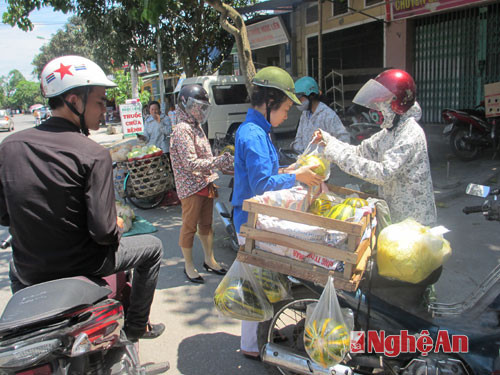 |
| Cantaloupe sold at Hung Dung market (Vinh City). Photo: Le Hoa |
Cantaloupe is increasingly popular with consumers, so in recent years, its cultivation has expanded significantly. Currently, the entire commune has 10 hectares of spring cantaloupe with 100 households participating, concentrated most heavily in Xuan Hoa, Xuan Thinh, and Trung Khanh hamlets. The cantaloupe is ready for harvest in less than 3 months, coinciding with the early summer heat, making it easy to sell and usually fetching good prices. Traders buy the cantaloupe directly from the fields and distribute it to markets in cities, towns, and surrounding areas. Families with the means to directly sell the cantaloupe retail double their income. Mr. Nguyen Van Manh's family in Xuan Thinh hamlet, who cultivates 1 sao (approximately 1000 square meters), said: "While the planting process is easy, harvesting is quite strenuous because the fruit ripens quickly, and if not harvested in time, it spoils. Therefore, my family has concentrated manpower to harvest the produce efficiently and sell the cantaloupe directly at the market." Although watermelon prices are lower this year than before, his family still earned a profit of 14 million dong, ten times more than growing peanuts.
According to local melon farmers, this year's harvest coincided with cool weather, resulting in lower prices than in previous years. However, a plot of land planted with melons still yields a profit of 7 to 8 million VND, while direct sales at markets can bring in 14 to 15 million VND. In years with favorable weather, the profit can reach 20 million VND per plot. After harvesting the spring melon crop, farmers continue planting summer-autumn melons and watermelons; followed by winter sticky corn, completing a production cycle on the same plot of land. Farmers estimate that, conservatively, one hectare planted with spring melons, followed by summer-autumn melons or watermelons, and then winter sticky corn yields a profit of approximately 370 million VND. This is a significant figure, unmatched by any other crop group currently available. However, according to Mr. Dang Ba Huong, Vice Chairman of the Nghi Thach Commune People's Committee, honeydew melons are difficult to preserve after harvest, and the market is still small and fragmented, so the area planted with honeydew melons cannot be further expanded. The current issue is that households should stagger the production of this crop to avoid congestion during harvest, which would lead to a drop in prices. On the other hand, each family should try to allocate manpower to shift from wholesale sales at the field to retail sales at the market to increase profits during harvest.
The introduction of this crop into production by farmers in Nghi Thach is an optimal choice to increase value per unit area. This is also the initial result in building a high-income farming model in the locality.
Nhat Tuan(Nghi Loc Radio Station)


