
By introducing electricity tariffs, is EVN replacing the Ministry of Industry and Trade?
Dr. Nguyen Dinh Cung argues that EVN is a company that cannot replace the entire electricity industry. Developing electricity pricing is the responsibility of the Ministry of Industry and Trade.
The above statement was made by Dr. Nguyen Dinh Cung, Director of the Central Institute for Economic Management Research (CIEM), at a workshop to gather opinions on the proposed improvements to the retail electricity pricing structure organized by EVN this morning (September 22).
Previously, Vietnam Electricity Group (EVN) proposed three retail electricity pricing options: Option 1: Maintain the current 6-tiered electricity tariff; Option 2: Calculate a flat rate of 1,747 VND/kWh; Option 3: Simplify the residential electricity tariff from 6 tiers to 3 or 4 tiers.
According to EVN's analysis, each option has different advantages and disadvantages. For example, EVN argues that maintaining the current six-tiered electricity pricing system complicates electricity bill payments for customers. The higher the electricity consumption, the higher the price, contrary to the logic of normal consumer goods where buying more leads to lower prices. This makes it difficult for customers to understand, monitor, and track their bills, leading to a lack of understanding and acceptance.
Because there are multiple tariff levels, recording meter readings without careful attention can easily lead to errors in calculating electricity bills, affecting people's rights.
Meanwhile, with the proposed flat electricity price of 1,747 VND/kWh, EVN calculates that households using less than 240 kWh/month will experience increased monthly electricity bills, while those using more than this amount will benefit. This option has the advantage of transparency and ease of implementation, but it may initially face difficulties due to its significant impact on low-income groups...
Leaving aside the question of which method of calculating electricity prices should be chosen, experts at the conference believe that EVN's decision to set electricity prices for the entire society is outside its function.
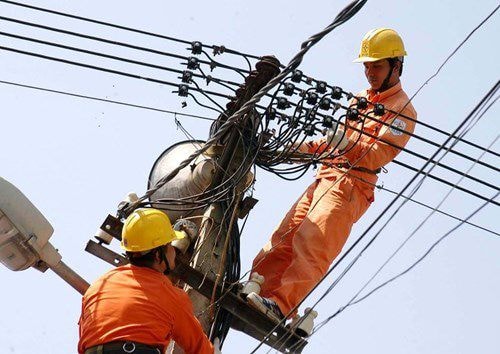 |
| Is EVN's introduction of electricity pricing replacing the functions of the Ministry of Industry and Trade? (Illustrative image - source: Vietnam Electricity Group). |
Dr. Nguyen Dinh Cung questioned why EVN proposed those prices and figures. The public needs to know where those figures came from. He also stated that the development of electricity pricing is not EVN's responsibility, therefore, EVN organizing the workshop was "surprising."
"EVN is a business entity; it cannot represent the entire electricity industry to set electricity prices for society. This task belongs to the Ministry of Industry and Trade. This distinction needs to be clearly made," Mr. Cung said.
Dr. Ngo Tri Long, a financial expert, also agrees with the progressive pricing system based on tiers, but believes that the price levels need to be recalculated and the intervals between each tier widened.
Sharing the same viewpoint, Dr. Le Dang Doanh argued that maintaining the current six-tiered electricity pricing system is unacceptable because people have already paid high electricity prices this past summer due to the consequences of this progressive pricing structure. Therefore, a change is necessary to reduce losses for the people. However, abolishing the progressive pricing system and implementing a single electricity price would eliminate the means to encourage and motivate consumers to save electricity.
On the other hand, according to Dr. Doanh, if a single electricity price is set, it will result in low-income earners paying the same price as those who consume a lot of electricity.
According to Vietnamese Education
| RELATED NEWS |
|---|


