
Introducing traditional folk games into schools: Positive effects
(Baonghean) - We are present at Dang Chanh Ky Secondary School, Xuan Hoa commune, Nghean district.
Twenty muscular male students from two classes stepped onto the arena amidst the enthusiastic cheers and applause of nearly 450 other students. The schoolyard became lively, filled with joyful laughter that dispelled the tension of the previous lesson, allowing the students to enter the next class in a relaxed and cheerful mood, thus enhancing their learning effectiveness.
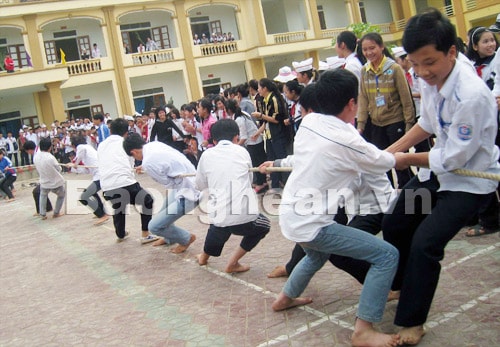
Playing tug-of-war at Dang Chanh Ky Secondary School (Xuan Hoa commune)
According to Mr. Phan Huy Tung, the head of the school's youth organization, since the 2006-2007 school year, the school has incorporated traditional folk games into the curriculum as a regular activity. Easy-to-organize games such as tug-of-war, jump rope, stick pushing, sack racing, relay races, and blindfolded tag have been warmly received and enthusiastically participated in by the students.
Thanks to the close cooperation between the school, family, and society in managing and educating students, the school has had no students violating the law for many years. In addition to utilizing break times to organize games, the school also proactively incorporates folk games into the first 15 minutes of class, and competitions such as: "The Young Pioneer in the Homeland of Uncle Ho"; "Proud of Our Homeland"; "Ringing the Golden Bell"...
Before each competition, there is a facilitator to organize folk games to inspire students' enthusiasm for participation. At Kim Lien Secondary School in Kim Lien commune, Nam Dan district, since 2008, folk games have been introduced into the school and have flourished. Students are very interested and actively participate; the school organizes an extracurricular activity once a month for all classes. This activity has helped students bond, increased solidarity among them, and especially fostered a spirit of teamwork, group coordination, and community spirit.
Quỳ Châu is a mountainous district highly regarded for its efforts in introducing folk games into schools, especially those reflecting the unique cultural identity of the northwestern mountainous region of Nghe An province. In addition to common games, the Quỳ Châu Department of Education and Training has directed schools to incorporate several games with distinctive mountainous characteristics, such as bamboo pole jumping, throwing the ball, playing O An Quan (a traditional board game), stilt walking, and Mạc Lè (a traditional game).
According to statistics from the Department of Education and Training, after three years of implementing the "Friendly School, Active Students" program, all 20 districts, cities, and towns have introduced games into schools, with 170 familiar folk games. In the coming period, the Department will direct the district-level Departments of Education and Training to add more games to schools, such as six-a-side volleyball, horse jumping, net fishing, stilt walking, and flag capturing.
However, the implementation still faces certain difficulties, such as the heavy academic curriculum, schools not being able to allocate enough time to organize games, and many units not being very proactive in participating in activities...
In reality, some folk games such as land-based boat rowing and throwing the ball require schools to purchase equipment, while funding is a major challenge for schools. Therefore, the implementation of folk games in schools in Nghe An is based only on a few simple games that do not require complex or expensive equipment.
Given the current situation where a segment of students are becoming engrossed in unhealthy online games, the education sector needs to address these difficulties and promote the integration of traditional folk games into schools in order to educate the future generation of the country to have healthy bodies and pure souls, and to live, study, and work in a way that benefits society.
Vo Van Dung


