
Give the wallet, spread the word.
(Baonghean) - Born in 1992, Le Thanh Phong is currently a final-year student at the Hue Academy of Music and the head of the UNESCO Nghe An Folk Song Heritage Club in Hanoi. Phong has boldly brought his traditional folk songs to the capital and to numerous stages, exhibitions, and art fairs in various localities. Soon, Le Thanh Phong will bring Nghe An folk songs to the Central Highlands for the Hung Kings Commemoration Ceremony, which will be held solemnly at Dong Xanh Park, Gia Lai province.
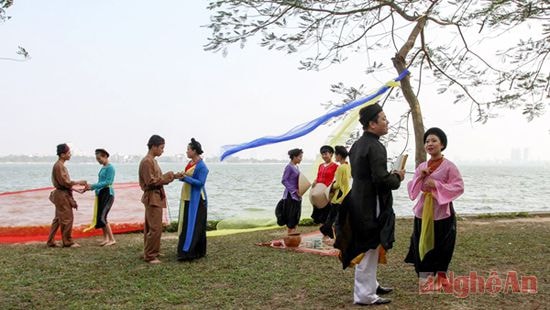 |
| Performance of Ví and Giặm folk songs at West Lake. |
- Hello Le Thanh Phong, recently, through newspapers and television, many people have come to know "the young man from Nghe An who loves folk songs and traditional music." Could you tell us a little about this "love for folk songs and traditional music" of yours?
- My paternal grandparents were originally from Hue. During the revolutionary years, they crossed the Ngang Pass to the North, answering the call of the Party, and settled down along the Lam River. From a young age, I listened to my paternal grandmother sing Hue folk songs, with their melancholic tunes and melodies, while my maternal grandmother and mother, both native of Thanh Vinh, always comforted me with their affectionate folk songs. Another stroke of luck was that two of my uncles were musicians at the Bong Sen Trang Cai Luong Theatre and the National Folk Music and Dance Theatre. Perhaps that's why folk music has naturally seeped into me.
- If I'm not mistaken, you founded the folk singing club back when you were still studying at the University of Culture, right?
- Initially, it was simply to ease my longing for my grandmother, mother, and homeland. I invited my fellow countrymen at the University of Culture—where I was studying—to sit together and recite folk songs and melodies, gradually forming a spontaneous folk song club. After my first year of university, with the advice of musician Thao Giang, Director of the Center for the Development of Vietnamese Music and Arts, I continued my studies by enrolling in the first course in Ethnic Music Theory and Criticism at the Hue Academy of Music, which was offered in Hanoi. Fortunately, I achieved excellent scores and was able to study at two universities simultaneously, one focusing on culture and the other on arts. Thanks to this, I had many opportunities to introduce and perform folk songs and melodies. My first performance for the Hanoi audience was at the Dong Xuan market, "Hanoi's 36 Streets," with the melancholic Xam folk song "Ten Virtues of Parents." Even now, whenever I recall it, I am deeply moved by the warm reception from the audience and the guidance of composer Thao Giang and People's Artist Xuan Hoach.
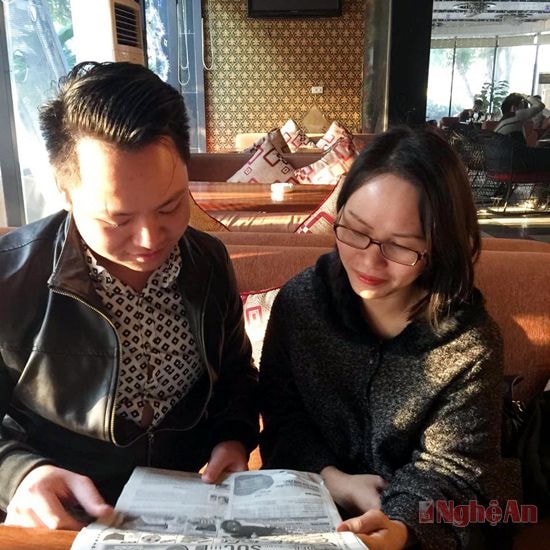 |
| Le Thanh Phong speaks with a reporter from Nghe An Newspaper. |
- Can you tell us about the origins of the UNESCO Nghe An Folk Song Heritage Club and how it operates?
- After operating for some time at the Hanoi University of Culture, the Folk Song Club attracted many young people. At this time, the club needed a stable and legally sound organization, so I submitted my proposal to the Vietnam Federation of UNESCO Associations for sponsorship. Fortunately, my proposal was approved, and the Federation assigned the UNESCO Center for Community Health Support to directly manage and facilitate its activities. On May 19, 2014, the club officially adopted its new name, the UNESCO Folk Song Heritage Club of Nghe An Province, as it is known today.
The club operates on two principles: preservation and promotion through experiential activities. "Preservation" involves the club's leadership visiting villages in Nghe An and Ha Tinh provinces that still practice the folk singing style of "vi" and "giam" to collect and document information for teaching to members. "Promotion" involves practical sessions that bring the learned "vi" and "giam" back to their natural environment. For example, at Xuan La communal house on the shores of West Lake, we organized a reenactment of a traditional folk singing performance. Young members of the club transformed into female and male singers with traditional skirts and blouses, and the young men wore traditional headscarves and silk robes, reminiscent of ancient scholars and teachers. This stimulated their creative thinking and allowed them to improvise using the original "vi" and "giam" melodies, rather than relying solely on pre-learned verses. This is also a key activity because the experience itself acts as a catalyst to attract people of all ages to watch, initially out of curiosity, then developing a deeper love and passion for the folk songs. Currently, through such experiential sessions, the club welcomes many tourist groups visiting Tay Ho, Hanoi, to see and learn about the cultural heritage of the folk songs and chants.
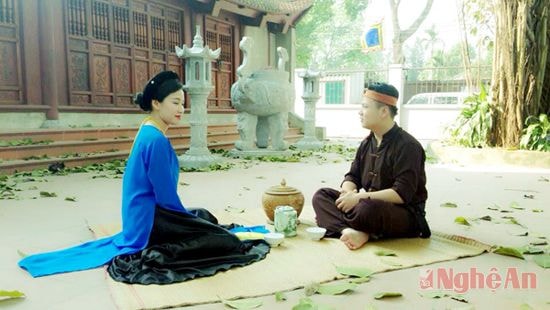 |
| Le Thanh Phong performs the Ví Giặm folk song at Xuan La communal house, Hanoi. |
- Keeping the club running must have been very difficult, right?
- A common difficulty, and one that's probably not unique to our small club but also faced by clubs in the two provinces of Nghe An, is finances. We're fortunate that our club has received a lot of publicity from the media, but in reality, we don't receive any funding from any organization. However, giving and receiving isn't just about material things. We are proud to have the support and opportunities provided by the leadership of the Vietnam UNESCO Federation, specifically the UNESCO Center for Community Health Support, which has provided legal protection and a space for our activities. In addition, the club receives artistic guidance and advice from the Center for the Development of Music Arts of the Vietnam Musicians Association, and especially the remote guidance from People's Artist Hong Luu and musician-Meritorious Artist Dinh Dac in Nghe An, which gives us added strength to operate effectively.
- Having witnessed many performances by the club that attracted a large audience, how do you perceive the public's reception of the folk songs and melodies of your homeland?
- The UNESCO Nghe An Folk Song Heritage Club, in addition to its activities and experiences, has established an experimental folk song and dance troupe from Nghe An before Tet (Lunar New Year) to serve in early spring festival programs. The young performers are selected through our activities and experiences and receive systematic, professional training from choreographers and stage production experts.
Since the beginning of the year, the troupe has performed in more than 20 shows, both large and small. I remember most vividly the first performance on January 15th for the Hong Long Village Association of Nam Dan in Hanoi. Because it was our first time, the performers made mistakes in the lyrics while singing and acting, but everyone in the audience clapped along and joined in the boat-rowing chants of the song "The Sunshine of Nam Dan." Both the performers and the audience became one. More recently, there was the exchange performance with the Vietnamese Coast Guard soldiers in Hai Phong. When we sang the Duc Son folk song "Heartfelt Message to the Island Soldier," the entire hall fell silent in emotion. This proves that the folk songs of our homeland are both familiar and unique, leaving a lasting impression on anyone who loves them.
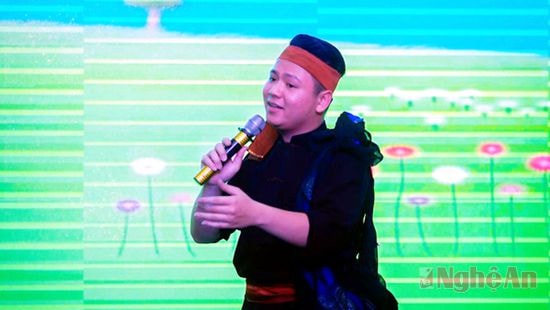 |
| Le Thanh Phong performing a song about his homeland in Nghe An province in Hai Phong. |
Are you preparing to pack your bags and head to the Central Highlands?
- This is very good news and a great responsibility for me and the young people in the UNESCO Folk Song Heritage Club of Nghe An. We will be bringing the Vi and Giam folk songs to perform in Playku City, Gia Lai Province in the coming days. The program will feature traditional art troupes from across the country, such as Quan Ho - Bac Ninh, the Cai Luong Troupe of Long An Province, and many more. All these spiritual cultural heritages will contribute to a grand artistic program offered to the Hung Kings Commemoration Ceremony, which will be solemnly held at Dong Xanh Park, Gia Lai Province. Currently, the experimental art troupe of the club has finished rehearsing the program titled "Echoes of Vi and Giam on the Highlands," which I wrote the script for, featuring many ancient Vi and Giam melodies arranged by musicians An Hieu and Khanh Ly, and choreographed by Hoang Trang.
- What are your thoughts on the future of wallets and wallets in general, and of our club in particular?
- In my opinion, anything that belongs to tradition and has cultural influence will have lasting value, and preserving it depends on how people receive and develop it. I would like to borrow a quote from musician Thao Giang, Director of the Vietnam Music Arts Center: "Not only folk songs like 'ví' and 'giặm', but also 'hát xoan', 'hát đúm', 'hát quan họ'... a hundred years ago were all sung by young people. Then, decades ago, the country went through war and had to deal with many important tasks to rebuild the nation, so those young people from back then became seasoned artisans. Therefore, for folk music to continue to endure, we need young people to continue singing and performing." This is what always motivates me and my friends in the club to strive and grow, to be worthy of being a new Vietnamese, building a civilized, modern country with a rich national identity.
Thank you, Le Thanh Phong, for this conversation!
TV(Perform)
| RELATED NEWS |
|---|


