
Germany takes a tough stance against Greece.
(Baonghean) - Accepting an invitation from German Chancellor Angela Merkel, Greek Prime Minister Alexis Tsipras recently made his first visit to Greece since taking power earlier this year. This is a sign of Berlin's last-ditch effort to give Greece a chance. As for Greece, Prime Minister Tsipras, though somewhat reluctantly, wants to mend the strained relationship with Germany and quickly find a solution to save Athens before it runs out of funds in early April. However, it seems the two sides are still unable to reach a consensus on this issue...
Accepting the invitation to Germany amidst strained relations and disagreements between the two countries, Greek Prime Minister Alexis Tsipras's decision demonstrates Athens' unwavering determination to compromise in its efforts to rescue the country's economy. This visit to Germany can be considered a last resort, as relations between the two countries have recently become tense due to a series of actions originating from Greece.
Looking back, the root cause was the Greek government's announcement to end the European Union's austerity programs; followed by statements opposing sanctions against Russia related to the Ukraine crisis. More recently, Greece warned of seizing German assets in Greece, considering them war reparations.
Furthermore, the magazine Syriza recently published a caricature of German Finance Minister Wolfgang Schauble wearing a Nazi uniform, a historical issue considered sensitive for Germany. With these actions, it's easy to understand why the Greek Prime Minister seemed somewhat awkward during his visit to Germany. Especially since this will be one of the last opportunities for Mr. Tsipras to find a more positive agreement with Europe.
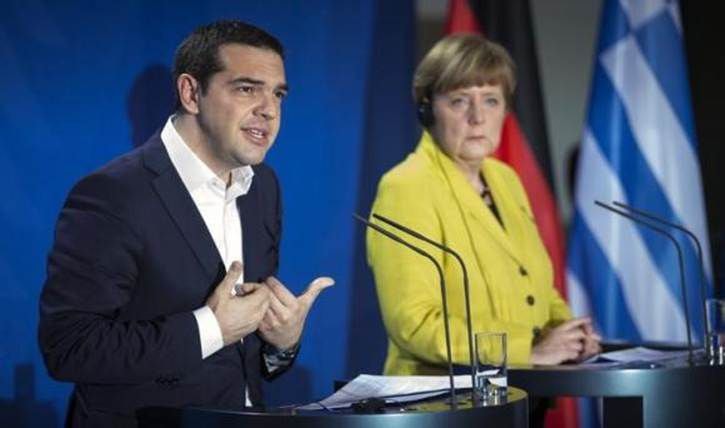 |
| Greek Prime Minister Alexis Tsipras (left) and German Chancellor Angela Merkel at a press conference following their talks on March 23. (Source: Reuters) |
This is understandable, as the latest report from the European Union (EU) indicates that Greece will run out of money by April 8th if it does not receive additional funds from international monetary institutions. Meanwhile, according to experts from the European Commission (EC), the Greek government will have to resort to cash from social funds and state-owned enterprises; on the other hand, it will have to repay a €467 million loan to the International Monetary Fund (IMF).
Thus, it can be understood that this series of pressures is forcing Prime Minister Tsipras to do everything possible to successfully negotiate with creditors, including the EC, the European Central Bank (ECB), and the IMF, before April 8th in order to receive the 7.2 billion euro credit line. In fact, Tsipras wants the remaining 7 billion euros of the bailout package disbursed to Greece immediately to avoid the risk of economic collapse and bankruptcy in the coming days, as well as to prevent Greece from leaving the Eurozone. However, Brussels is not being so accommodating, wanting more evidence of Greece's reform commitments before deciding to disburse the funds. Therefore, Prime Minister Tsipras's main objective in Berlin this time is to persuade Germany to take a faster approach on this issue.
However, despite being the leading economy in the European Union, Germany's decision to back down and invite the Greek Prime Minister to visit does not mean a change or reversal of the policy that European leaders have jointly adopted: a firm stance against Greece. Furthermore, Germany will not create favoritism or unfairness towards other members solely for the sake of Greece, as this would only create unnecessary discontent. Moreover, the German Chancellor cannot ignore the opinions of the people, as the percentage of citizens wanting Greece to leave the Eurozone is increasing, currently at 52%. Therefore, after the talks in Berlin, Chancellor Tsipras immediately encountered Merkel's firm stance, with the statement: "Even though Germany has 80 million people and we are the largest economy in the European Union, Europe still has its own principles..."
Perhaps after receiving this response, the Greek Prime Minister quickly understood the message Merkel wanted to convey to Athens: whether Germany likes it or not, Greece must still comply with what Europe dictates. Therefore, this visit to Germany by the Greek Prime Minister may somewhat warm relations with Berlin, but it does not mean there will be a shorter path for Athens in rescuing its national economy. Only genuine reform steps can help Greece at this time. But if that were the case, the next steps for Prime Minister Tsipras would certainly be extremely difficult because he has broken too many promises to his voters.
Phuong Hoa


