
Germany and France meet again at a World Cup after 28 years.
Unexpectedly emerging as one of the contenders for the 2014 FIFA World Cup Finals, the French national team will face Germany in their first quarter-final match at the Maracana Stadium in Rio de Janeiro on the night of July 4th.
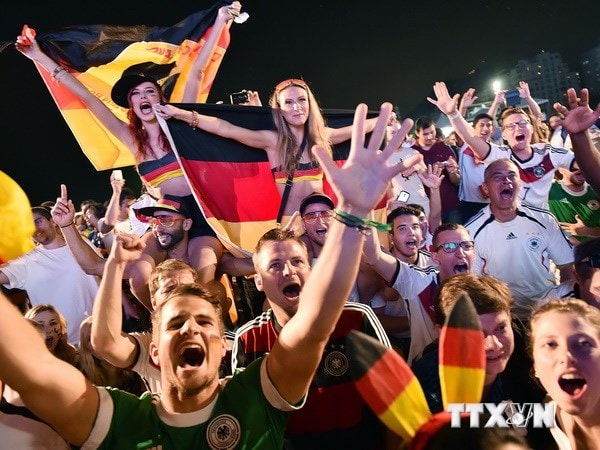 |
| The joy of German fans after their team's 2-1 victory over Algeria. (Source: AFP/VNA) |
This is the first time in 28 years that Germany and France have met at a World Cup.
In the round of 16, Les Bleus defeated Nigeria with two late goals, while Die Mannschaft secured a hard-fought 2-1 victory over Algeria in extra time.
By scoring 10 goals in 4 matches in Brazil, the French national team has taken a significant step towards rebuilding its image after its dismal performance at the 2010 World Cup in South Africa.
Reaching the quarter-finals with a solid team performance has been very effective in rebuilding their image, but facing the Germans in this quarter-final is both the toughest challenge yet and a driving force for the Gallic Roosters to continue striving for their dream of conquering the World Cup this summer.
When the term "Angstgegner"—the fearsome one—was used by the French media on the front pages of newspapers and television in recent days to describe the German team, coach Didier Deschamps knew that he had a task to overcome the fear of an entire nation if he wanted to restore France's reputation on the World Cup stage.
To defeat the Germans, the "Gallic Roosters" will have to exploit several weaknesses in the German defense. The way Algeria attacked down the flanks, especially in the first 45 minutes, was excellent. But this was partly due to the underperforming German defense, which was unable to stop Sofiane Feghouli, Faouzi Ghoulam, and Islam Slimani.
The German team was torn apart by Algeria's simple cross-field passes due to defensive positional errors. Lacking speed, Mertesacker, Jerome Boateng, Shkodran Mustafi, and Benedikt Howedes were easily bypassed by the North African players. Therefore, France had to bring on Griezmann and Valbuena to exploit this weakness in the German defense.
In particular, Valbuena is in outstanding form, setting a record for passing accuracy at 94% in the match against Nigeria, creating 5 chances and delivering 15 crosses.
Vabulena is also the type of player who is frequently fouled and draws opposing defenders, creating space for Paul Pogba, Yohan Cabaye, and Blaise Matuidi to move forward. If this happens, it would be a nightmare for the Germans.
Furthermore, coach Deschamps had to deploy Benzema as a central striker, even though statistics clearly show that the Real Madrid forward is most effective in that position.
In midfield, Pogba and Matuidi are currently the most impressive midfield pairing at this World Cup, but so far they haven't had the chance to compete against world-class players like Schweinsteiger or Mesut Ozil in this area.
Khedira, Schweinsteiger, and Ozil were famous for their near-perfect synergy in South Africa four years ago, but they haven't improved much since then.
As one of the greatest talents in the world of football, Ozil can penetrate any defense and possesses skills that strike fear into opponents.
The challenge facing coach Joachim Loew's leaky defense and how Germany will react to the biggest test so far in the tournament will be how to neutralize Benzema, Giroud, and Griezmann.
One thing is certain: Loew will not allow his team to attack the opponent's goal with crosses. Instead, the German manager prefers to control the game, possess the ball more, and rely on the speed and mobility of Thomas Mueller.
Meanwhile, captain Philipp Lahm's experience playing on either wing against the fast-paced French team will be crucial for Germany. However, Loew insisted that Lahm would not abandon his midfield position to return to his familiar defensive role, which had made him famous.
Mustafi and Lahm's positive contributions against Algeria included creating four attacking opportunities. This means that when they push forward, they leave only the slow center-back Per Mertesacker in their own half, making it very dangerous for Valbuena and Griezmann to attack down the flanks.
Interestingly, in 1998, the Daily Mirror ran a headline that read "Arsenal (England) wins the World Cup" after the French team defeated Brazil 3-0 at the 1998 World Cup in France. The French team, inspired by Emmanuel Petit, Thierry Henry, and Patrick Vieira, achieved victory on home soil in 1998.
Sixteen years later, the connection between Arsenal and France still exists, but now it's an even stronger one: Arsenal and Germany. Les Bleus and Die Mannschaft will meet in the quarter-finals of the 2014 World Cup on American Independence Day (July 4th) at the Maracana Stadium – where the heavy influence of the "Gunners" (Arsenal's nickname) will decide the fate of the match, and possibly even the entire World Cup.
Arsenal manager Arsene Wenger continues to contribute to his home country's national team, with players like Laurent Koscielny, Olivier Giroud, and Bacary Sagna representing the Gunners at this year's World Cup.
On the other side of the pitch, Per Mertesacker, Mesut Ozil, and Lukas Podolski are also German internationals playing for Arsenal. Thus, Arsenal – one of the greatest clubs in the world – is making a significant impact on football in this most prestigious competition on the planet.
It's a real shame that Germany and France have to eliminate each other in the quarter-finals, as these are two of the most impressive teams in this World Cup.
Speaking to the press on July 1st, coach Joachim Loew stated: "The France-Germany clash will always be a classic and very dramatic match."
Match information:
Location: Maracana Stadium, Rio de Janeiro
Capacity: 74,738
Time: 11:00 PM, July 4th
Expected lineup:
France: 1-Hugo Lloris, 2-Mathieu Debuchy, 4-Raphael Varane, 5-Mamadou Sakho, 3-Patrice Evra; 6-Yohan Cabaye, 8-Mathieu Valbuena, 14-Blaise Matuidi, 19-Paul Pogba; 10-Karim Benzema, 9-Olivier Giroud.
Germany: 1-Manuel Neuer; 20-Jerome Boateng, 5-Mats Hummels, 17-Per Mertesacker, 4-Benedikt Hoewedes; 7-Bastian Schweinsteiger, 16-Philipp Lahm, 18-Toni Kroos, 8-Mesut Ozil, 19-Mario Goetze; 13-Thomas Mueller.
Head-to-head:
- France and Germany (formerly West Germany) have met 25 times since 1931, with France winning 11 times and Germany winning 9 times.
- In the World Cup arena, Germany has the advantage, having defeated France twice in the semi-finals of the 1982 and 1986 World Cups, while Germany has only lost to them once, back in 1958.
- The German team has lifted the trophy three times, while France has only won once, when the World Cup was held on home soil in 1998.
- Since 1987, France has only lost to Germany once in their last seven matches, winning five of them, while Germany won once in the most recent friendly match between the two teams on February 6, 2013.
According to VNA


