
How to use the neutral (N) key on a car correctly?
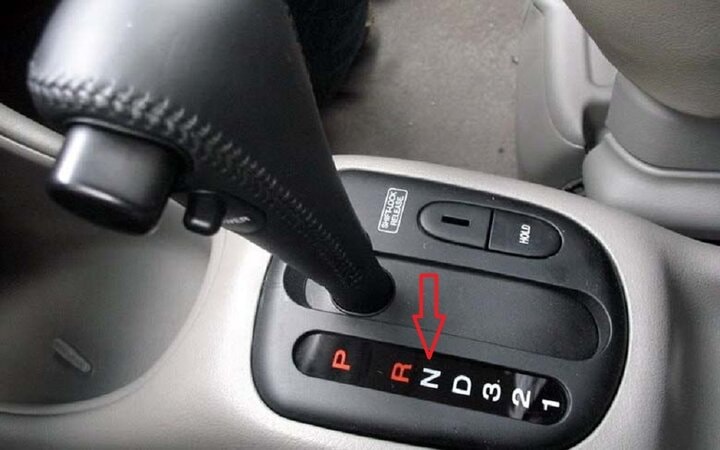
Not all drivers fully understand the N (Neutral) symbol on a car's gear shift lever.
What is the function of the number N?
The neutral gear (N) disconnects the engine from the wheels, causing a loss of power transmission to the wheels when the driver presses the accelerator. This allows the wheels to continue rotating freely without mechanical intervention, while still allowing for vehicle control. Using neutral gear won't harm the engine, but it will require more braking force to stop the vehicle, and prolonged use may damage the torque converter.
Cases where the number N should be used
The functions of the gear shift related to vehicle operation are clearly defined: D (Drive) for driving, R (Reverse) for reversing, and P (Park) for parking. However, only N (Neutral) is not directly related to any vehicle state. When in N, the engine-wheel connection is disconnected, meaning the vehicle does not move even though the engine is running.
Because of this design, car manufacturers recommend using the neutral (N) position only in specific situations, specifically when you want the engine to be disconnected from the wheels.
First, when the car stalls, you need to shift the gear lever to neutral (N) to easily tow or push the car. If it's not in neutral, the mechanical linkage will prevent the car from moving if the pushing force is weak; conversely, if the force is too strong, it could damage the internal mechanical parts.
If the engine stalls while the gear lever is in D, P, or R, the driver will not be able to shift to N. In this case, the Shift Lock button next to the gear lever must be pressed to move the gear lever.
The second situation where you should use N is when the throttle is stuck. In this case, disconnecting the throttle will prevent the car from accelerating out of control, allowing the driver to come to a stop.
Cases where the number N should not be used
Firstly, many drivers have a habit of shifting to neutral (N) to let the car coast when not accelerating, for example, approaching an intersection or going down a long hill. Recent studies show that modern cars are all set to idle mode when stopped, so shifting to N or D does not affect the car's fuel consumption.
Meanwhile, shifting to neutral (N) releases the engine from the vehicle, increasing the risk of losing control, especially on steep mountain roads.
When the brakes fail, do not use the neutral (N) gear. Instead, decelerate by shifting to a lower gear. Manual and sport transmission vehicles are ideal for actively shifting to lower gears in this situation. Only use N when a low gear helps to slow the vehicle down to a near-stop. At this point, use N to disconnect the engine, preventing the vehicle from being pulled forward. Use the parking brake to bring the vehicle to a complete stop and turn off the engine.
Regarding stopping at red lights, whether or not to use N (neutral) is simply a matter of driver habit; using either D (drive) or N (neutral) is acceptable, as the more important thing is to keep the brakes on, regardless of whether it's in N or D. However, drivers often become complacent after shifting to N, neglecting to apply the brakes, leading to the vehicle rolling backward, especially on inclines.


