
Chu Huy Man Street - Potential for suburban tourism
(Baonghean)I love this breezy road along the embankment in the summer; on one side, villages are stirring with the appearance of towns, lush with trees and fruit; on the other, the wind caresses the waves of the river mouth. The wide, modern asphalt road bears the name of a renowned General, as if to carry the pride of building a new life in his homeland: Chu Huy Mân Road, Hung Hoa Commune, Vinh City…
In ancient Vietnam, urban areas were originally hamlets and villages, gathering in areas near rivers and markets to form prosperous towns and cities, creating a vibrant suburban atmosphere. Everyone knows that hundreds of years ago, during the foreign colonial period, Hung Hoa was a fishing village, a mat-weaving village, with salty, acidic fields and dilapidated thatched houses. After the revolution, that village, formerly part of Yen Truong district, gradually revived to become a developed suburban commune of a first-class city as it is today.
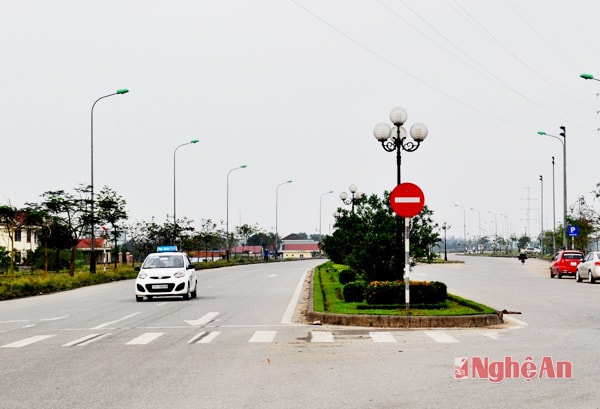 |
| Chu Huy Man Street. |
Connecting along the Lam River, stretching from Dung Quyet Street (Ben Thuy) to the end of Phong Hao hamlet (Hung Hoa) towards Cua Hoi, the Chu Huy Man road is 3,600 meters long and was officially named in March 2013. It's unknown whether this road was a dike or just a dirt path along the riverbank when 16-year-old Chu Van Dieu (the birth name of General Chu Huy Man; he changed his name in 1935) joined the revolution. But today, traveling along this road, gazing up towards Ben Thuy – Dung Quyet, and looking towards Truong Thi – Yen Dung, one can imagine the Nghe Tinh Soviet of 1930-1931, on this very road where 17-year-old Party member and deputy head of the self-defense force of Yen Luu commune (now Hung Hoa) led the farmers of Yen Luu commune (now Hung Hoa) in a resounding rally, raising the hammer and sickle flag to demand their right to live.
Now, no one in Nghe An province can help but feel proud to introduce to friends and visitors the Lam River riverside road, which is increasingly demonstrating its tourism potential, rich in historical sites and ecological landscapes on both sides. Just the more than three and a half kilometers of Chu Huy Man road alone contains countless historical evidence of conquering nature and defeating enemies. The land and people are preserving and multiplying cultural values refined over generations at the mouth of the river where clear and muddy waters flow into the sea.
This is the Hung Hoa fuel depot, a key target of American bombing raids that marked the beginning of the destructive war against North Vietnam. Our anti-aircraft artillery brought down the enemy aircraft, shooting down three planes on August 5, 1964, creating a triumphant victory for the people and soldiers, marking a glorious chapter in the nation's history of resistance against the Americans. Here is the pier where ships dock to unload goods, its weathered bridge, weathered by decades of rain and sun, now a fairytale "arm," allowing you to stroll lightly on a moonlit night, feeling the breeze, listening to the concrete and steel whispering stories of the years… And then there's the small, rustic market by the river, with bundles of water spinach and onions, bunches of betel nuts, and small shrimp… still belonging to the land and water, stirring up the bustling sounds of the local dialect of Chan Phuc – Hoan Chau every morning. Perhaps the market bears witness to the hardworking, diligent people of the countryside, clinging to their livelihoods at the estuary, and somehow acquiring the name Tru Market? The bustling morning is brief, then the market disperses, giving way to the quiet, drowsy sounds of the Lam River's oars tapping against the sides of the small boats, and the chirping of skylarks flitting from the pristine green islets to the villages. As the morning sun rises, the riverbanks along the road are covered in lush green grass, and herds of cattle frolic, a vital livestock industry in the outskirts of Hung Hoa. Beside the dense, eye-catching green acacia forests, countless white ducks from the newly established farms...
The suburbs evoke a nostalgic longing for the distant past of urban streets. But the suburbs also allow us to feel the vibrant and dynamic development of a young city. Let's temporarily "say goodbye" to the expansive natural scenery on the east side of Chu Huy Man Street and embrace the lively atmosphere on the west side: Modern office buildings and newly constructed houses with tiled roofs are gradually transforming the still distinctly village-like space of Hung Hoa, which will soon become a ward. However, perhaps the dreamy countryside charm of the suburbs will be preserved forever by the touches of historical sites and landscapes built, restored, and maintained through cultural awareness and spiritual consciousness.
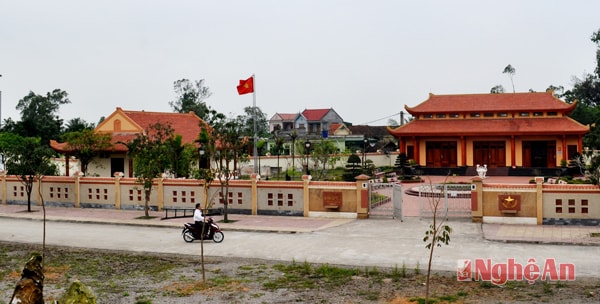 |
| The grounds and memorial house of General Chu Huy Mân. |
Standing on Chu Huy Man Street, at the intersection opposite the "three-arched gate" leading to Tru Market, one can clearly see the undulating, soaring roof of the legendary Ba Co Temple, built around the 16th century. This temple is dedicated to Princess Que Hoa and the ancestors of the Le Nhu family from the Le Trung Hung dynasty, who were said to have manifested their divine power to help the people. Their merits are commemorated in three royal decrees from several Nguyen dynasty emperors, which are still respectfully preserved at the temple. Further down the road is the General Chu Huy Man Memorial House, situated on a 7,743m² plot of land belonging to his family where he was born and raised. In the future, it will become a center for revolutionary tradition education in the suburban commune and a meaningful stop on the pilgrimage route along the Lam River. Along the same road leading to the General Chu Huy Man Memorial House is the entrance to Phong Hao sedge mat weaving village, a centuries-old traditional craft. The Hung Hoa sedge mat weaving craft remains faithful to the tradition of toiling in the sedge and jute fields, diligently weaving on handlooms night after night. For generations, these artisan weavers, without needing guidance, have meticulously crafted each strand and pattern for their mats, regardless of price. Those who are well-off or even wealthy didn't make their living from mat weaving, but the thought of abandoning the craft evokes a sense of poignant regret in everyone… Therefore, in Vinh City's strategy for developing traditional craft villages, there is a focus on elevating the Hung Hoa sedge mat weaving village into a "tour" – a cultural tourism route showcasing Vietnamese rural life…
This is just a sketch of a road "carrying" a suburban belt of Vinh City. I leave it to you to experience it when you visit one day, walk along Chu Huy Man Street, and have a "conversation" with the land and people here. I'm sure you will also share the pride in a road with such significant future implications for Vinh City!
General Chu Huy Mân (birth name Chu Văn Điều) was born on March 17, 1913, into a poor peasant family in Yên Lưu commune, Yên Trường district, Hưng Nguyên prefecture (now Hưng Hòa commune, Vinh City). Chu Huy Mân joined the revolution in 1929, became a Party member in 1930, and had a vibrant revolutionary life, making significant contributions to the revolutionary cause of the Party, the people, and our Army. At the 4th National Congress of the Party in 1976, he was elected a member of the Politburo and held the positions of Deputy Secretary, Head of the Inspection Committee of the Central Military Party Committee, and Director of the General Political Department (1977-1986), in charge of assisting the Lao Revolution, and Director of the Nguyen Ai Quoc School (1980). He was also a member of the National Assembly in the 2nd, 6th, and 7th terms; and was elected Vice Chairman of the State Council in the 7th term (1981-1986). He was promoted to the rank of General by the President in 1980. General Chu Huy Mân retired in December 1986; he passed away on July 1, 2006 in Hanoi, leaving behind immeasurable grief for his family, his hometown, and the entire nation… |
Dinh Sam


