
Cu Chinh Lan Street - A charming little street
(Baonghean) - Small streets with bougainvillea trellises and clumps of golden bamboo embracing humble archways. The fleeting hustle and bustle of each morning, noon, and evening fills the quietude of the almost abandoned factory areas and the somewhat simple lives of the street-front residents, who were once mechanics and construction workers during the subsidy era… Cu Chinh Lan Street in Vinh City still retains the memories of Vinh City during the war and its post-war reconstruction…
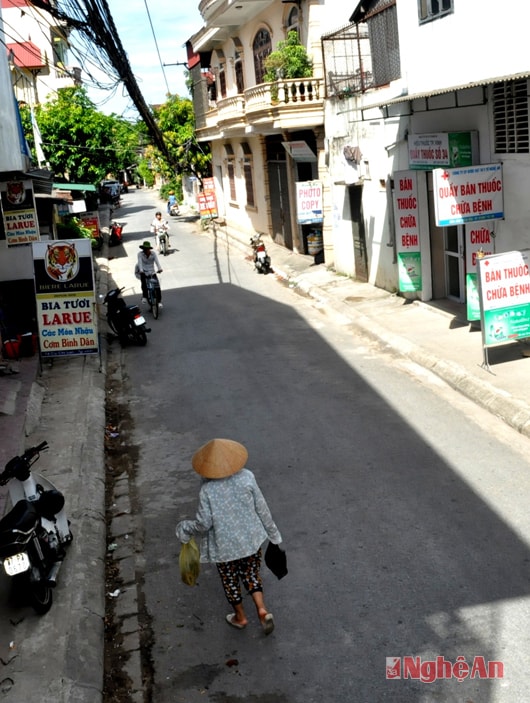 |
| Cu Chinh Lan Street (Vinh City). |
Perhaps the shortest street in Vinh City, Cu Chinh Lan Street is only 300 meters long, connecting Nguyen Thiep Street and curving deep into the residential area behind it. Cu Chinh Lan Street shoots out like an arrow towards the main Le Duan Street, a major North-South trade artery. Short and narrow, yet it harbors a unique way of life: profound yet dynamic, bustling but not chaotic, its residents, though from diverse backgrounds, share a warm and close-knit community. Visitors to the street often want to linger and chat with the friendly people there…
Before 1990, the road was a bumpy, sandy dirt path, mainly used by the people of Hung Thuy (Hung Dung - Ben Thuy) to get to the fields to harvest rice. That is, at that time, the densely populated residential area beyond the curve of Nguyen Thiep road was still a vast, boundless expanse of fields stretching as far as the eye could see. Even earlier, during the war, the area around Cu Chinh Lan road was a logistics zone for the Air Defense troops of Military Region 4, with artillery and vehicles constantly coming and going for maintenance day and night. Bamboo and trees grew densely along the road. In the early 1980s, the enterprises of Company 6 (now Trung Do Joint Stock Company) began building collective housing for their staff and workers; followed by the residential area of the Phuong Hoang Hotel – and only then did the road retain its original form to this day.
Former soldier, Lieutenant Colonel Tran Huy Toan, originally from Nghi Xuan, Ha Tinh province, currently serves as the head of Block 7 in Trung Do ward, where Cu Chinh Lan street is located. His house faces the west side of the street, with the walls almost touching the road. His wife is also a veteran and a military officer! While he enthusiastically chatted about the street with us, she gently greeted us and then took their young grandchild out to sunbathe under the lush green bougainvillea leaves in front of the house. Mr. Toan explained that the houses were built so close to the street because of the old urban planning, which is difficult to change later. Mr. Toan built his house in 1990 on land allocated to his wife as part of a standardized collective housing project after she left the army and transferred to work at the Phuong Hoang Hotel. The house, built with "Veranda" concrete, was one of the most impressive houses on the street at that time. It took several upgrades to become the spacious two-story house with waterproof tile cladding it is now, but the rooms are still cluttered and cramped, each one tiny. The only good thing is that the owner takes good care of the house and arranges everything meticulously... Along the entire street, except for a few newly built multi-story houses that stand out out of place, the rest are all old-fashioned, even some rows of single-story houses remain in their original state from the old collective housing era. Despite attempts at renovation, the old, faded tiled roofs bearing the words "construction"—these are kiln-fired tiles from the subsidy period—are still clearly visible.
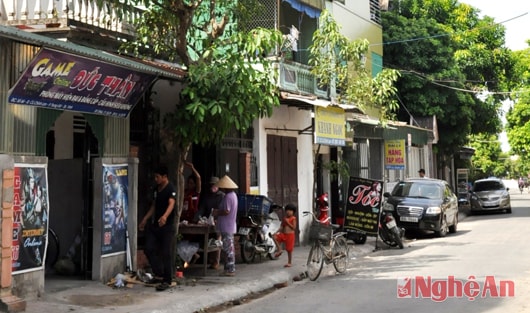 |
| Both sides of the street are now lined with a wide variety of services. |
Knowing our purpose was to write about the street named after the hero and martyr Cù Chính Lan, Mr. Toản counted on his fingers, and found that out of the dozens of houses on the street, there were 25 veterans of the war against the Americans, including 10 wounded soldiers of various ranks from rank 4 to rank 1. Mr. Toản was born in 1953, enlisted in 1971 as an infantry soldier, fighting throughout the battlefields of South Vietnam, North Vietnam, Laos, and Cambodia. Later, he worked as a staff officer at the Nghệ An Military Command, retiring in 2007. In 2012, he was elected as the neighborhood leader. Despite his battlefield experiences, he is a romantic man, passionate about poetry and folk songs. Although he never studied music, he has written several songs that have won awards at the city's amateur arts festival and the Veterans' Association. Speaking about the street, he said he is very proud of and loves this small town very much! Glancing at his wife's encouraging smile, he tapped out a song he had composed, which the city had printed in its music book and regularly broadcast on the neighborhood radio program: "...Whoever crosses the Lam River/ Whoever goes to Ben Thuy, Trung Do to Phuong Hoang, please stop by Cu Chinh Lan/... Oh... a hundred memories, a thousand affections!... After singing, he said: "I'm not that bad yet. This street also has a retired lieutenant colonel who was a musician in the 4th Military Region Art Troupe, but he teaches music all day long. His family has three brothers who were martyrs, and he honors them very touchingly!"
When I called, the lieutenant colonel and musician wasn't home. Veteran and block leader Tran Huy Toan led me to the house of veteran and Agent Orange victim Ho Vinh Bao, former Party Secretary and Block Leader of Block 7, Trung Do, from 2002 to 2008. Mr. Bao's house is located in a wide alley, but it's also a type of house that's been gradually upgraded, similar to Mr. Toan's. Having fought the Americans in the Southeast region for a long time, after peace came, he married a worker from Company 6 and settled down under his wife's subsidized collective land allocation. Mr. Bao boasted: "The street is very short, but there are five alleys, four of which have been designated as civilized streets, and we'll do the same in 2014. The street is now mostly inhabited by middle-aged and elderly retirees, because most of their children are university graduates and successful. I have three children who all studied at university and work in Hanoi." However, the street hasn't "aged" but seems younger thanks to the fact that almost every house has a few rooms for rent to Vinh University students. According to Mr. Bao, there are currently about 200 students renting rooms on the street, so the service is quite developed. Some houses, even with limited land, have built towering five-story buildings specifically for student rentals.
A few decades ago, the entire Cu Chinh Lan street was lined with only one pho restaurant offering "self-service" pho, and across the sidewalk was a tea stall with flickering oil lamps at night. Those places have now been replaced by a fashion clothing shop opposite a computer repair and sales store. The street now offers a wide variety of services: barbershops, spas, cafes, pho, sticky rice, steamed rice cakes… There’s even a tiny general store with a sign that says “Quality Thai Products,” and the pretty, doll-like salesgirl quickly explains, “We just display everything like this, but whatever anyone needs, in any quantity, we can get it in just ‘5 seconds’!” Nearby, there’s a motorbike rental shop with six “Way Alpha” bikes parked in three rows from the old kitchen area down to the street, renting for 15,000 dong an hour. Students renting rooms only need an ID card, while the landlord, connected to the internet, knows everything: which class and course they're in, whether they're still studying or have dropped out... no escaping! At the end of the street, where it connects to Nguyen Thiep Street, opposite the house of a former bulldozer driver with long hair tied up like an artist, is a stall selling fruits, vegetables, and food, considered the "fresh food market" of the entire street. And that one stall is all that's needed for this small street. Rain or shine, wind or storm, you can step out onto the street and find fresh fruits, vegetables, meat, and fish of all kinds.
As the last rays of the setting sun cast their final glow upon the street, Cu Chinh Lan Street becomes its most bustling. People from the inner residential areas rush out onto the main street on bicycles and motorbikes. The food stalls are crowded with customers. Behind the small archways, women come out to enjoy the evening breeze; calls from one end of the street to the other are clearly audible… The small street comes alive with activity.
Dinh Sam
Cù Chính Lan was born in 1930 in Quỳnh Đôi village, Quỳnh Lưu district, Nghệ An province. At the age of 16 (in 1945), Cù Chính Lan joined the village's youth team and then the commune's militia. When the resistance war against the French began, Cù Chính Lan was among the first generation of young people in the commune to volunteer for military service. During the Hoa Binh campaign (against the French), in the second Giang Mo battle on December 13, 1951, Cu Chinh Lan jumped onto an enemy reinforcement tank and threw a grenade into the driver's cabin, destroying it completely and making a decisive contribution to the victorious end of the battle. Cu Chinh Lan's heroic act of destroying a French tank supplied by the US initiated the movement of attacking enemy tanks with conventional weapons in our army. On December 29, 1951, Cu Chinh Lan participated in the battle to destroy the Co To outpost. Despite being severely wounded, he did not leave the battlefield, continuing to command his squad to successively breach five rows of barbed wire fences leading to the enemy's bunker. When the main outpost was completely destroyed by our forces, he breathed his last at the age of 20. The name of Hero and Martyr Cu Chinh Lan is given to streets in many cities across the country. |


