
Dao Tan Street - Ancient charm in the heart of the city.
(Baonghean) - The road running through the inner area of the ancient citadel will become much more well-known in the future when the Vinh Ancient Citadel Park Project is implemented, featuring a diverse and rich complex of services, entertainment, and cultural tourism. Even now, Dao Tan Street is already considered one of the most culturally and historically significant streets in Vinh…
(Baonghean) - The road running through the inner area of the ancient citadel will become much more well-known in the future when the Vinh Ancient Citadel Park Project is implemented, featuring a diverse and rich complex of services, entertainment, and cultural tourism. Even now, Dao Tan Street is already considered one of the most culturally and historically significant streets in Vinh…
It seems that no resident, or even a visitor from afar, coming to the Red City, would want to miss this street. The ancient moat remains, the majestic city gate standing as a witness to the rare pride of Vinh, a Class 1 city. Time silently revolves, and the street continues to accumulate depth of feeling through the four seasons, alongside the profound museum buildings that guide us back to thousands of years of Nghe An's culture and history; and witness the vibrancy of the home stadium, the "Vinh City cauldron," which has been the home of the Song Lam Nghe An football team for several seasons, along with other facilities that nurture high-achieving sports talents.
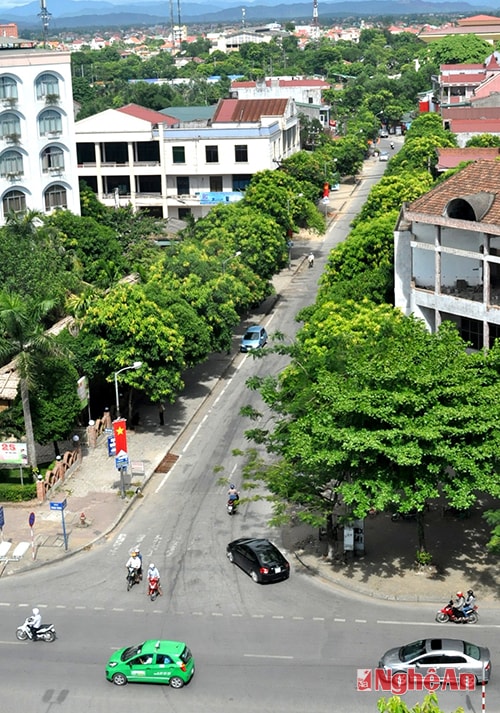 |
| Dao Tan Street |
Dao Tan Street is about one kilometer long, connecting the two major streets Tran Hung Dao and Quang Trung. What's special is that both ends of this street pass through the Left and Right gates of the ancient Vinh Citadel. How many footsteps of our ancestors, noble and humble, officials and commoners alike, have passed through here over the centuries of the Nguyen Dynasty? The Governor-General of An-Tinh, after whom the street is named, often strolled here, whether in the court, at his private residence, or enjoying the scenery of the palace gardens, "watching flowers bloom, waiting for the moon to rise." He must have pondered deeply about the nation's soul and the people's fate, pouring his profound patriotism into the art of Vietnamese traditional opera. It's no wonder that he was considered the most incorruptible official of his time, and later generations honor him as one of the founders of Vietnamese traditional opera!
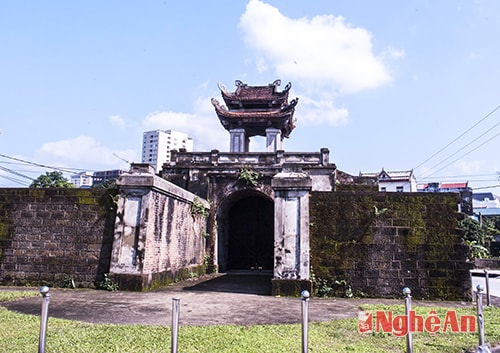 |
| The Left Gate of Vinh Ancient Citadel on Dao Tan Street |
When the ancient citadel began to be planned for the construction of a cultural and historical park linked to tourism development more than 10 years ago, the Left Gate of the citadel had not yet been renovated as it is now. The colors of time were imprinted on the ancient citadel, with moss and lichen covering layers of old stone. The citadel's vegetation reflected in the deep moat, lulling the lingering tranquility of a majestic citadel; the streets were still very sparsely populated. At the beginning of the street, there were only a few breakfast stalls selling beef tendon noodle soup next to a few small coffee shops, and in the middle of the street, a few vendors selling boiled snails and porridge. At the end of the street, near the Right Gate, there was a market next to the tomb of the patriot Doi Cung, the leader of the Do Luong uprising against the French; the population that "moved into the citadel" after the August Revolution included workers, farmers, soldiers, and intellectuals, creating a bustling and diverse urban life.
People from other towns come here mainly to enjoy the famous and delicious pork offal porridge at Co restaurant, and especially during football seasons. Since the Vinh Stadium was built in the middle of the ancient citadel, fans of the Song Lam team have flocked here to watch their "darling" players from Nghe An football compete. Dao Tan street becomes a "buzzing" place, jokingly likened to the roads leading to the "Arena of Rome" of the ancient Roman Empire, turning the street into a place that leads people to a "union" of passionate love for the king of sports in the country, a name that the Song Lam Nghe An team has left a strong mark on. Perhaps this influence has led to the street now becoming a specialized street for clothing and sports equipment, with even mini-supermarkets always bustling with buying and selling?
The ancient city walled street, a testament to the city's history, "contained" the working class and also served as a refuge for many artists and writers. There were photographers, painters passionate about poetry, and musicians who poured the complexities of life into the vibrant melodies of today, yet never forgot the time they went to fight against the Americans with hearts "full of hope for the future." I was fortunate to work there when the Nghe An Newspaper office was located at the beginning of the street; many afternoons I spent at the small roadside stall of an old veteran who had fought in the Battle of Dien Bien Phu, serving drinks to that photographer, painter, and musician. The joys, sorrows, loves, and hates of the people in the ancient citadel are brought to life in the eyes of artists and writers, and at least somewhere now, those who have passed away due to serious illnesses have left behind lingering words of affection, while those who have left the citadel to make a living elsewhere still yearn for the moonlit nights at the citadel gates… After those not-so-distant years, they left the citadel, some going to the eternal realm, others to other lands of change and hardship, but their final farewell “step” was also on this Dao Tan road…
Besides the street specializing in clothing and sporting goods, the food scene on Dao Tan Street is also becoming increasingly diverse. Breakfast options like sticky rice, steamed rice rolls, duck noodle soup, eel porridge, and coffee are scattered along the street, with highlights being Restaurant 25 within the Saigon-Kim Lien Hotel complex and Cafe Viet within the Nghe An Museum grounds. Both are designed with bamboo and rattan, evoking a harmonious Vietnamese countryside atmosphere in the style of the ancient city streets. But the most notable is the night food street, serving from dusk until dawn. Friends from the North and South visiting Vinh are often invited to this night food street, showcasing not only a fascinating aspect of Vinh's nightlife but also offering guests a taste of authentic local cuisine.
The market near Doi Cung's tomb at the end of the street is open all day. It's considered a market with typical products and trading styles of one side of the city; it's the "main" market in the southwest of Vinh's inner city. The Huu Gate, which hasn't been renovated, retains its original architecture and is now an ideal location for photographers to capture the ancient charm of Vinh or for wedding photo albums. If the Ancient Citadel Park project, linked to tourism, is implemented, alongside the Nghe An Museum and the Nghe Tinh Soviet Museum, Doi Cung's tomb will become an important destination for tourists.
Although a young city, Vinh retains the essence of its ancient citadel, a value that will be further enhanced in the future. It has already absorbed the rich tapestry of both past and present, shaping it into a central urban hub in the North Central region. And Dao Tan Street will be an important inner-city road, connecting to and spreading these values. And surely, every resident of the city wants to gather for themselves new feelings of pride and affection for a vibrant, developing street within the ancient citadel of their hometown!
Text and photos:Dinh Sam
Dao Tan, whose real name was Dao Dang Tan, was born in 1845 in Vinh Thanh village, Thoi Tu commune, Tuy Phuoc district, An Nhon prefecture, Binh Dinh province (now Vinh Thanh village, Phuoc Loc commune, Tuy Phuoc district, Binh Dinh province). He was an upright official during the Nguyen dynasty, serving as Governor-General of An-Tinh (Nghe An - Ha Tinh), Governor-General of Nam Ngai, Minister of Justice, Minister of War, and Minister of Public Works; holding the rank of First-Class Official, he was granted the title of Associate Grand Scholar and the title of Vinh Quang Tu. Dao Tan is considered the founder of Vietnamese classical opera (hat boi) and the second of the three founding fathers of Vietnamese theater (Pham Thi Tran, Dao Tan, and Cao Van Lau). He contributed dozens of plays to the art of traditional opera, some of which are still performed today, such as "Tam Nu Do Vuong," "Son Hau," and "Dao Phi Phung"... In 1904, due to his opposition to the high-ranking official Nguyen Than, Dao Tan was dismissed from his position and retired to his hometown. He passed away on August 23, 1907; his tomb and temple are currently located in Binh Dinh. Dao Tan's name is used for streets in many cities throughout the country. |


