
Mac Dinh Chi Street: A unique charm in the heart of the bustling city.
(Baonghean) - Not as profound and ancient as the characteristic narrow alleys of Hanoi's Old Quarter, nor as winding, intricate, and nameless as the labyrinth of Saigon's alleys, hundreds of small streets in Vinh City proudly bear unique names that evoke countless characteristics no less significant than those of the main roads. Mac Dinh Chi Street is one such street…
(Baonghean) - Not as profound and ancient as the characteristic narrow alleys of Hanoi's Old Quarter, nor as winding, intricate, and nameless as the labyrinth of Saigon's alleys, hundreds of small streets in Vinh City proudly bear unique names that evoke countless characteristics no less significant than those of the main roads. Mac Dinh Chi Street is one such street…
Connecting the two bustling thoroughfares of Ngu Hai and Dinh Cong Trang, many residents predict that in perhaps five to seven years, Mac Dinh Chi Street will shed its quiet appearance if Ngu Hai and Dinh Cong Trang streets are planned to become one-way streets in the near future. At that time, Mac Dinh Chi Street will become a useful and convenient crossroad for the city's residents, and the vibrant rhythm of city life will surely surge in. Whether this prediction will come true remains to be seen, but the people here are still somewhat anxiously awaiting that day, and half-jokingly, half-seriously telling each other to "enjoy" the remaining peaceful days in this charming little street amidst the bustling city.
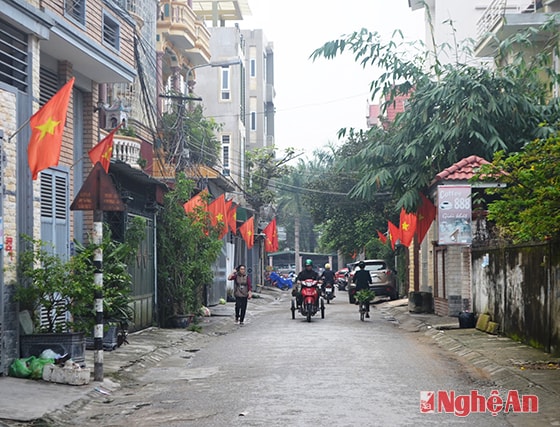 |
| Mac Dinh Chi Street. |
It is precisely this close-knit, friendly, and boisterous character of the residents that makes Mac Dinh Chi Street so interesting. Perhaps it's because the street is so narrow that this neighborly camaraderie is more likely to endure? The street is indeed narrow; in fact, you can easily count 38 houses side-by-side along both sides in a single quick stroll. Most are imposing two- or three-story houses, interspersed with lower, flat-roofed buildings, but still quite distinctive thanks to the lush green trees lining the sides. In the memories of the street's residents, Mac Dinh Chi Street was originally defined as a narrow inner-block road, a shortcut connecting two major streets, and over the decades, its appearance seems to have remained largely unchanged. Previously, the street had a few banyan trees and paulownia trees at the intersection with Dinh Cong Trang Street. Later, the growth of these trees seemed incompatible with the urban green space, so they were cut down. In their place are rows of fragrant mango trees, their branches intertwined with vibrant yellow flowering vines clinging to the rustic brick-paved walls, adding beauty to the humble archways.
Unlike other main roads, Mac Dinh Chi Street has no intersecting alleys; it runs straight and deep. Most houses face the street, with only two or three set back slightly. It's unclear whether this was the original design or if social changes have led the owners to abandon the bustling street and choose to live further back, enjoying their own peaceful retreat.
The residents of this street are mostly middle-aged people and retired officials and employees, so the lifestyle is rather simple. It's only bustling briefly in the morning, at noon, or for a couple of hours during rush hour when children go to school and adults return from work. For the rest of the day, the street is quiet and peaceful, quite different from the neighboring Dinh Cong Trang and Ngu Hai streets. Even the services along the street have a gentle, understated feel, not ostentatious or chaotic. This quiet atmosphere might seem strange to those accustomed to the hustle and bustle of city streets.
Despite its small size, the street is packed with convenient services. There are beauty services like nail salons, flower shops from Da Lat; local cuisine with fragrant vermicelli with fermented shrimp paste; radio, cassette, and TV repair shops with simple white lettering on a dark blue background, reminiscent of the 1990s; and even a family living room "renovated" into a bicycle repair shop… The street is only a few hundred meters long, yet it boasts a spacious garden cafe with beautiful surroundings. Apparently, business has been slow lately, and the owner is considering closing it down.
There's only one grocery store on the entire street. It's an old living room, tidied up to prioritize wholesale sales. Beyond the creaky iron door are glass display cases showcasing everything from toothpicks and face towels to shampoo, toothbrushes, candy, snacks, milk, diapers… So, just one grocery store is enough to supply all the households on this street. Many people say living here is the best thing in the world, because everything is close and within easy reach, yet it retains the peaceful atmosphere of rural life.
In all four seasons, Mac Dinh Chi Street takes on its own unique charm. Spring brings the vibrant colors of flowers blooming on the balconies of beautiful multi-story buildings, welcoming the Lunar New Year. Summer brings scorching heat to the uneven, decades-old pavement. Autumn brings gentle breezes that soothe the hearts of those strolling through the streets, creating a tranquil urban atmosphere. And in winter, like this night, the street is dimly lit by the yellow lights from both ends of the main street, casting a vast, familiar glow over the small, beloved space. I've walked this street many times, feeling a pang of regret that the journey is too short, failing to fully capture the peaceful feeling of a hurried day passing by. Once, I stopped my motorbike, gazing up at the sky above. Amidst the jumble of tall buildings and low roofs, a crescent moon still shone brightly, as if reminding the street's inhabitants not to forget this small corner of their village and homeland. This feeling, it seems, can only be experienced in small streets like this…
Text and photos:Phuoc Anh
Mạc Đĩnh Chi (1272 - 1346) was from Lũng Động village, Chí Linh district, now Lũng Động hamlet, Nam Tân commune, Nam Sách district, Hải Dương province. He was orphaned at a young age, and his family was poor; he and his mother had to go into the deep forest to gather firewood to earn a living. Due to his extraordinary willpower and exceptional intelligence, Mạc Đĩnh Chi soon became famous as a child prodigy in Confucian scholarship. In the Imperial Examination of the year Giáp Thìn (1304), Mạc Đĩnh Chi passed with the highest rank (Hội nguyên). In the final examination (Đình), he was awarded the title of Trạng Nguyên (First-ranked scholar). However, when he presented himself to the King, King Trần Nhân Tông, seeing his unattractive appearance, intended to not award him the top prize. Knowing this, he composed the poem "Ngọc Tỉnh Liên Phú," a poem in classical Chinese expressing his aspirations. After reading it, King Trần Anh Tông praised him as a genius and granted him the title of Trạng Nguyên, bestowing upon him a banner of honor to return home and pay respects to his ancestors. Upon returning to the capital, the king summoned him to an audience and questioned him about political matters. The scholar answered eloquently, much to the king's satisfaction. He bestowed upon the scholar the title of Han Lam Hoc Si (Academician), later promoting him to Thuong Thu (Minister), and then to Dai Lieu (Grand Chancellor). Mac Dinh Chi served under three kings: Tran Anh Tong (1293-1314), Tran Minh Tong (1314-1329), and Tran Hieu Tong (1329-1341). Today, in remembrance of his contributions, many major cities throughout the country have streets and schools named after Mac Dinh Chi. |


