
Pham Ngu Lao Street
(Baonghean) - Soon, Pham Ngu Lao Street will surely be recognized as one of the old streets that still retains many historical and social imprints of Vinh City through various periods. The street cuts across the commercial street Dang Thai Than and, at the other end, Tran Hung Dao Street, with many houses on both sides still featuring the traditional "ve rang da" style and washed stone pillars from the 1990s…
The streets of Vinh City still retain many old traces because the entire eastern side of Pham Ngu Lao Street belongs to the Vinh Ancient Citadel complex, with its past of clear blue moats and lotus blossoms blooming on the lake's surface in summer. Built in the 19th century under the Nguyen Dynasty, the Vinh Ancient Citadel moat was both a strategic military structure and a picturesque tourist spot. The moat was dug to a depth of 8 thước (3.2m) and a width of 70 thước (28m). The moat system was connected to the Vinh River (Cua Tien River) by a canal 5 thước (2m) wide, 4 thước (1.6m) deep, and 3 thước (1.2m) wide at the bottom. That is the appearance of the moat during its golden age, still preserved in historical records. However, today, for many reasons, especially the rapid development of urban space, people have pushed out, building houses and taking advantage of all the remaining vacant land. The appearance of the ancient citadel complex is therefore no longer intact, but the ancient atmosphere of a majestic region with high walls and deep moats seems to still resonate today.
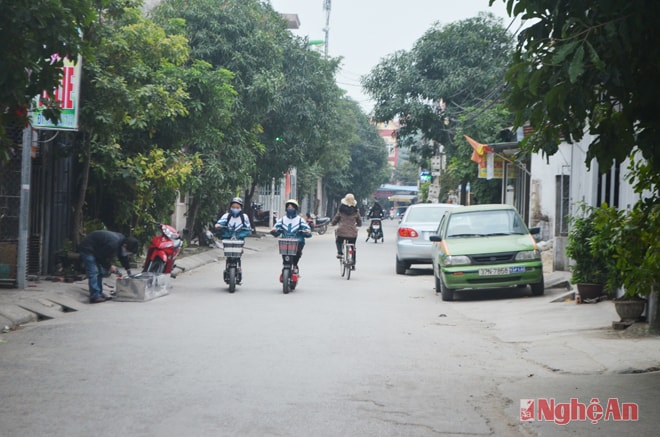 |
| The peaceful pace of Pham Ngu Lao Street. |
I asked many people on the street and searched through official documents, but I still haven't found the exact year the street was named after the general of the Tran Dynasty. All I can note is that the street has a long history, a wide thoroughfare unlike many of the bumpy dirt roads of Vinh City at that time. The street evokes memories of the state-owned trade era, the time of cooperatives, with the Truong Son Mechanical Cooperative located across the street. Most of the current residents were formerly workers of the mechanical cooperative, and that "history" still lingers today, with many shops and individual businesses specializing in iron, steel, sliding doors, glass cabinets, etc., present along the street, welding torches blaring day and night. The residents here are mostly working-class people, and their lifestyle is therefore simple. A noticeable characteristic of Pham Ngu Lao Street is its enduring rural character, still intertwined with village culture. Houses stand close together, people go to work, while the elderly, children, and those with free time create their own communal spaces to chat, pluck gray hairs, and quietly cook a pot of sweet soup for a late-morning meal…
These afternoon tea and pastry breaks provided the backdrop for many rambling, disjointed conversations about the city streets. I heard that during the subsidy period, right at the beginning of the street bordering Dang Thai Than Street, there was a hair salon owned by the sisters Tam and Lien. That salon, with its trendy, high-curl hairstyles that reached above the nape of the neck, was a rare display of sophistication in the city, attracting many women seeking beauty treatments. I recognized that hairstyle from movie commercials at the 12/9 Cinema back then, but I couldn't imagine what the curling techniques were like back then, or how those city girls, with their beaming smiles, admired their modernized selves in the mirror. I wonder where that once-famous hair salon is now – have the descendants of Tam and Lien migrated far away or settled in this city? And whether by chance or design, a rather grand hair salon has recently sprung up right in the middle of the street, its gleaming lights and the fragrant scent of expensive cosmetics filling the air. At first glance, it felt somewhat out of place amidst the simple, rustic architecture of the local houses.
For years, the street has remained largely unchanged. Walking down the street, you see the same houses and shops, only occasionally interrupted by the rumble of concrete mixers adding a touch of modernity to the facades. The west side of the street appears more "modern," partly due to its earlier settlement compared to the east side, where working-class residents later intermingled. And as if trying to mask the new constructions and cling to the old charm, the street still retains simple, handwritten signs hanging from sliding iron gates, such as "Traditional Mumps Remedy" or "Breakfast Rice Noodles"... The street has few services, or at best, only small-scale ones to adequately serve the residents, so passersby rarely visit. The quiet, unhurried atmosphere has become a lasting legacy on the street.
Near the end of the street leading to Doi Cung Market, the area began to feel bustling with commerce. The residents of this neighborhood were accustomed to the wholesale trade of the city's main market. The market offered cheap prices, a wide variety of goods, and usually opened early and closed late, making it a pleasure for the women of the family to leisurely stroll along the street to the market, gathering countless stories from the locals and making many new friends along the way.
For many personal reasons, my youth was intertwined with this street. The rhythm of the old town, therefore, always carries a heavy sense of nostalgia for me. Walking along Pham Ngu Lao Street, stretching for nearly a kilometer, evokes a feeling of longing for this 200-year-old ancient city. Perhaps this love for the streets is as blind and fleeting as all other loves in the world? Just love, regardless of whether the lover's face is oval or rosy. Just love, even if it's crooked, uneven, gray, and wrinkled. Ah, so it's called love, and therefore, for so many years, I have looked at that old Pham Ngu Lao Street with such affectionate eyes, regardless of its bumpy, potholed surface, regardless of its winding, uneven sections and the much-discussed rumors about the city's construction…
Phuoc Anh
Pham Ngu Lao (1255-1320)Pham Ngu Lao was a general of the Tran Dynasty in Vietnamese history. He was from Phu Ung village, Duong Hao district, Hai Duong province (now An Thi district, Hung Yen province). According to the newly compiled genealogy of the Pham family by Pham Con Son, he was the eighth-generation descendant of General Pham Hap of the Dinh Dynasty. During the two wars against the Yuan invaders (1285-1288), Pham Ngu Lao achieved many victories. In 1285, during the second resistance against the Yuan army, he and Tran Quang Khai attacked Chuong Duong and Ham Tu, crushing the enemy's massive fleet and annihilating the Yuan army occupying Thang Long. In the third resistance against the Yuan army, Pham Ngu Lao and other generals ambushed the enemy's retreat route on the Bach Dang River. In this battle, the Tran army captured Yuan generals Phan Tiep, Ao Lu Xich, and O Ma Nhi. In 1290, King Tran Nhan Tong entrusted him with command of the Sacred Wing Army, bestowing upon him the title of Right Kim Ngo Grand General. During the reign of King Tran Anh Tong, he was promoted to the rank of Grand Marshal and granted the title of Quan Noi Hou. Pham Ngu Lao led three military campaigns to punish the invading and harassing forces of Laos in 1294, 1297, and 1301; and twice led victorious campaigns against Champa in 1312 and 1318, forcing the Champa king, Che Chi, to surrender. Not only was he skilled in military affairs, but he also left behind many poems expressing his aspirations and patriotism. Currently, only two of his works remain: Thuat Hoai (Expressing Feelings) and Van Thuong Tuong Quoc Cong Hung Dao Dai Vuong (Visiting the Grand General Hung Dao Dai Vuong). Pham Ngu Lao passed away on November 1, 1320, at the age of 66. |


