
The Path Through the Fire: Final Episode: After the Miracle Comes the Commander
(Baonghean) - Having a deep connection with Zone 4 when he was the Political Commissar of the military region, then the Commander of the Truong Son Army, Politburo member and Deputy Prime Minister Dong Si Nguyen was deeply moved and impressed when mentioning the strategic role and position of Nghe An in the resistance war against the US. He wrote: “Nghe An was the direct rear area of the great Southern front, a major base of the Ho Chi Minh strategic road, a crucial region. That is why when the US imperialists attacked the North with air and naval forces, Nghe An was one of the first provinces to be fiercely attacked by the enemy and also the last province to cease fire in retaliation against American planes.”
| RELATED NEWS |
|---|
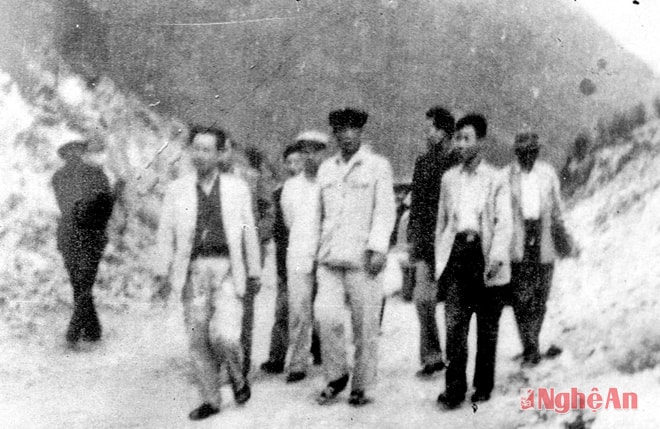 |
| General Secretary Le Duan, along with comrades Vo Thuc Dong, Secretary of the Provincial Party Committee, and Chu Manh, Chairman of the Administrative Committee of Nghe An province, at the Truong Bon strategic point in December 1968. (Archival photo) |
It's impossible to forget that the main force of the Nghe An Department of Transport increased from 4,500 people to 16,444 by 1967. During two years of fierce bombing and shelling, Nghe An opened 146 km of Highway 15A connecting Thanh Hoa with Ha Tinh and Quang Binh. With National Highway 1 severely damaged, the transport workers and volunteer youth creatively opened a new route 152 km long, running alongside Highway 1A. This doesn't include the 34 km bypass roads around key areas like Hoang Mai, Cau Giat, Cau Bung, Cau Cam, Truong Bon, Phuong Tich, and the 50 km of roads built for ferry terminals and pontoon bridges across rivers, ensuring smooth traffic and goods flow when the main terminals were blocked.
To combat localized transport congestion, Nghe An established six transit stations clustered in Vinh, Nam Dan, Hung Nguyen, Dien Chau, Quynh Luu, Nghia Dan, Do Luong, Tuong Duong, and Ky Son. These stations were located along Route IA, Route 7, Route 49, Route 48, Route 34, and Route 15A. Hundreds of thousands of people became the transport force, using all kinds of rudimentary means such as ox carts, horse-drawn carts, wheelbarrows, fishing boats, and bicycles. Nghe An transported nearly 20,000 tons of goods to the front lines using a "leapfrog" method, avoiding key targets of bombing at Ben Thuy, Cau Cam, and Nam Dan.
Lacking motorized transport vehicles, thousands of steel-reinforced cement boats were manufactured in An Binh (Quynh Luu), Chau Hung (Hung Nguyen), and Nghi Thiet (Nghi Loc). The magnetic bombs dropped by the US along the Lam River and the Le Canal were no match for this unique means of transport. Along with the main units, the people's transport forces of Quynh Luu, Dien Chau, Nghi Loc, Thanh Chuong, and Anh Son districts contributed to transporting 759,456 tons of goods directly to the front lines. The slogans "The enemy destroys, we repair and move on," and later "The enemy destroys, we keep going," were perhaps the culmination of the countless creative transport methods employed by the people on this frontline of Zone 4, with Nghe An being the pioneering locality from the early years of the war against the US imperialists' attempts to disrupt transportation.
When mentioning the victories and miracles against the Americans, one cannot forget the intelligence, sweat, and dedication of the collective leadership of the Nghe An Provincial Party Committee and the Provincial Administrative Committee during that fiery period. Calling the highest leadership of Nghe An at that time the "Command for Fighting and Defeating the Americans" on this fiery land would not be wrong. The soul behind all strategies and decisive actions in many areas of "excellent production, excellent combat" naturally belonged to the collective, but the individual imprints were left by Provincial Party Secretary Vo Thuc Dong, Deputy Secretary and Chairman of the Provincial Administrative Committee Chu Manh, and Nguyen Si Hoa - Vice Chairman of the province and Head of the Nghe An Department of Transport. They were proactive, tirelessly visiting every ferry terminal, bridge, and road after the bombing had just subsided, the ground, bridge piers, and the blood of the transport soldiers still stained red. The image of comrades Vo Thuc Dong and Chu Manh alongside General Secretary Le Duan arriving at the Truong Bon strategic point after the fateful bombing on October 31, 1968, has become a testament etched into the historical flow of the war against the Americans on the front lines of Military Region 4.
It's unforgettable. In August 1968, the Standing Committee of the Nghe An Provincial Party Committee issued Resolution No. 29 establishing the Provincial Traffic Assurance Command. Provincial Chairman Chu Manh was assigned the responsibility of commander, Vice Chairman Nguyen Si Hoa as chief of staff, Nguyen Thuan - Deputy Director of the Transport Department, Ministry of Transport, as deputy chief of staff, and Le Viet Cong - Head of the Transport Department, as deputy chief of staff. Tran Ngoc Ninh, Deputy Provincial Military Commander; Pham Hong Thai, Deputy Head of the Provincial Party Committee's Propaganda Department; Chu Thao, Deputy Head of the Public Security Department; Nguyen Van Nhuan, Head of the Post Office Department; Tran Thao, Deputy Head of the Food Department; and To Ba Que, Deputy Secretary of the Provincial Youth Union were members of the command. The Nghe An Traffic Assurance Command was placed under the command of the 4th Military Region Traffic Assurance Command, with Major General Le Quang Hoa as political commissar. The entire military command system, militarized in all aspects of production, combat, and combat support, operated with sensitivity, strategy, creativity, and decisiveness. The subsequent establishment of the Transport and Logistics Support Station on Route 15A, National Highway No. 1, and the formation of the "attack the enemy to open the way" strategy, the creation of a "bicycle transport brigade" with tens of thousands of military vehicles, and the establishment of district-level "youth volunteer companies" to ensure local transportation... transformed the organizational strength of the provincial Transport and Logistics Support Command into a "division-level engineering force." The Command as the architect of the month-long VT5 transport campaign, successfully transporting 120,000 tons of goods across the Lam River, served as a testament to the capabilities and intelligence of the Command, whose "heart and soul" was Commander Chu Manh. After so many years, meeting him again at the groundbreaking ceremony for the Truông Bồn Historical Site, now at an age far beyond "rarely seen before," he still spoke with a clear, resonant voice, laughed heartily, and was as carefree and kind-hearted as he was when he commanded the road construction, ensuring traffic flow under the relentless bombing.
I remember back then, the responsibilities were heavy, and wartime living conditions were harsh and lacking. Provincial Chairman Chu Manh was no exception. At the evacuated office in Thai Son commune, he slept in a bunker. Besides his monthly salary of 150 dong as provincial chairman, there were no other allowances. The car of the highest-ranking provincial leader was only a GAZ 69, a Soviet-supplied vehicle. Sometimes he drove a small, square-backed Romanian car, and when it got muddy, he had to mobilize militiamen to pull and push it, sweating profusely for hours.
During the anti-American war, there was a man in the transportation and traffic control command center who was "as hot as fire," namely Chief Le Viet Cong. He was from Thua Thien-Hue province. He was tall, with a bear-like gait, and his eyes normally twinkled as if smiling, but when he got angry because work wasn't going smoothly or his subordinates disagreed, he looked like a ball of fire. For him, there was only work and nothing else. He was dignified and decisive in handling traffic jams on bridges, roads, and ferries using his intellect and practical experience. He hated vague reports the most. He would often interrupt his subordinates with firm statements in his distinct Hue accent: "Have you counted how many bomb craters, how many hit the road, how many are still unexploded, how much earth and rocks need to be leveled, where will it come from, and how many troops are needed?" Then, "Have you waded under the bridge yet? What time did the tide rise? What is the dead water level? How many bridge pillars need replacing, where will they come from, and at what time will the girders be installed to allow traffic to resume?" Sometimes, realizing the lack of realism and superficiality in explaining the state of damaged bridges and roads, especially at key ferry crossings, he would become furious. “Are you afraid of dying?! Why don’t you go down and check if there are still unexploded bombs instead of hiding in bunkers listening to the soldiers’ reports? I’ll dismiss you!” He once waded into the river to observe the extent of damage to the Mượu and Phương Tích bridges, trying to find solutions while unexploded bombs still littered the key areas, with the engineering corps only just managing to put up warning markers… In 1968, preparing the content for the “Two Excellences” emulation congress of Nghe An province held in Kim Lien, Nam Dan, he directed the collection of sufficient witnesses and artifacts, not only within the industry but also exemplary cases of “the entire population participating in ensuring transportation” during the war against the US to save the country. He directed the establishment of a transportation performing arts troupe, forming the core of the “Singing to drown out the sound of bombs” movement in the Transportation sector.
In 1968, at the evacuation site of the Department of Transportation in Cong Thanh commune, Yen Thanh district, I was assigned to write the commentary for the "Two Excellences" exhibition. Unexpectedly, he sent someone to call me to his office. He lived in a deep underground bunker, carved into the foot of a rocky hill. I was startled because I, a mere "lowly employee," had never before had contact with the head of the department, except for the times I went to the collective canteen and saw him striding out of the leadership bunker. The moment our eyes met, my apprehension eased. He offered me a pack of Dien Bien cigarettes, a premium brand at the time, and said: "Once you've finished the exhibition for the department, I'll let you go to school. You can choose what you want to study. Transportation or journalism are both good. But you must go to school because this is also a policy for the children of martyrs in the department." I later learned that a few months after my father's death, he was the one who instructed the head of the organizational department, Nguyen Van Lai, to transfer me from Construction Team 1/5 to the Department of Transportation, to work in the emulation and propaganda section.
After the liberation of South Vietnam, he left Nghe An and returned to Hue to work, where he was appointed Vice Chairman of Binh-Tri-Thien province until his retirement. Occasionally, he would travel from Hue to Vinh to visit those who had been closely associated with him during those difficult and challenging years, navigating every meter of road and bridge shrouded in bomb smoke. He, one of the outstanding commanders of Nghe An and of Zone 4 on the front lines of ensuring transportation during wartime, has passed away. But for me, even with just a brief encounter, he has become an unforgettable memory...
Van Hien


