
The Path Through the Fire - Part III: Fighting to the Death to Defend the Bridge
(Baonghean) - In the last few months of the Year of the Horse (Bính Ngọ), the bridge construction workers had no time to celebrate the Lunar New Year (Đinh Mùi). They were busy urging each other to quickly deploy personnel to key points to ensure traffic flow from Hoàng Mai station to Bến Thuỷ ferry terminal.
| RELATED NEWS |
|---|
One afternoon in December, rushing back from Nghi Dien, the evacuation site of the Nghe An Provincial Department of Transport, Mr. Nguyen Hong, team leader of the 1/5 unit, and Mr. Tran Van Ngoan, deputy team leader and Party branch secretary, convened a team meeting to announce the second phase of the "Determined Victory Transport Campaign." The highest command of the campaign was the Ministry of Transport and the 4th Military Region Command. Deputy Minister Duong Bach Lien and Colonel Nam Long, Commander-in-Chief of the 4th Military Region, directly commanded all activities to ensure transportation from Thanh Hoa to Vinh Linh. Transport, police, anti-aircraft artillery, communications, and ferry services organized the campaign's strategic deployment (from November 1966 to February 1967).
The strategic direction and objectives of the campaign, codenamed "Quang Trung," involved transporting 79,705 tons of military supplies to the Southern front. Military transport units and the Transport Department of Zone 4 collected and transshipped goods along National Highway 1, crossing the Hoang Mai Bridge, Cam Bridge, and Ben Thuy Ferry, delivering the goods to Military Depot 9 and Lac Thien Junction. From there, the goods were handed over to the General Directorate of the Front, which transported them along the Ho Chi Minh Trail deep into the B3, B2, and Southeast fronts.
Participating in the transport campaign, I soon learned that the number of motor vehicles carrying goods from Hoang Mai across Cam Bridge on both the main and auxiliary routes reached 12,153. Vehicles successfully entered Ben Thuy 25,539 times. Many vehicles of the Nghe An Automobile Transport Enterprise achieved record transport speeds of 2000 tons/km during the month-long campaign.
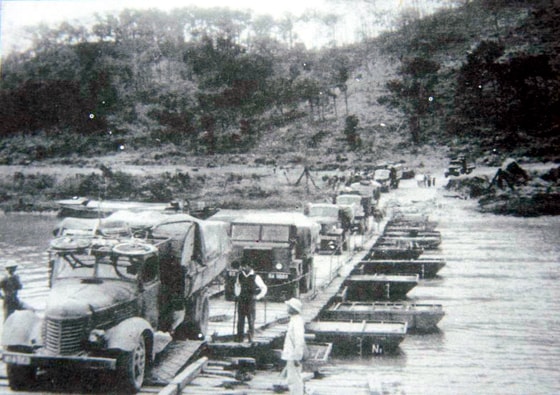 |
| A convoy of military transport vehicles crosses the Cam Bridge pontoon during the Quang Trung transport campaign (1967-1967). (Archival photo) |
However, amidst the pride of overcoming bombs and bullets, we cannot forget and be grateful for the countless young, courageous faces who fell one after another for the survival of the supply line. The pinnacle was the sacrifice of 15 Youth Volunteers and 18 officers and soldiers of the 16A Air Defense Battalion (Military Region 4) at Cam Bridge on February 5, 1967 (corresponding to the 26th day of the 12th lunar month of the Year of the Horse).
Before depicting the "Fight to the Death" to defend the bridge and keep the road open at the La Nham - Than Vu fire zone, let me reiterate today's events. From March 1965 to December 1972, just along National Highway 1A, from North Hoang Mai to Ben Thuy ferry, there were 236 martyrs, averaging 3 martyrs per kilometer of bridge and road stained with blood. How can we forget Hoang Mai, with 38 martyrs; Bung Bridge, with 21 martyrs; Thuc Pham Bridge, with 1 martyr; Cam Bridge, with 141 martyrs; Ben Thuy ferry, with 48 martyrs; Phuong Tich Bridge and Road 34, with 7 martyrs (among them was martyr Tran Van Ngoan, Party branch secretary and deputy head of construction team 1/5). He sacrificed his life at 9:00 AM on May 27, 1967.
The enemy aircraft and ground informants were as cunning as wolves. They launched numerous attacks along the 905-battle route, dropping 8,246 bombs of various types: fragmentation bombs, delay bombs, cluster bombs, phosphorus bombs, Bunpop missiles, and artillery fire from the sea. The sky and the ground were constantly being torn apart, the deafening roar of jets and exploding bombs almost piercing the ears.
Nearly half a century after that bloody decisive battle, I, along with veteran Captain Hoang Van Nhu and Captain Nguyen Van Khanh from Do Luong, former battalion medical officer and logistics assistant of the 16A Anti-Aircraft Artillery Battalion, returned to the "death coordinates" of that time.
Bombs, bullets, and natural disasters have devastated and distorted the landscape, but the bridge, the target protected by Battalion 16A, remains in its original position (km 442 + 444) on the North-South railway line. The only difference is that its function of transporting road vehicles has shifted to this permanent bridge, standing majestically over the Cam River.
It wasn't too difficult; we found the positions of the 37mm artillery positions of Company 10 (k10), Company 9 (k9), Company 8 (k8), C2 85mm artillery, and C14.5mm quad-barreled artillery. The battalion's command post at Hill 187 still bore traces of fortifications carved deep into the hard, gnarled mountainside. Local people still refer to the anti-aircraft positions as "Jackfruit Garden," "Tea Camp," "Ginger Slope," "La Nham," "Banyan Tree," and "Elephant Mountain" whenever they mention the fierce battles to defend the Cam Bridge during the war against the US.
From the southern abutment, the positions of Battalion 16A fanned out like a fan, closely surrounding the Cam Bridge, a target the unit had to protect at all costs.
Amidst the gentle sea breeze of Cua Lo, heroic and tragic memories flooded back like waves in the heart of the veteran. Captain Hoang Van Nhu, a medical officer, suddenly lowered his voice. "In that battle, my battalion lost an entire platoon. The heaviest losses were suffered by Company C2 and Company 10 (k10), because the battle positions were ordered to move close to Cam Bridge, attacking the enemy who were plunging into their field fortifications."
He recounted that on February 4, 1967 (the 25th day of the 12th lunar month of the Year of the Horse), many Abari reconnaissance planes circled the skies over Cam Bridge. Battalion Commander Nguyen Dinh Mach urgently reminded the units to prepare to engage the enemy according to the plan of moving the battle positions close to Cam Bridge. The main attack was carried out by Company 2 with 85mm artillery and Company 10 with 37mm artillery. At around 9:00 AM on February 5, 1967 (the 26th day of the 12th lunar month of the Year of the Horse), two groups of three AD6 jet fighters flew overhead over Voi Mountain, dropping a barrage of bombs on Cam Bridge.
They flew in from the south. The 85mm hand-operated cannons at position C2 fired long-range interceptor fire, but still couldn't stop the enemy aircraft. A barrage of bombs rained down on the southern abutment of the Cam Bridge, spilling over into the position of Company 10 (K10), position C2, causing heavy casualties among the gun crews. Company commander Phan Nhi assessed that the enemy was concentrating their attack on his position. He shouted hoarsely, commanding the gun crews to intercept the enemy's dive-bombing attacks and deflect the bombs from their positions. The shouts of "Aim straight at the enemy and fire!" echoed throughout the battlefield. Before they could reinforce their fortifications, treat the wounded, or transport the bodies of fallen soldiers to the rear, four groups of F4H aircraft from direction 34, the Nghi Thiet sea area, swooped in, dropping bombs, rockets, and Bunpop missiles on the position of Company 10 (K10), position C2. The K9 and K8 positions opened fire, concentrating all their firepower to support the enemy and prevent them from carrying out their insidious plan to wipe out Phan Nhi's position. But the enemy continued to charge forward frantically in wave after wave.
As dawn broke, the fighting intensified. Company commander Phan Nhi was riddled with shrapnel and bomb fragments. Yet, he gritted his teeth and stood firm at his command post, motivating his company to fight to the last bullet, to the last gun crew. This courageous company commander from Quang Nam province fell at the Cam Bridge battlefield. Along with him were other soldiers who had chosen "rather die than leave the gun emplacement," such as: Bui Van Quang, Vu Huu Xuat, Le Huu Loi, Ngo Dinh Tinh, Nguyen Hong Dinh, Phan Van Kim, Hoang Dinh Nhuong, Dinh Van Phu, Bui Van Son, Le Van Que, Nguyen Si Toi, Tran Quoc Thon, Nguyen Van Thuc, Nguyen Van Chau, Dinh Van Thuy, Tran Tu Loi, Cao Van Chuong… All were artillerymen of K10 and C2…
In a frenzied retaliation, the enemy aircraft circled around, launching missiles and scattering devastating bombs onto the battlefield. Many soldiers were wounded and fell on the gun emplacements, their hands still clutching the aiming and targeting controls. Some died in the position of loading ammunition and pulling the trigger. One platoon commander was sprawled on the embankment, his blood-stained hand holding the command flag… In this desperate battle to defend the Cam Bridge, nearly 20 beloved sons of the Fatherland shed their blood and fell before the fervent hope and yearning for the coming spring.
After that tragic day, the entire battalion was seething with determination to destroy enemy aircraft on the spot and avenge their fallen comrades. Battalion commander Nguyen Dinh Mach was like a steel rod forged in fire. He calmly commanded the companies to build ambush positions to intercept and attack the enemy aircraft.
After nearly a week of incessant drizzle in December, leading up to the Lunar New Year of the Goat, the weather suddenly cleared and became dry. The entire day of the 28th of the lunar month was quiet over the Cam Bridge area. According to the battle plan, the 37mm artillery batteries of K10, K9, and K8 moved to their ambush positions to intercept the AD6 units "on the night." As predicted, at 8:45 PM on December 28th, 1966 (February 7th, 1967), a group of AD6s (infiltrators) emerged from the sea, searching for and attacking transport vehicles crossing the Cam Bridge. Following orders from Battalion Commander Nguyen Dinh Mach, the artillery battery commanded by Dinh Toan fired the first volley of rounds at an AD6 flying within effective range. The flash of the bullets, bright as swords, pierced the AD6. It roared, instantly transforming into a blazing torch, swaying as it tried to escape to the sea, but it was too late; it crashed down onto the coastline near Bai Lu (Nghi Yen, Nghi Loc).
Having suffered a devastating blow in 1967, they reduced the number of key attacks on the Cam Bridge. The traffic maintenance forces seized the opportunity to repair the bridge, fill in bomb craters, open more ferry crossings, and build additional railway bridges for small locomotives to transport goods across the Cam River.
The tragic and heroic memories are not far off, they cannot fade, at least not for my comrades in D16A who lived worthy lives before the spirits of the martyrs at the Cam Bridge strategic point. I, a transport soldier present at Cam Bridge from the end of 1965 to July 1966, and Captain Hoang Van Nhu - medical officer, and Nguyen Van Khanh - logistics assistant of D16A, have visited Cam Bridge and Nghi Loc Martyrs' Cemetery many times, the eternal resting place of over 100 officers and soldiers of D16A and 33 martyrs of Team 69 of the Youth Volunteer Force. The three of us cannot help but feel deeply saddened and hope that a memorial and tribute worthy of the blood and sacrifice of so many beloved sons and daughters who died in the resistance war against the US will be built at Cam Bridge.
Van Hien


