
The destined love of Ca Tru singing
(Baonghean)Dien Yen village (Ke Lu), located in the northern part of Dien Chau district, has been known for hundreds of years as the birthplace of Nghe An's traditional Ca Tru singing. Through the ups and downs of history, from its golden age to when Ca Tru was considered merely an "antique" and "in urgent need of preservation," the voices of female singers still linger here. Therefore, when Ms. Mai Thi Hanh (born in 1962) and Mr. Nguyen Van Thanh (born in 1955) – members of the Dien Chau Ca Tru Club – were introduced as a married couple of Ca Tru artists, with the wife being a female singer and the husband playing the zither, living here, we assumed they were descendants of their ancestors.
But it turned out that wasn't the case. Mai Thi Hanh, the female singer, was originally from Huong Son, Ha Tinh, while Nguyen Van Thanh, the male musician, was from Quynh Luu. They met by chance and got married while working together at Yen Ly station. After getting married, they discovered each other's talents: the wife was a talented folk singer who performed everywhere in the railway industry, and the husband was an organ player. "Back then, I only sang folk songs and revolutionary songs, never thinking I'd one day sing Ca Tru. I didn't even like it. But then, after watching a live Ca Tru performance, I suddenly fell in love with the sound of the clappers. I loved it so much that I started learning Ca Tru. Once I could sing it, I was hooked, couldn't give it up, and... I brought my husband along," Hanh happily recounted her journey into Ca Tru.
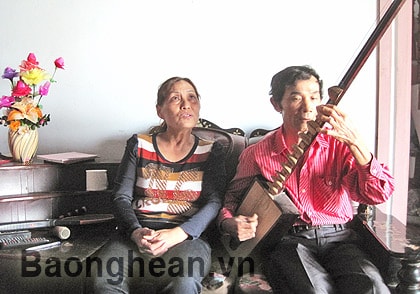
The artisan couple Mai Thị Hạnh and Nguyễn Văn Thành.
It sounds simple, but learning ca trù is a long journey. Many people sing beautifully, with clear, heartfelt voices, but they still feel "powerless" against ca trù. Because a female singer not only sings, but also needs to use the clappers correctly to match the rhythm, harmonizing with the stringed instruments and drums, for the singing to truly resonate. Having been passionate about singing since childhood, and possessing a bit of a natural talent, Ms. Hanh sang all kinds of music, but it wasn't until she was nearly 40 that she hesitantly tried her hand at ca trù. Initially, she found ca trù's sounds, filled with constant "uh-huh," quite off-putting. But the enchanting sound of the clappers, echoing in her ears, made her determined to learn how to play them, not how to sing. Then, with her hands clapping and her mouth humming along, the soul of ca trù became ingrained in her very being. In 2004, Ms. Hanh joined the Dien Chau Ca Tru Club - a gathering place for Ca Tru enthusiasts in the district. There, she had the opportunity to sing and practice with other Ca Tru singers, including elderly people and families with long-standing Ca Tru traditions, further honing her singing techniques.
Starting with folk singing and lullabies, she still remembers the first song she could sing perfectly was the romantic folk song "A Few Lines." Later, more difficult songs came spoken songs, temple songs, and 36-voice songs... mastering both fast-paced and slow-paced styles. For her, coming to Ca Tru (traditional Vietnamese singing) at this time felt like the right moment, as a woman who had experienced so many ups and downs in life, so many changes within herself, her soul had become more mature and serene. And, she felt with all her heart the profound values within Ca Tru. It was no longer just a type of music, but history, tradition, and the words of her ancestors. When someone sings with love and dedication, that's when "even if you wanted to give it up, you couldn't."
Whenever Ms. Hanh went to club activities or performances, Mr. Nguyen Van Thanh would always drive her there. Seeing his wife's growing passion for this traditional music genre, he was also "influenced" by it. Having some talent with musical instruments himself, having previously played the organ at weddings to earn extra income for the family, Mr. Thanh now tried learning the dan day (a type of Vietnamese stringed instrument). At first, he didn't dare tell anyone, only his wife and he knew. They both went online, read materials, listened to how others played, and then imitated them. And surprisingly, they played well. It seems like a destined match for this couple; when the wife became passionate about ca trù (a traditional Vietnamese musical genre), the husband learned to play the dan day, so they complemented each other perfectly. To this day, Nguyen Van Thanh has become a skilled dan day player at the Dien Chau Ca Tru Club.
Ca trù is inherently selective in its audience, making it difficult to find a large audience. Therefore, whenever they have the opportunity to perform, the artists of the club strive to leave a lasting impression and move the audience's emotions, even if the remuneration sometimes doesn't cover the cost of transportation. The same goes for female singers and male instrumentalists like the couple Mai Thi Hanh and Nguyen Van Thanh; they spare no time or effort for ca trù. Before retiring, during cultural performances at their workplace, this couple would often include a ca trù performance. Mai Thi Hanh proudly shared: "Once, during a railway exchange from Thanh Hoa to Quang Binh, I also performed a ca trù piece to introduce them to the ca trù of Nghe An province. Everyone praised it as excellent and unique." Now, every spring, they sing at birthday celebrations for the elderly and at ancestral worship ceremonies in their village. Ms. Hanh also shared her intention to pass on the craft to her daughter-in-law, having seen the bride's parents sing a <i>ca trù</i> song at the wedding ceremony. She added, "The bride's family has about 5 or 6 people who can sing <i>ca trù</i>, so maybe the girl will learn it, and I can train another <i>ca trù</i> singer for the club."
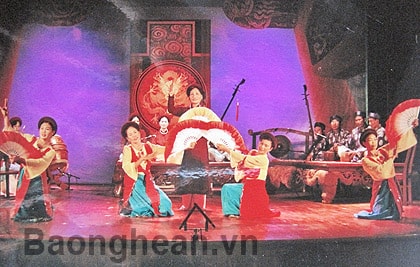
Singer Mai Thi Hanh performs the song "Dai Thach" at the 2011 National Ca Tru Festival (photo provided by the subject).
At the 2011 National Ca Tru Festival in Hanoi, Ms. Mai Thi Hanh won first prize with her dance and song performance "Dai Thach". During a training course in October 2012 at the Hanoi Conservatory of Music, Nguyen Van Thanh, who also played the double zither, was selected to participate. In just 10 short days, he learned to play three pieces with 36 melodies – a feat few can accomplish due to their difficulty, length, and rapid key changes. These achievements were partly a source of personal pride, but also a way to create a strong reputation and establish a prominent position for Ca Tru in Nghe An province, preserving and promoting the unique cultural values of her homeland.
“We sing and perform because of our passion. Sometimes we leave our jobs to go, not just to make money. Everyone in the club is dedicated, especially Mr. Nguyen, the founder of the club, and Mr. Thuong now; they understand and care deeply about Ca Tru… Ca Tru is a heritage left by our ancestors, so when we sing, we also hope to preserve the traditional Ca Tru culture of Dien Chau,” confided Nguyen Van Thanh, a male singer.
Leaving the ancient land of Ca Tru in Ke Lu, now bustling with people and new houses obscuring the roof of the Chay communal house, my mind is still filled with images of the female singer with captivating eyes, a smiling mouth, her hands tapping on the table to keep time as she sang, while her husband, beside her, tuned his zither and "performed" for us the 36-note melody he had just learned. I believe that this land not only produces but also welcomes, inspires, and nurtures those who are passionate about Ca Tru, preserving and cherishing the precious heritage left by our ancestors. Ca Tru still possesses a remarkably enduring vitality…
Le Nga - Nguyen Tue


