
Ecuador attempts to save satellite that crashed into space debris.
Ecuador's Space Agency (EXA) is trying to contact its only satellite after it stopped sending and receiving signals following a collision with space debris.
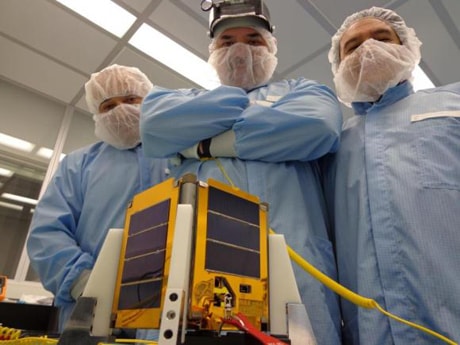 |
| The Ecuadorian government invested $700,000 to launch the Pegasus artificial satellite into Earth orbit in April. Photo: info.ec. |
Pegasus, Ecuador's first and only satellite, is cube-shaped with sides measuring 10 cm. Weighing 1.2 kg, it was launched in China on April 25th. It flies at an altitude of 650 km, transmitting images it captures back to Earth and playing the Ecuadorian national anthem.
A few days ago, Pegasus crashed into a cloud of dust from an old Soviet rocket launched into space in 1985, BBC reported.
EXA announced that their satellite remained in orbit after hitting the dust cloud, but its solar panels sustained damage.
"The Pegasus antenna has lost its orientation and it's rotating erratically on both axes," announced Ronnie Nader, EXA director.
Nader confirmed that the satellite was unable to send or receive signals, but he hoped that EXA experts would be able to contact it.
"We are still working actively to stabilize Pegasus's movements and re-establish its signal," EXA confirmed.
The accident occurred as EXA planned to launch its second artificial satellite in August of this year. Thousands of Ecuadorians used social media to express their support for EXA. However, some argued that the government's investment of $700,000 in the Pegasus launch was a mistake.
The U.S. National Aeronautics and Space Administration (NASA) estimates that approximately 170 million pieces of space debris (1 mm or longer) are orbiting the Earth. These include defunct satellites, rocket parts, fragments, and various components. About 30,000 pieces of space debris are longer than 10 cm. Radar can detect these, but cannot detect smaller pieces of debris.
At the 6th Space Debris Conference in Darmstadt, Germany, in April, experts warned that the frequency of collisions between artificial satellites, spacecraft, and space debris will skyrocket in the future. Models show that the amount of space debris longer than 10 cm will increase by 30% within the next 200 years. At this rate, every 5 to 9 years, humanity will witness a collision between an artificial satellite and space debris in low Earth orbit (below 2,000 km above the ground).
According to VnExpress - VT


