
Peaceful village life
(Baonghean) - I've long thought that one day I would write about that village, Dinh village, Chi Khe commune (Con Cuong district), but then I didn't know how to put pen to paper. It's a familiar place to me; I was born and spent my childhood there…
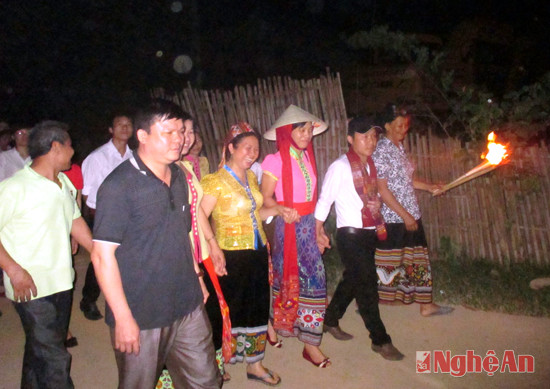 |
| Nighttime wedding procession - a unique wedding custom of some ethnic groups in Con Cuong. |
Ban Dinh is the place that once witnessed the formation and growth of one of the two largest Thai ethnic minority communities in southwestern Nghe An province. The Quạ community encompassed the two communes of Mon Son and Luc Da; the Chai community, my hometown, occupied almost the entire area of what is now Chi Khe commune. The center of the community was right in Ban Dinh.
The first thing I remember about that village was the thatched-roof stilt house and the lush garden where my family lived with my grandfather. Back then, around the late 1980s, Dinh village had fewer than a hundred houses. At that time, my grandfather and a few others in the village were considered successful and had pensions, which allowed them to renovate the house. Every morning, looking out from the house at the garden filled with long-standing fruit trees, it felt like a cool, shady forest. The villagers used to plant jackfruit, pomelo, betel nut trees, and other trees along the boundaries between the houses. Besides the fruit trees, the garden also had a section for growing tea, palm trees, and various vegetables grown by the villagers.
The village of Bản Đình is situated in a wide valley, surrounded by fairly high rocky mountains. At the end of the village is the Khe Chai stream, abundant with water and fish, providing irrigation for the largest rice paddy area in the commune. Despite poverty, every time Tet (Lunar New Year) comes, the village still holds festivals with games like tug-of-war and visiting each other's homes until the "end of the first day" (the 10th day of the first lunar month). In good harvest years, the spring festival lasts even longer. At that time, people still loved the traditional folk songs and dances. Mr. Vi Văn Hợi (91 years old) recounted: "In the old days, this area was called Mường Chai," Mr. Hợi began his story. – The name Mường comes from the name of the Khe Chai stream. Mường was governed by the Vi, Lô, and Lương families, who were truly powerful officials with their own land. The sons of these families were called "Tạo," and the daughters were called "Nàng." Whenever a Tạo went somewhere, someone would lead a horse and carry a sword to accompany them; As for the women, their maids would hold umbrellas for them and carry basins of rice water when they went down to the stream to wash their hair. During the old regime, besides the villages of Chai, Dinh, Lam Khe, Chan Nhan, and Tat, Muong Chai also had villages of Xang, Huoi Not, Tooc, and several other villages deep in the forest, each with only about a dozen houses. These small villages were merged into larger villages like Dinh and Chai around 1960-1961, according to the government's policy of settled farming and resettlement.
However, the Thai people had been residing here for several generations before the formation of the villages. The first people to settle in this land established the Chai village, and later the Vi family from Phu Quy came and established the Tooc village. When the rice fields of Tong Chai were cultivated, the Vi, Lo, Luong families and other families mostly concentrated near the rice paddies, so Dinh and Chai villages became densely populated areas, while the more remote villages were settled by families who went to work in the fields and then stayed there.
As our generation grew up, the country was free from war. At that time, people only talked about business, getting rich, and how to protect the forests from destruction while making life easier for the people. Since the village got electricity from the national grid, television, refrigerators, and chainsaws also came to the village. From then on, many people preferred brick houses over stilt houses, and gongs were gradually sold off… After decades of living in brick houses, the villagers began to feel regret and nostalgia for their traditional stilt houses. Wooden stilt houses were rebuilt… The sound of gongs echoed again during the spring festivals. Night after night, under the roofs of the stilt houses, in the electric light, the women diligently wove cloth.
Then the government launched a campaign to build new rural areas. The villagers enthusiastically participated by donating land and contributing their labor to build rural roads. In a short time, most of the side roads and alleys in the village were completed. Dinh village became a "model example" of new rural development...
Huu Vi


