
Did FIFA deliberately rig the 2002 World Cup so that South Korea would reach the semi-finals?
(Baonghean.vn) - World football is in turmoil over allegations of corruption within FIFA, and it is highly likely that things will become even more complicated in the near future as some countries are ready to drop bombshells to expose FIFA's shady dealings.
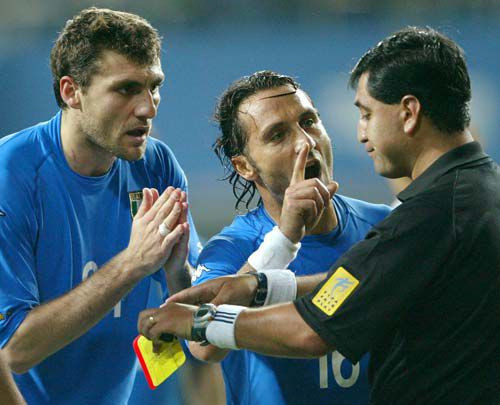 |
| Mr. Moreno and the infamous Italy-South Korea match at the 2002 World Cup (Image from the Internet). |
Following the US, the Italian media continued to heat things up by revisiting the negative "scandal" of 2002, accusing FIFA of deliberately rigging the World Cup to ensure host nation South Korea reached the semi-finals.
In 2002, the World Cup was held in Asia for the first time, and it was also the first time two countries co-hosted the tournament. Japan had participated in previous World Cups, while South Korea was making its debut in the 2002 World Cup.
According to allegations by Italian media, FIFA colluded with South Korea to arrange for the country to advance deep into that year's World Cup.
The Italians' accusations target the knockout round match between host nation South Korea and Italy. Many reputable newspapers in Italy claim that the referee officiated biasedly, making decisions that favored the home team.
It was a penalty early in the match that the Italian defender hadn't committed a foul on. Fortunately, goalkeeper Buffon made an excellent save. However, the events that followed didn't change, as the Ecuadorian referee Moreno's officiating was always perceived as blatantly biased towards the home team.
Referee Moreno disallowed Italy's goal despite their striker not being offside. Even more infuriating was his decision to issue a second yellow card to Totti. The Italian midfielder was fouled inside the penalty area, but Moreno claimed Totti feigned injury and issued the yellow card.
At the time, public opinion generally disagreed, because it was a genuine collision and the yellow card for Totti was not only unfair but also put Italy in a difficult position playing with fewer players at a time when their physical condition was already depleted.
Playing under constant pressure and unfair treatment, the Italian players lost their composure, and inevitably, in the 117th minute, South Korea scored to make it 2-1, painfully eliminating Italy from the competition.
After Italy, Spain became the next victim to file a complaint with FIFA, as in that World Cup quarter-final match, the Spanish team was even more unfairly treated. Despite having at least two valid goals, the referee still disallowed Spain's goals.
Despite playing better and more convincingly, like Italy, Spain also suffered a painful exit after being defeated by South Korea on penalties.
After officiating the infamous match between Italy and South Korea at the 2002 World Cup, referee Moreno was subsequently suspended for 26 matches due to his involvement in a scandal in the Ecuadorian national league.
Recently, this same referee was arrested by police and sentenced to 26 months in prison for drug trafficking. Moreno's subsequent scandals further reinforced the belief that there were irregularities in the match he officiated between South Korea and Italy at the 2002 World Cup.
Italian media suggest that FIFA's excessive favoritism towards South Korea stems from a desire to promote the country's football and image to the world. Of course, behind FIFA's overzealous enthusiasm, many officials within the organization also reap substantial profits from the kickbacks offered by South Korean football.
While there is no basis to confirm any wrongdoing at the 2002 World Cup, with Italian media making accusations and FIFA facing strong condemnation for scandals involving corruption and money, many believe that a "bomb" is about to explode and FIFA must be held accountable for the negative arrangements at the 2002 World Cup and many other incidents.
Vinh Liem
| RELATED NEWS |
|---|


