
Holding producers accountable for their products.
(Baonghean)Developing a high-quality vegetable growing area to supply the NAM SUNGVINA garment factory and the Thap - Hong - Ky small industrial cluster is a commendable approach by Dien Chau district. This has enhanced the value and brand of clean vegetables, linking producers' responsibility to their products.
Ms. Nguyen Thi Thuy (from Hamlet 3, Dien Hoa Commune, Dien Chau District) recounted: “For a long time, my family has been accustomed to growing green vegetables using traditional methods, selling them to traders, resulting in unstable sales and constant price manipulation. In 2012, my family participated in a high-quality green vegetable farming project to supply a garment factory in the industrial cluster. Technical staff from the district directly guided us on techniques, seed selection, planting methods, proper care, and detailed data recording throughout the production process. Although it required more time for care and strict adherence to technical requirements, the vegetables yielded high productivity, good quality, higher purchase prices, and most importantly, stable sales. Therefore, my family felt very confident investing in intensive green vegetable farming.”
On her family's vegetable farm, Thuy's plots are scientifically planned and divided into distinct zones. Three plots are dedicated to water spinach, yielding 150-200 bunches per week, with harvesting lasting 6-9 months per year. This allows her to supply the garment factory with over 1 ton of water spinach per month. The remaining two plots are used to grow cabbage, supplying the factory with 1.3 tons per month, from July to December annually, also generating significant income. In addition, Thuy encourages her family members to cultivate high-quality green squash for the factory.
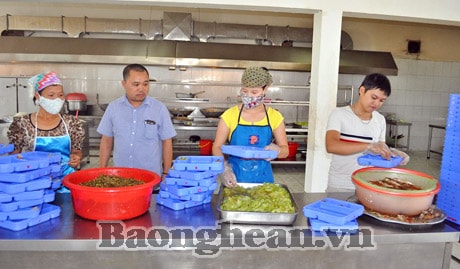
Fresh vegetables are processed in the kitchen of the NAMSUNGVINA factory.
Currently, the NAMSUNGVINA garment factory employs 1,250 workers. Accordingly, the canteen serves 1,250 main meals daily to the workers and consumes over 150 kg of vegetables from the Dien Hoa growing area. Ms. Cao Thi Thao, the kitchen manager, said: “All the vegetables entering the kitchen are thoroughly inspected. Each type of vegetable is checked against the records provided by the growers and kept in the kitchen. Therefore, the vegetables entering the kitchen must comply with the correct technical procedures and harvesting schedule, so we are very confident about the source of these vegetables.”
In Dien Hoa commune, many families have participated in a high-quality vegetable farming project, covering an area of 2 hectares, supplying the Thap-Hong-Ky small industrial cluster and several restaurants and hotels in the region. However, to ensure high-quality vegetables, farmers must strictly adhere to the cultivation process, which adds more time and costs. Consequently, the input costs of clean vegetables are also high, but the selling price must follow market rates. To prevent farmers from being disadvantaged, Dien Chau district has proactively provided financial support for the additional production costs (implementing the clean vegetable farming process), so farmers can feel secure with the high-quality vegetable farming model.
According to the investment and development plan of NAMSUNGVINA Garment Factory, by 2015, phase 2 will attract approximately 4,000 workers. Therefore, the demand for high-quality green vegetables will increase rapidly. To meet this demand promptly, the district is planning to expand the high-quality green vegetable growing area in Dien Hoa commune to 5 hectares. In the future, Dien Chau district will see the operation of more large projects in the fields of industrial garment manufacturing and construction materials production, especially the Dien Thanh beach resort, restaurants, hotels, etc., which will also have a need for high-quality green vegetables.
Furthermore, Dien Chau district also intends to expand into the domestic market, supermarket chains, and export markets. To make this a reality, the district is planning and orienting the development of specific vegetable growing areas, investing in technical infrastructure, and issuing mechanisms and policies to attract businesses to invest in this field. Recognizing this as a potential and promising investment "channel," several businesses have explored the possibility of investing in high-quality vegetable farming projects in Dien Chau. Currently, this businessman is very interested in the vegetable growing area in Dien Hoa. His idea doesn't stop at supplying clean vegetables to Korean factories in Dien Chau district and Nghe An province, but he is determined to bring Dien Chau vegetables to Korea...
The way production is organized and linked to consumption, especially by assigning responsibility to vegetable growers for the products they produce, has created a market and brand for the clean vegetable growing area of Dien Chau. This effective approach will be an important foundation for Dien Chau to gradually develop high-quality green vegetable specialized farming areas.
Hoang Vinh


