
Cambodian rice exports to South Korea and the US, while Vietnam still relies on China.
Cambodia confidently asserts that it will export rice to the US and South Korea, recognizing these as promising markets. Meanwhile, Vietnam's rice exports remain dependent on the Chinese and African markets.
According to the Phnom Penh Post, Cambodian export businesses are actively building partnerships with the US and South Korea to export rice to these promising markets, which have historically been considered demanding.
Mr. Song Saran said: "We will definitely export rice to the United States because the US is a very large and promising market for Cambodia."
Last month, Amru Rice Campodia of Cambodia also signed a rice export agreement with South Korea's Hanwha Group and expressed its desire to export rice to South Korea. Mr. Song Saran stated, "Our market in Europe has peaked, so we will try to expand our market in Asia, especially in South Korea."
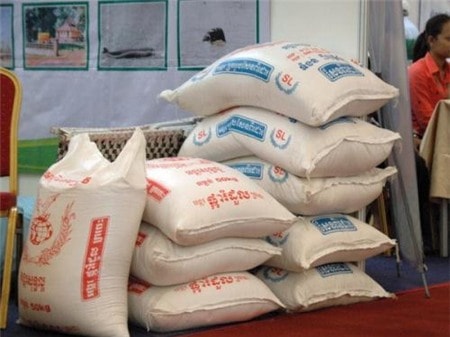 |
| Cambodian rice will target the US and South Korean markets, while Vietnamese rice will continue to rely primarily on China, a few Southeast Asian countries such as Malaysia, the Philippines, Indonesia, and African nations. |
Meanwhile, Vietnam's rice exports are mainly to 10 countries and territories around the world: China, Ivory Coast, Malaysia, Ghana, Philippines, Singapore, Hong Kong, Indonesia, Angola, and Russia. Of these, China remains the primary market.
Speaking to the press at the end of 2013, Mr. Truong Thanh Phong, Chairman of the Vietnam Food Association (VFA), had to admit: "If it weren't for informal exports to China, we don't know what would have happened to rice exports this year."
According to statistics released on January 17, 2014, by the General Department of Customs, Vietnamese businesses exported over 2.15 million tons of rice to the Chinese market in 2013 (including exports through northern land border gates), accounting for more than one-third of Vietnam's total rice exports in 2013.
Meanwhile, as of the end of November 2013, markets such as Malaysia, the Philippines, and Indonesia experienced sharp declines. Specifically, the Indonesian market decreased by 81.42% in volume and 78.12% in value, the Philippine market decreased by 67% in volume and 65.71% in value, and the Malaysian market decreased by 39.05% in volume and 42.49% in value compared to the same period in 2012.
In January 2014, the Philippines once again became Vietnam's largest rice export market under the government-level contract that the two countries had signed two months earlier.
Most of Vietnam's rice import markets saw a decline in both volume and value compared to the last month of 2013.
Key markets such as China and Africa experienced sharp declines, alongside markets like Ivory Coast, Angola, the Netherlands, and Spain, which also saw decreases in both volume and value.
Recently, Thailand also officially announced the release of hundreds of thousands of tons of subsidized rice, which poses a major challenge to Vietnam's rice exports, potentially leading to a deeper decline in both quantity and value.
Many experts believe that Vietnam's low-grade rice is currently unable to compete with India's low-grade rice in terms of price, and that Vietnam's high-grade rice struggles to surpass Thailand's high-grade rice in terms of quality.
In a previous interview, Ms. Duong Phuong Thao, Deputy Director of the Import-Export Department of the Ministry of Industry and Trade, stated that many years ago, Vietnam's strength lay in exporting low-grade rice. However, given the current global situation, producing only low-grade rice makes it difficult to compete in the world market and meet the requirements of emerging markets such as Latin America and Europe.
While Cambodia confidently launched a strategy to penetrate the two demanding markets of the US and South Korea, Vietnam continuously lowered its export targets, focusing primarily on China and African countries.
In another development, Vietnam's automotive industry recently faced embarrassment when Cambodia successfully produced smartphone-controlled cars while Vietnam couldn't even manufacture screws and wires, causing many investment projects from leading global corporations to leave Vietnam.
Recently, Mr. Hirotaka Yasuzumi, Executive Director of the Japan External Trade Organization (JETRO) office in Ho Chi Minh City, also compared Vietnam with Thailand and stated that the Vietnamese automobile market cannot yet be compared to Thailand's because Thailand produces up to 2.5 million cars per year while Vietnam only produces about 100,000 cars per year, making it difficult for any automobile company to leave Thailand and relocate to Vietnam.
According to Dat Viet


