
Domestic rice is "magically transformed" into imported rice.
Thai jasmine rice, Japanese rice, Korean rice, Taiwanese fragrant rice… have become popular choices for consumers. Rice experts say that these foreign-branded rice varieties are not actually imported into Vietnam, but are simply foreign rice varieties grown in Vietnam.
Rejecting domestic rice, opting for inferior imported rice...
The reason housewives prefer imported rice is because they believe it's of better quality. Ms. Thanh Hien (in Dong Da district) said: "Now, Hai Hau sticky rice - a specialty of the Northern Delta region - has lost its reputation because its quality is no longer as fragrant and delicious as before. The rice seller advised me to try Thai sticky rice and I immediately loved it because the grains are very uniform, look beautiful, and the cooked rice is stickier and more fragrant. Since then, I've only been loyal to Thai sticky rice." Ms. Van Dung (Cau Giay district) said: "I prefer Korean and Japanese rice because the cooked rice is very sticky, fragrant, and has a rich, sweet flavor. Rice cooked in the morning is still delicious and sticky even when eaten in the evening. Children love it, so I accept buying it even though it's more expensive than domestic rice."
The owner of a rice dealership at Thanh Cong market said that many people buy rice with foreign names, and they are usually well-off because imported rice is often 2-3 times more expensive than domestic rice. Rice varieties grown by Vietnamese farmers, such as Tam Hai Hau, Tam Dien Bien, and Nang Huong, which were previously considered specialties, are now being rejected by many consumers.
Recently, city families have been eating less rice, so they often choose high-quality rice, or rice labeled as imported. Another rice vendor argues that slightly wealthier people always prefer foreign products and therefore have to eat imported rice. In reality, imported rice isn't necessarily better than domestic rice.
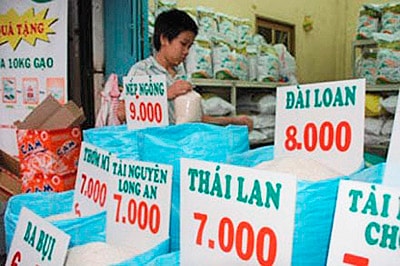
Illustrative image
Domestic rice is being rebranded as... imported rice!
Currently, some types of domestically produced rice, simply by being labeled as foreign, have seen their prices increase by nearly 30% compared to domestic rice. This practice of attaching foreign names to rice is a tactic employed by rice distributors to attract customers. These foreign-branded rice varieties are not actually imported into Vietnam. The foreign names are derived from the rice varieties themselves.
Specifically, Thai fragrant rice is a product of the Jasmine rice variety originating from the International Rice Research Institute (IRRI), Taiwanese fragrant rice is the VD20 variety originating from Taiwan, and American fragrant rice is a product of a rice variety originating from Thailand called Kown Dak Mali. These are quite commonly grown in the Mekong Delta provinces.
Statistics on official rice imports show that in 2011, the total amount of rice imported into Vietnam was 5,800 tons, in 2012 it was 27,600 tons, and in the first six months of 2013, only nearly 13,000 tons were imported. Compared to domestic rice consumption of about 19-20 million tons/year, the average amount of officially imported rice each year is only over 20,000 tons. From these figures, it can be confirmed that the large amount of rice labeled as "foreign" on the market is a deceptive practice of passing off domestic rice as foreign rice to mislead consumers. The owner of a rice wholesale agency revealed that rice shops often mix and flavor rice according to type, then package it, label it as foreign rice, and pass it off as imported rice.
Why are famous Vietnamese rice brands losing credibility? One expert suggests that rice traders, driven by profit motives, have been mixing high-quality rice with lower-quality rice, reducing overall quality and leading to consumers losing interest in domestic rice.
According to (baolaodong) -PH


