
Reuniting with the filmmaker of "The Last Hours of President Ho Chi Minh's Life"
Every year on Independence Day, the former military cameraman remembers President Ho Chi Minh with unforgettable and poignant images and footage. Exactly 46 years ago, when President Ho Chi Minh breathed his last amidst the immense grief of the nation, he was one of the few people present to perform the special task of recording the President's final moments.
He is Lieutenant Colonel Nguyen Thanh Xuan (84 years old), residing in Lien Son 1 hamlet, Kim Lien commune, Nam Dan district, Nghe An province - one of only two cameramen who recorded the final footage of President Ho Chi Minh. This is also invaluable documentary footage about the nation's leader.
My connection with cinema
Amidst the nationwide celebrations commemorating the 70th anniversary of National Day on September 2nd, I returned to "Trù village, my mother's hometown, and Sen village, my father's hometown" to meet Mr. Xuân and hear him recount his journey into filmmaking and the sacred moments when he was tasked with recording the final footage of our nation's leader.
In an interview with VietnamPlus, the former military cameraman recounted that, born and raised in a land rich in revolutionary traditions, he volunteered to join the army at the age of 21. His unit, the 151st Engineering Battalion of the 351st Artillery Division, was where he served as a road-clearing unit for crucial battles.
Having been exposed to various weapons and pyrotechnic effects, in 1959, Nguyen Thanh Xuan was assigned by the Propaganda Department (under the General Political Department) to create pyrotechnic effects for a short segment in the film "Holding the Flag of Victory," commemorating the founding of the Vietnam People's Army. This was also the first black-and-white film of the Army's film industry.
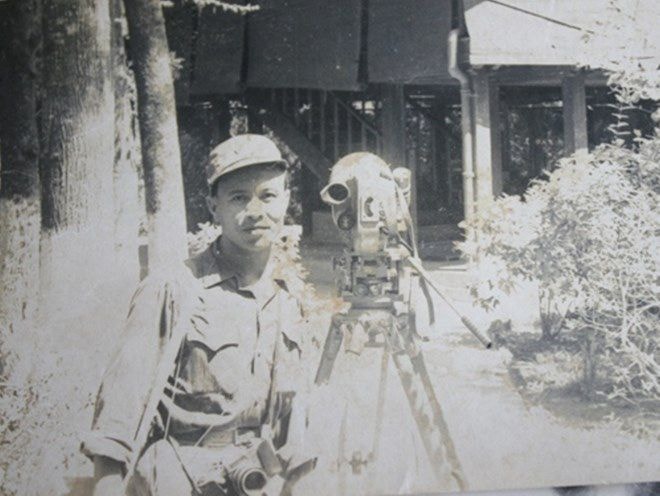 |
| Lieutenant Colonel Nguyen Thanh Xuan in his youth. (Photo provided by the subject). |
“After completing the filming, the film crew saw that I had a talent and passion for filmmaking, so they invited me to work at the military film studio. My main job at that time was to handle explosives, guns, and create smoke and fire effects for the film scenes,” Mr. Xuan recalled.
After nearly six years working at the military film studio, Mr. Xuan's passion for cinema further motivated him to explore and learn about cameras. Through numerous trips with film crews, "learning on the fly" about filming techniques, the young soldier's skills gradually improved significantly.
“After honing my skills for a while, at the end of 1965, I received orders from the General Political Department to go to Quang Tri Citadel to film the battlefield. From there, I became a key war correspondent at the Army Film Studio, participating in documenting the advances of our army and people on all fronts,” Mr. Xuan recounted excitedly.
Since being assigned as the main cameraman with the Russian Convat camera, serial number 67083, Mr. Xuan successfully produced his first film, "Aim Straight at the Enemy and Shoot," which praised the heroic Nguyen Viet Xuan Battalion.
After that film, Mr. Xuan was assigned to film many other famous movies such as "Thuan Hai Cotton Field" (about soldiers engaging in economic activities), "H66 Tank Regiment," and "The Great Victory of Spring 1975." Particularly noteworthy is the film "The Last Moments of Uncle Ho," which was broadcast on September 2nd, 1990, commemorating the 100th anniversary of his birth.
A documentary film that will go down in history.
Having spent over 30 years behind the camera, making numerous well-known historical films, what Mr. Xuan is most proud of is having filmed scenes of President Ho Chi Minh from his lifetime to his last breath. Images of President Ho Chi Minh wearing a steel helmet while visiting anti-aircraft artillery positions at Long Bien Bridge, or visiting naval soldiers, were all captured by Mr. Xuan, representing significant milestones in history.
Mr. Xuan recounted that on August 25, 1969, he received an order from the General Political Department to prepare for a mission. He had never felt so nervous. On previous filming trips, he always knew the purpose of the trip beforehand. But this time, the film studio's leadership only briefly informed him to prepare the equipment and be ready to depart for documentary filming when ordered.
“Around 2 a.m., while I was preparing for a business trip, there was a knock on the door announcing that we should all get our belongings ready and get in the car for a trip immediately. I asked where we were going and what our mission was, but I only received a brief reply: 'Go straight to the back gate of the Presidential Palace; someone will be waiting there.' Then, without anyone saying anything, we quickly got into the car,” Mr. Xuan recalled.
| Mr. Nguyen Thanh Xuan, the filmmaker of "The Last Moments of President Ho Chi Minh's Life". (Photo: Hung Vo/Vietnam+) |
After several days of maintaining a state of readiness, on the night of August 29th, the film crew, including Mr. Xuan, Comrade Tran Anh Tra, and a driver, arrived and slept at the General Political Department's office to prepare for orders. A short while later, Comrade Vu Ky – President Ho Chi Minh's private secretary – announced, "President Ho Chi Minh is currently seriously ill. The superiors have sent you here to perform your duties. Please rest for a while; someone will call you when needed."
At this point, Mr. Xuan and the film crew members realized how crucial their mission was for this trip. In the early morning of August 30th, Comrade Vu Ky announced that the doctors were doing their best to care for President Ho Chi Minh's health so that he could celebrate Independence Day with the people on September 2nd.
However, at 9:47 AM on September 2nd, while the Politburo was meeting, someone ran up to report to Comrade Le Duan that Uncle Ho had breathed his last. “At that moment, I and Comrade Tra received orders from Comrade Vu Ky that Uncle Ho had passed away, and that the comrades should quickly go in and record the last images of him,” the former soldier recounted.
“Seeing Him, I tried to suppress my grief to record these scenes. At that time, even though I tried not to cry, tears kept streaming down my face, blurring the camera lens. I used two cameras continuously, switching from one to the other as soon as the film ran out,” Mr. Xuan recalled the painful moment with President Ho Chi Minh.
According to Mr. Xuan, at nearly 11 a.m. on September 2nd, after filming was completed, the Politburo held another meeting on organizational matters. At this time, Mr. Xuan was taken to Military Hospital 108 to film scenes of Russian doctors applying preservatives to President Ho Chi Minh's body. After filming those historical scenes, all the materials about President Ho Chi Minh were handed over to the film studio for safekeeping and security.
On the morning of September 2, 1969, the National Day rally proceeded as usual, much to the delight of tens of thousands of people in the capital. The only difference was that no one could see Uncle Ho on the platform anymore.
In the years that followed, despite being cameramen, he and his colleague Tran Van Tra never once got to see the images they had filmed.
It wasn't until 1990 that director Pham Quoc Vinh unexpectedly informed Mr. Xuan that the documentary footage of President Ho Chi Minh's last breath would be used in a documentary titled "The Last Hours of President Ho Chi Minh's Life." That same year, Mr. Xuan was able to watch the film live at the Army Film Studio.
According to Vietnamplus


