
Meet Finland's 34-year-old female Minister of Education.
With a friendly smile, dressed in black trousers and a black and white striped shirt, and a quick and efficient demeanor, the Finnish Minister of Education and Culture made a positive impression on those he met.
As part of his working visit to Nordic countries to explore and promote international cooperation opportunities in education, on the morning of August 29th, Minister of Education and Training Phung Xuan Nha held a meeting with the Finnish Minister of Education and Culture, Sanni Grahn-Laasonen.
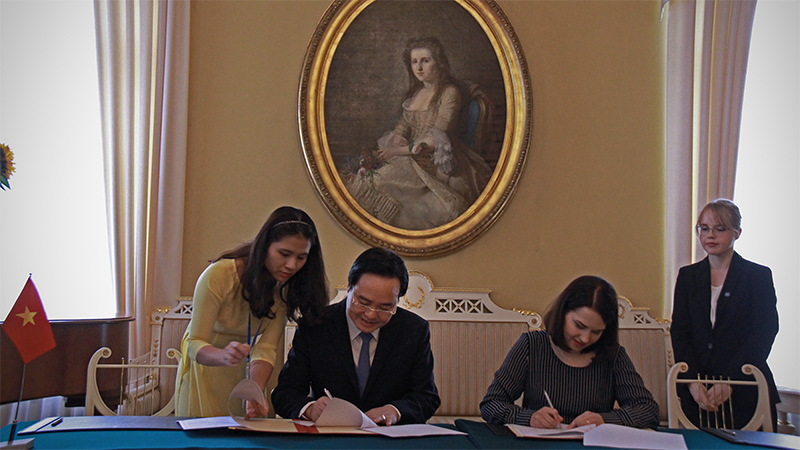 |
| Minister Phung Xuan Nha and Minister Sanni Grahn Lassonen |
During a brief working session, conducted directly in English with his counterparts, Minister Phung Xuan Nha requested technical assistance in education. In addition to discussions on potential cooperation in developing training programs, transferring materials and learning resources, and promoting entrepreneurship, both sides devoted considerable time to coordinating teacher training and professional development.
Following the talks, 18 memoranda of understanding were signed between Vietnamese universities and their Finnish counterparts, witnessed by the Ministers of Education of both countries.
 |
| Minister Sanni Grahn-Laasonen. |
Sanni Grahn-Laasonen became Finland's Minister of Education and Culture in 2015, at the age of 32 (she was born in 1983). Prior to that, she served as Minister of the Environment. Since becoming Minister of Education, she has promoted reforms in general education, with a program recently adopted in 2016.
Sanni Grahn-Laasoen earned a bachelor's degree in social sciences and then completed a master's degree in political science. She worked as a journalist and later as the editor-in-chief of a newspaper in Finland. In addition, Lauren joined Parliament at a relatively early age.
On the sidelines of the event, the Finnish Minister granted VietNamNet a brief interview.
Reporter:Madam, since Finland emerged as an educational marvel, hundreds of delegations from around the world have visited, and numerous programs and articles have highlighted this excellence. Could you briefly outline the values of Finnish education?
Minister Sanni Grahn-Laasoen:Finland has an equitable education system, ensuring fairness for everyone. We want to create opportunities for all citizens, regardless of their background, rich or poor.
Finnish students achieve some of the highest academic results in the world according to PISA assessments. The secret to this success lies in our teaching staff. We have a high-quality teaching team. All teachers are rigorously selected and hold master's degrees.
In Finland, teaching is a noble profession and is highly respected by society.
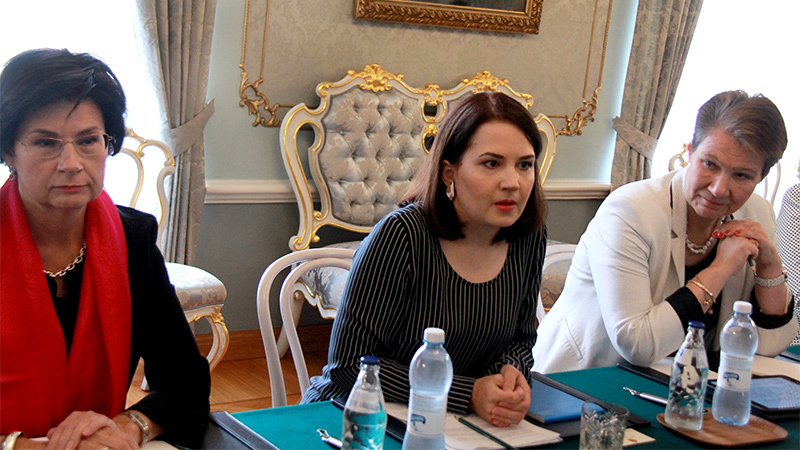 |
| Together with colleagues at the Finnish Ministry of Education and Culture. |
Our teachers are given a great deal of autonomy. They have freedom in their teaching methods, teaching materials, and curriculum organization.
Neither teachers nor students are subject to strict control and supervision.
We don't have standardized tests because we don't want to put pressure on the students. What's important is that students feel happy and comfortable coming to school.
Are teachers well-paid in Finland, ma'am?
- Teachers are paid fairly well, though certainly not as much as doctors.
I would say that teachers' salaries are important, but in our country, there are other reasons that highlight the importance of the teaching profession.
Generally, many people want to become teachers. At teacher training colleges, only 1 in 10 applicants are selected each time. Only the most talented and intelligent people choose to work in the teaching profession.
We prioritize research-oriented teacher training. This provides a foundation for them to proactively develop curricula in collaboration with students.
Furthermore, parents, students, educational authorities, and society as a whole have great confidence and trust in the teachers.
Vietnam has a land area comparable to Finland, and its history shares some similarities with Finland in the past. Currently, Vietnam's population is many times larger than Finland's, and its socio-economic foundation still lags far behind Finland's. So, in your opinion, what can Vietnam learn from Finland to develop its education system effectively?
- Finland is a country with a small population, so every student is given the opportunity to develop their full potential and compete internationally. Since gaining independence 100 years ago (1917), we have invested heavily in education from a very early stage.
 |
| A portrait of Minister Sanni Grahn Laasonen on a Finnish website. |
After 100 years, Finland has become a wealthy, developed country with one of the highest standards of living in the world. This is all because we invest in education; the whole country considers education important, and everyone wants to develop it further in the future.
Finland has become widely known in recent decades for Nokia phones and the "miracle education" phenomenon. Now, Nokia has declined. Do you think that at some point, Finnish education will also lose its dominance, just as Nokia once did?
The world is changing very rapidly, and we must always strive to keep up with the development of humanity.
We must strive to learn every day, to learn throughout our lives in order to grow.
Thank you, ma'am!
According to Vietnamnet.vn
| RELATED NEWS |
|---|


