
Remarks from the "Population of Nghe An and Development" Journalism Award
(Baonghean) - After nearly 12 months of launching (July 11, 2014 – June 21, 2015), the Journalism Award with the theme "Population of Nghe An and Development," organized by the Provincial Population and Family Planning Department in coordination with media agencies: the Provincial Journalists Association, Nghe An Newspaper, and the Provincial Radio and Television Station, was quite successful. The organizing committee received a positive response from agencies and units in the province.
Immediately after the launching ceremony, in addition to issuing documents, directives, and concretizing them with plans, the Population and Family Planning Sub-Department organized many implementation conferences and coordinated with provincial-level departments and organizations to promote the rules of the competition and encourage members to participate.
With a total of nearly 60 entries, including articles, reports, investigative reports, notes, reflections, and stories about good people and good deeds, the "Nghe An Population and Development" Journalism Award closely adhered to the set criteria. These criteria included reflecting the current situation, analyzing the causes, and proposing effective solutions for population and family planning work in Nghe An, conveying the policies and guidelines of the Party and State, and Resolution No. 20 of the Provincial Party Committee on strengthening population and family planning work in the new situation.
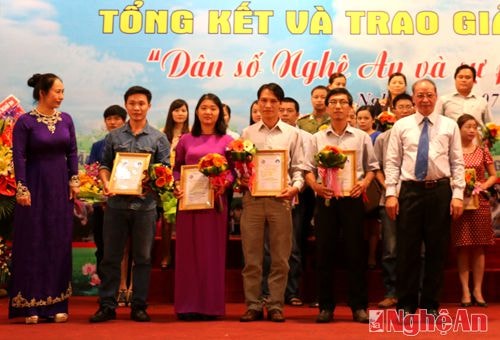 |
| Provincial leaders and the General Department of Population awarded the A prize to the group of authors. |
The entries submitted to the competition have contributed to the dissemination of information on population and family planning policies, highlighting exemplary collectives and individuals in population work. Notable examples include: The series of articles "Gender Imbalance at Birth" by authors My Ha and Minh Quan (Nghe An Newspaper), published in three consecutive installments (January 21, 22, and 23, 2015 in Nghe An Newspaper), clearly reflected the reality of gender imbalance at birth in Nghe An, its consequences, and the correct recognition of women's value, thus emphasizing the need for proper implementation of population policies. The series of articles "Nghe An - Efforts to Improve Human Resources" by authors Ha and Lai fully reflected the activities in population and family planning work in Nghe An province, while also highlighting the current situation, solutions, and the persistent efforts to improve the quality of Nghe An's human resources.
The television documentary "Ly Y Xi as a Population Officer," by authors Ngoc Dung and Son Hieu, highlighted the exemplary life of a Hmong woman (from Pha Lech Phay village, Dooc May commune, Ky Son district, a mountainous border area). She is the busiest woman in the commune: "At dawn, when the rooster first crows, Y Xi and her children are already out in the fields. Her husband is a border guard officer working far away, so she handles everything in the family." Y Xi is a population officer in a commune where 100% of the population is Hmong. Their customs and traditions regarding marriage, childbirth, and other family matters remain largely unchanged. Poverty and hunger continue to plague them.
With her determination, Y Xi overcame all obstacles and difficulties, excelling as a dedicated population officer. Her belief and perseverance led to her success. The television documentary "A Sad Lullaby..." by authors Thach Son and Lang Van Linh (Ethnic Language Department, Nghe An Radio and Television Station) skillfully selected a topic and exploited the strengths of ethnic languages to reflect the continued existence of child marriage and consanguineous marriage in mountainous and ethnic minority areas inhabited by the Hmong and Khmu people. From there, it aimed to educate and persuade the people to abandon outdated customs and improve their quality of life.
The carefully selected images, lively camera angles, concise composition, and commentary and voiceover in the Hmong language captivated the audience. In particular, through his in-depth research and exploration of life, uncovering the dark sides of the implementation of population and family planning policies, author Huy Khoi (Do Luong Radio and Television Station) boldly addressed the ethical, moral, and responsible aspects of some state officials and employees who, simply to have both sons and daughters, circumvented the law to have a third child, even "rejecting their own children," affecting the overall movement of their agencies and units and significantly impacting public opinion through the audio report "Rejecting Their Own Children"...
Despite being the first year of the event, it was considered a success due to the large number of participants, with over 60 entries. Many works showed good originality and content, creating a strong impact. The works also demonstrated innovative methods of expression and excellent professional skills.
Commenting on the award, Mr. Tran Duy Ngoan, Chairman of the Vietnam Journalists Association, said: "The success of the award has partly affirmed the enthusiasm and dedication of journalists, reporters, and collaborators in the work of disseminating and educating about population and family planning. Each article, report, and story from the participating authors has brought diversity and a multitude of colors from everyday life to the competition."
Tran Thi Huong
(Department of Population and Family Planning)
Global message for World Population Day 2015 - Always ensure the dignity, safety, and reproductive health of all women and girls. A woman's life is always precious, no matter the circumstances. - Women and girls are vulnerable populations when natural disasters occur, and their specific needs are often not met. Ensuring their safety, dignity, and health will contribute to the well-being of their families and communities. - When natural disasters occur, we need to focus on the reproductive health care needs of women and girls of reproductive age. If we can do this, the lives of women and girls will be safer and they will be healthier. |


