
Observations from a competition
(Baonghean) - These days, the provincial-level excellent teacher competition for primary school teachers is taking place with great enthusiasm. This is an important competition, held every four years, and this year's competition is expected to have many breakthroughs, because this is the first level of education to implement reforms according to the Ministry of Education and Training's policy on "Fundamental and comprehensive reform of education and training"...
| A lesson taught by a teacher at Hong Son Primary School (Vinh City). Photo: My Ha |
For nearly two weeks now, the atmosphere of teaching and learning at Hong Son Primary School (Vinh City) has been more vibrant as the school was selected by the Department of Education and Training as one of three locations to organize a competition for excellent primary school teachers for more than 100 teachers throughout the province.
This is the first year the Ministry of Education and Training has implemented many innovations in teaching and learning and in student assessment. Therefore, the school's leaders and teachers hope that this competition, with the gathering of excellent, reputable, and experienced teachers from across the province, will be an opportunity for the school's teachers to learn, interact, and exchange experiences…
The school administration has rearranged nearly 200 teaching hours for students from grades 2 to 5 to ensure that teachers can complete their exams while maintaining students' schedules and preventing disruption to the curriculum. In addition, the school has made every effort to provide teachers, especially those from distant areas, with the opportunity to familiarize themselves with the new environment and students, facilitating the teaching demonstration process.
Despite being busier than usual and having a rather disrupted work schedule, Mr. Pham Huu Lam, the school's Vice Principal, shared: "We are very proud to have been trusted and selected by the City Department of Education and Training and the Provincial Department of Education and Training. Furthermore, we believe that each lesson taught by the candidates here is an opportunity for us to learn from and improve teaching and learning in the future."
Innovations in examinations and changes in teaching, learning, and assessment methods at the primary school level are the first two breakthroughs implemented by the Ministry of Education and Training in accordance with Resolution No. 29 on "Fundamental and Comprehensive Reform of Education and Training." This was clearly demonstrated in the 2015 provincial-level primary school teacher excellence competition, where the first "innovation" was the way the exam questions were formulated. While previous exams had fairly specific questions based on a fundamental foundation, aiming to enable teachers to impart knowledge to students in the most complete and profound way, now all parts of the competition—from evaluating innovative teaching methods and essay writing to practical pedagogical skills—revolve around the requirement for innovation in teaching methods and assessment methods. For example, in the essay section, the question "Teachers are required to design a lesson based on students' experiential activities" is an "open-ended" question, allowing teachers to fully express their creativity in organizing a lesson.
During the grading process, the judges were very pleased that although the exam only focused on Mathematics, many teachers had quite flexibly applied images related to daily life and exploited many practical experiences to build new lessons. Many exam papers bore the distinct mark of their respective regions. For example, in a lesson about rectangles, some teachers asked students to observe rectangular objects around their homes. Based on that, the teacher would help students calculate the area and perimeter. Through this practical lesson, students not only understood easily but also found it enjoyable as they discovered their own lives and the objects around them. Students from mountainous areas could distinguish between the headscarves of the Thai and Hmong people based on the shape of the objects.
At the end of the first phase, only about 90% of participating teachers met the requirements in the essay section. In the multiple-choice section, although the questions revolved around the Party and State's policies, the industry's reforms, and the Department of Education and Training's directives in accordance with Resolution No. 29, the new testing method—questions and grading done directly on the computer—made it difficult for teachers who didn't quickly grasp the questions or understand the issues to complete the exam within the allotted time.
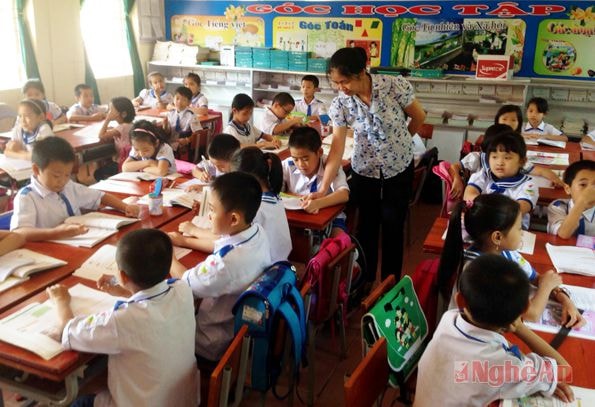 |
| Teaching using the VNEN model at Nghi Thuy Primary School (Cua Lo Town). Photo: My Ha |
The practical exam, with two main lessons for one elective and one compulsory subject, provided teachers with an opportunity to showcase their abilities on the podium. Watching a geography lesson on "The Americas" in class 5C at Hung Binh Primary School, students and judges were delighted to see the teacher create a rather elaborate lesson with many vivid, handmade visual aids.
Furthermore, with the support of digital lesson plans, each country introduced, and each characteristic regarding its population, climate, and rivers, is illustrated with images. Another lesson, about industrial zones in the central coastal plain, uses examples from factories in industrial zones in Nghe An province, making the teaching quite flexible, practical, and up-to-date.
Having been selected to judge the provincial excellent teacher competition four times, Ms. Nguyen Thi Phuong Thao, Vice Principal of Le Loi Primary School, felt particularly excited about this year's competition. This was because the open-ended questions, without specific answers, allowed both the participating teachers and the judging panel to apply their own interpretations flexibly in scoring. Through the meticulously prepared, creative, and innovative lessons, she sensed the teachers' concern and responsibility towards their students.
Ms. Phuong Thao further shared: "Previously, teaching elementary school students was based solely on imposing knowledge, making it difficult for them to absorb and feel burdened. Now, however, new lessons are prepared by teachers using experiential learning methods, allowing students to learn independently, explore, and develop their abilities. In this competition, many teachers applied new teaching methods such as the 'hands-on' method and the 'tablecloth' method. The use of electronic lesson plans is also more frequent, but not as strictly as before; instead, they are used flexibly between presentations and the use of the whiteboard. Although I was a judge, I also learned a lot from my colleagues."
Nguyen Khanh Linh, a 5th grade student from Hung Binh Primary School (Vinh City), happily shared: "While learning, I found the illustrations on the computer very easy to understand and remember, very relatable to primary school students."
Up to this point, after a semester of innovations in teaching and learning, the changes in grading methods have been implemented quite systematically in schools. And although there are still some differing opinions, the biggest benefit of the innovations at the primary school level is creating a comfortable learning environment for students, helping them develop their abilities and talents, and providing them with more life skills education.
Mr. Tran The Son, Head of the Primary Education Department of the Department of Education and Training, stated: "The competition has created a new educational environment, a driving force for excellent teaching and learning, supplementing the core teaching staff, creating a pool of qualified personnel for schools, and providing an opportunity for teachers throughout the province to exchange and learn from each other. The results of the competition serve as a benchmark for each teacher to self-assess and improve themselves, accumulate experience, and enhance their professional competence to fulfill their teaching and learning tasks."
My Ha


