
Recorded in Khe Sanh
Quang Tri is currently buzzing with excitement as it celebrates the 45th anniversary of the Khe Sanh victory (July 9, 1968 - 2013). Passing through Dong Ha, Cam Lo, and up to Huong Hoa… wherever we stopped, upon learning that we had traveled over 300 kilometers from Nghe An for this occasion, every Quang Tri resident nodded as if to say they understood our journey was justified and natural! Khe Sanh – that place name has truly resonated with pride in victory, not just for the heroic people of Quang Tri…
(Baonghean)Quang Tri is currently buzzing with excitement as it celebrates the 45th anniversary of the Khe Sanh victory (July 9, 1968 - 2013). Passing through Dong Ha, Cam Lo, and up to Huong Hoa… wherever we stopped, upon learning that we had traveled over 300 kilometers from Nghe An for this occasion, every Quang Tri resident nodded as if to say they understood our journey was justified and natural! Khe Sanh – that place name has truly resonated with pride in victory, not just for the heroic people of Quang Tri…
The moment I set foot on Ta Con airport and the remnants of the old Lang Vay battlefield, I deeply regretted not having prepared more thoroughly for this trip. Highway 9 - Khe Sanh, Lang Vay, Ta Con… are place names associated with the resounding victory that marked the beginning of the 1968 Tet Offensive; these battlefields, though still imbued with pride, made it difficult to recall the legends of the land and its people, something I should have been able to do.
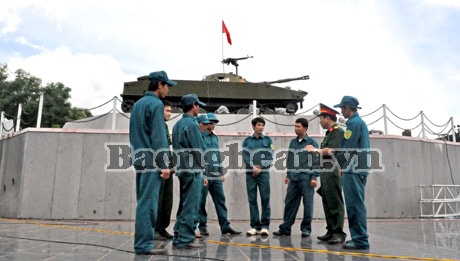
At the Lang Vay Victory Monument.
Perhaps it was also because I relied too heavily on the love for Quang Tri shared by a Quang Tri native. That was Tran Hoai, a correspondent for the People's Army Newspaper in North Central Vietnam, born in Vinh Linh when the war was beginning to show signs of the American defeat on the Vietnamese battlefield in 1971.
I know that for Tran Hoai, the two regions of Cua Tung - Vinh Linh and Khe Sanh - Huong Hoa are two haunting memories of his homeland, deeply ingrained in the emotions of his short stories and essays, which are quite substantial, written by a journalist in military uniform... Ten years ago (in 2003), while accompanying a team making a documentary film commemorating the 35th anniversary of the Khe Sanh Victory for the 4th Military Region's Newspaper and Television, Tran Hoai wrote an outstanding essay, "Khe Sanh, not just one day...", in the People's Army Newspaper, with a truly unique and accurate perception perhaps only found in the sensitivity of a son of Quang Tri: "I looked at the iron-colored rock formations beneath my feet, on the world-renowned stronghold, and thought to myself that the iron and steel weapons, bombs, and explosives had melted and dissolved into the rocks of Khe Sanh, rather than the metallic elements being melted by the earth's core at millions of degrees, erupting into volcanic eruptions, giving the land here a bright red color of blood."
On that land once stained crimson with blood, a lush green landscape now stretches across rubber and pepper plantations, and the banana and cassava fields cultivated by the Kinh, Van Kieu, and Pa Co ethnic groups in their recent victory over poverty and backwardness. Every five years, Quang Tri solemnly commemorates the Khe Sanh Victory. Each time they are invited to attend, the soldiers who fought in the battles of Lang Vay, Ta Con, Cam Lo, and others are overjoyed and amazed by the dramatic changes in these former battlefields. Along the 60 kilometers from Dong Ha to Huong Hoa, it is difficult to imagine the heroic and fiercely bombarded Highway 9 of 45 years ago. This legendary road has now become part of the 1,450-kilometer East-West Economic Corridor, running through four countries: Vietnam, Laos, Thailand, and Myanmar, with increasingly bustling trade.
It seems as though an entire generation of children from this fiery land has grown up pursuing military careers (!). Lieutenant Colonel Nguyen Thuan Hue, Head of the Military Command of Huong Hoa District, is actually a high school classmate of journalist Tran Hoai from Vinh Linh. Leading us to Hill 320 of the former Lang Vay base, now located in Tan Long commune, Huong Hoa district, Lieutenant Colonel Hue recounted in detail the events of the Lang Vay battle, including the coordinated forces of the local troops of Huong Hoa district; he said he felt proud and honored to be assigned the task of overseeing military affairs here… Hill 320 is a strategically important mountain peak, situated close to Highway 9. From here, one can overlook the entire Lang Vay base site and a vast area along the Se Pon River, extending all the way to neighboring Laos.
According to Lieutenant Colonel Hue, the descendants of the Van Kieu and Pa Co ethnic minority people in Huong Hoa district who sheltered soldiers and served as civilian laborers, contributing to the Khe Sanh Victory, are now actively engaged in production, adapting to new business practices, and striving to achieve an average income of 18.5 million VND per person per year in 2012. Meeting with the Tan Long commune self-defense forces on duty protecting the televised event of the Military Television Station, "Khe Sanh: From a Thousand Hearts," Ho Van Truc, born in 1979, and Ho Van Banh, born in 1992, both from the Van Kieu ethnic group, said that besides their regular combat readiness, they participate in agricultural production with their families, cultivating hectares of cassava and bananas for commercial purposes, earning nearly 100 million VND each year. The Huong Hoa cassava starch factory has a raw material area of up to 4,500 hectares in the two mountainous districts of Huong Hoa and Dakrong in Quang Tri province and 2,000 hectares in neighboring Laos. The SEPON cassava starch produced by the factory is exported to China, Taiwan, South Korea, etc. It was the first time I met the Van Kieu people whose stories of faith in the Party and President Ho Chi Minh were so beautiful and moving during the resistance against the US; even now, they remain just as sincere and devoted to the revolution!
According to documents from the Huong Hoa Military Command, from the beginning of 1966, the US intensified its troop and weaponry deployment to western Quang Tri, establishing a dense network of bases at key locations such as Ta Con, Lang Vay, Cu Boc Hill, and Dong Tri. The Lang Vay base was considered the "masterpiece" of the US military commander in Vietnam, General Westmoreland, with the expectation that it would be a "tough" military stronghold for defense, blocking the northwestern part of the Tri Thien battlefield; an "anchor" to the west for the strategic defense system south of the demilitarized zone; transforming Khe Sanh into a patrol base to prevent enemy forces from Laos from crossing along Highway 9 and also a base for commando operations to harass the enemy along the Vietnam-Laos border. At the same time, Khe Sanh was used as a springboard for ground sweep operations, an airfield was built there for American reconnaissance planes to take off to search for and destroy the main forces of the People's Army of Vietnam, and to disrupt and cut off the Ho Chi Minh Trail, the vital supply route from the North to the anti-American battlefield in the South.
The Lang Vay base was built on two high points, 320 and 230, measuring 600m in length and 200m in width. It had numerous trenches and fortified positions with very strong firepower, including 105mm artillery and 106.7mm mortar positions. Surrounding the base were layers of barbed wire fences, and at the foot of the hills were large minefields with high destructive power. The base was garrisoned by US special forces and the South Vietnamese army, consisting of 6 companies, under the direct command of 30 American advisors...
The history of the Vietnam People's Army has clearly recorded and analyzed extensively the attack to destroy the Lang Vay stronghold, considered the first combined arms battle in which tanks participated in an offensive by our army, resulting in the complete annihilation and capture of the enemy, and the seizure of many weapons and equipment; it was the opening battle of the Khe Sanh Victory.
In Huong Hoa, we were fortunate to meet two veteran soldiers who fought in the Lang Vay battle, two Heroes of the People's Armed Forces whose names are forever linked to the pride of the Khe Sanh Victory. They are Major General Le Xuan Tau, former Commander of the Armored Corps from 2000 to 2005, and Colonel Tran Huu Bao, a soldier of the heroic 304th Infantry Division.
On this occasion, the two gentlemen returned to Quang Tri to participate in the events commemorating the 45th anniversary of the Khe Sanh Victory. Receiving us in the grand lobby of a hotel in Lao Bao town, Hero Major General Le Xuan Tau did not speak much about the battle in which his tank, numbered 555, led the 3rd Platoon, 3rd Tank Company, in a fierce battle that significantly contributed to the complete destruction of the enemy's Lang Vay stronghold on the night of February 6th to the morning of February 7th, 1968. He only spoke in a subdued voice about his comrades who had fallen throughout the war; He recounted stories of his comrades who had fought alongside him and supported him in successfully completing his mission in the Battle of Lang Vay, such as Phan Van Hai – then the Company Commander of the 3rd Tank Company, and Le Van Bang – the Deputy Political Commissar of the Company, both from Thanh Chuong, Nghe An, who retired with the rank of colonel. Now, they face difficulties in life that he has not been able to help them with, nor to welcome them to Khe Sanh on this occasion…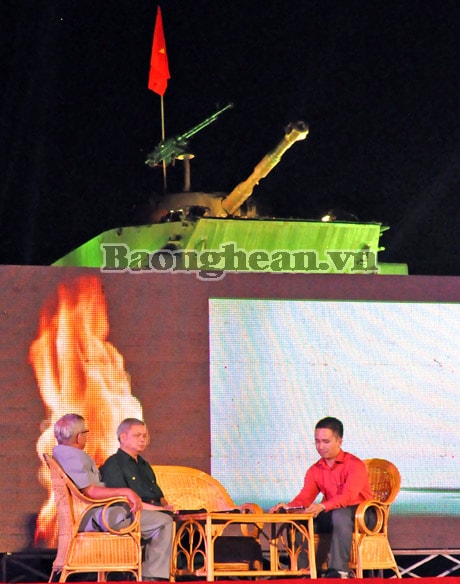
An exchange with two heroes of the armed forces: Major General Le Xuan Tau and Colonel Tran Huu Bao - witnesses of the Lang Vay battle, broadcast via Huong Hoa television - a military television program, commemorating the 45th anniversary of the Khe Sanh Victory.
In an informal conversation, Colonel Tran Huu Bao, a veteran infantry soldier who single-handedly eliminated 78 enemy soldiers and was awarded the title of outstanding hero, spoke in his warm, deep Nghe An accent. He said that remembering history and preserving the pride in the fighting spirit and victory of the Khe Sanh Campaign is to both heal the wounds of war and strengthen the aspiration for peace…
In 2011, when Major General Le Xuan Tau revisited Khe Sanh, he met a former American veteran and advisor at the Lang Vay outpost. John (the veteran's name) brought his entire family of six to visit Khe Sanh and exclaimed to Major General Le Xuan Tau: "Your victory was justified because you fought with all your courage!"
Did John understand that such courage stemmed from the just cause of the Vietnamese people's war? Perhaps this was the same American veteran who returned to Lang Vay in 2003, whose image of him sobbing and kneeling on the former battlefield remains etched in Tran Hoai's journalistic memory, even though he has never written about it. Did that pain of the American veteran contain a sense of remorse and awakening in those who took up arms to wage war?
On a windy afternoon in Quang Tri, the Ta Con Airfield historical site is bustling with activity as event organizers are busily setting up stages and platforms in preparation for the 45th anniversary celebration of the Khe Sanh victory.
Currently, many war artifacts are displayed here, from military uniforms and personal equipment of American soldiers to various types of military transport planes and helicopters bearing the USA brand. In Ta Con, since 1966, the US military has built a large complex of fortifications, becoming the largest military position in the Route 9 – Khe Sanh defense system. Spanning 2 km in length and 1 km in width, it comprises numerous smaller fortifications with dense, fortified structures and a large airfield for landing and takeoff of heavy military transport aircraft such as C130s and C123s, as well as troop-carrying and armed helicopters.
During our Khe Sanh campaign, the Battle of Ta Con Airfield was the final offensive (from May 8th to July 15th, 1968) to repel the American forces retreating from Khe Sanh. History records: "The victory at Ta Con contributed greatly to the glorious victory of our army and people on the Route 9 Khe Sanh front, closely linked to the Spring 1968 General Offensive and Uprising, playing a crucial role in forcing the US to withdraw its support and ease the burden on the Saigon puppet regime, stop bombing the North, and sit down at the Paris peace talks, initiating a process of strategic failure for the US."
The Ta Con historical site, also located in Tan Lap commune, although not yet fully restored, has become an attractive destination for domestic and international tourists on their journey to explore the "DMZ tour" (demilitarized zone tourism).
According to Mr. Le Quan Mien, Head of the Ta Con Airfield Historical Relic Management Board, the site receives approximately 7,000 visitors annually. Notably, many visitors from Europe, the United States, Canada, and Australia are very knowledgeable about the Ta Con base and the Battle of Ta Con. One American visitor once told Mr. Mien that the defeat of the American soldiers at Ta Con - Khe Sanh was a blessing for tens of thousands of American families, as they were able to welcome their children back home, leaving behind a brutal and meaningless war waged by the American army! On the Ta Con fields today, alongside the reconstructed war relics, trenches, and fortifications, there is a peaceful green expanse of vegetables cultivated by the local people on the vacant land.
Laura, a young American girl, and her group of friends traveled from the other side of the globe to Vietnam, to Ta Con. They stood for a long time before each artifact and model, their footsteps thoughtful as they walked along the remnants of the airfield. Laura gave me her email address, adding below, "TACON – meaningful!" I don't know if Laura is the daughter or granddaughter of an American soldier who fought at Ta Con, but her smile and eyes were so friendly and peaceful, just like the afternoon in Ta Con itself!
Leaving Khe Sanh – Huong Hoa, bidding farewell to the historical Ta Con and Lang Vay, I continued down Highway 9 towards Cam Lo and Dong Ha… Remembering the words of the Commander of the Huong Hoa District Military Command, Nguyen Thuan Hue: “After 45 years, the victory at Khe Sanh remains a source of enduring pride for the people of Huong Hoa, for the Van Kieu and Pa Co ethnic groups here; but perhaps it would be even more complete if Khe Sanh truly exploited its potential for historical and battlefield-related tourism, contributing to increased revenue and improved living standards for the people.” And I once again “reproached” myself for not being more prepared for this trip, promising to return someday to fully experience the pride of the Khe Sanh victory on the legendary Highway 9!
Dinh Sam


