
Recorded at An Ha Farm
(Baonghean)I have visited many mushroom farms in the province, such as Yen Thanh, Quy Chau, Que Phong… most notably in Yen Thanh. But honestly, nowhere else has a large-scale production facility for edible and medicinal mushrooms like An Ha Biotechnology Joint Stock Company in Tan Ky. It is a reliable address for this locality to expand mushroom cultivation for farmers in the New Rural Development program...
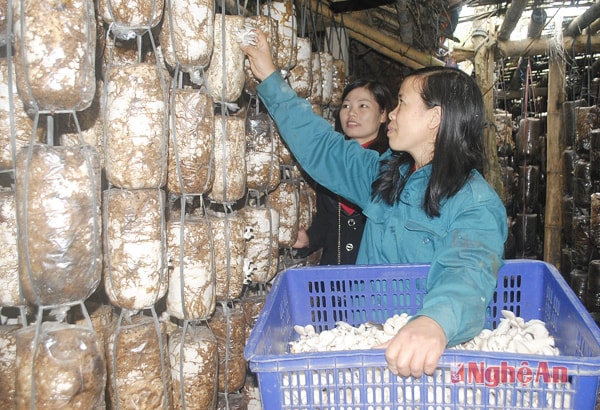 |
| Ms. Nguyen Thi Thuy from An Ha Company is harvesting mushrooms. |
One day in mid-March, we visited the edible and medicinal mushroom production facility of An Ha Biotechnology Joint Stock Company, located in Block 10, Lat Town (Tan Ky District). Our guide was Ms. Vu Thi Linh, an officer from the Ethnic Affairs Department of Tan Ky District, in charge of mushroom cultivation techniques for the company. Ms. Nguyen Thi Thuy, a worker at An Ha Company, said: The company has 8 regular workers, and up to 15 during peak seasons. Regular workers are given the opportunity to attend training courses at the Institute of Agricultural Genetics on cultivation, care, and post-harvest preservation of mushrooms. From early morning, she had to pick mushrooms to be transported by truck to Muong Xen Town (Ky Son District) to sell to traders, having harvested 30 kg. The mushrooms she was picking were being sold to a family in Lat Town.
Before delivering the mushrooms, she uses scissors to carefully trim the stems, and any old mushrooms are also removed. For customers far away, after cleaning the mushrooms, the workers pack them into packages, each weighing 1-2 kg, using a vacuum sealing machine. Ms. Linh said: "Packaging mushrooms with a vacuum machine ensures they won't be crushed during transportation and allows for longer preservation." When asked about the workers' income, Ms. Thuy openly shared: "I've been working for the company since 2011, earning 90,000 VND per day. Working continuously for a month, I earn nearly 3 million VND. Working as a mushroom producer isn't physically demanding, but it requires careful attention and adherence to the correct technical procedures to ensure the quality of the mushrooms. In particular, the sterilization process of the bags in the incubator and the inoculation require highly skilled workers."
Leading us to the sheds where the mushroom bags are hanging, Ms. Linh said: "Currently, this facility has 80,000 bags of oyster mushrooms, 70,000 bags of wood ear mushrooms, and 10,000 bags of reishi mushrooms. Thanks to proper cultivation techniques, we have mushrooms for sale in the market every season. In 2013, the company harvested 22 tons of oyster mushrooms, 3.5 tons of dried wood ear mushrooms, and 200 kg of reishi mushrooms. The total revenue from all types of mushrooms in 2013 was 900 million VND, with a profit of over 200 million VND after deducting expenses. Most of the mushroom products are supplied to the Institute of Agricultural Genetics, with a small portion sold retail in Tan Ky and neighboring districts. In 2014, the company aims to produce 150,000 bags of oyster mushrooms, 400,000 bags of wood ear mushrooms, and 30,000 bags of reishi mushrooms, reaching a total output of 85 tons of mushrooms and a total revenue of 3.5 billion VND."
Thus, in 2014, the company planned to produce three times more mushroom bags and mushroom output compared to 2013. Seeing my hesitation, Ms. Linh explained that this year the company would expand its mushroom farm to a second facility. Then, she enthusiastically led us to the second facility, located in Hamlet 2, Ky Son Commune. Before us was a 15,000 square meter plot of land, right behind the Ky Son Commune People's Committee headquarters. Inside, a factory built with a steel frame and corrugated iron roof was located, with many workers constructing industrial equipment for mushroom production. Ms. Linh introduced: "This is a project for the industrial-scale production and processing of edible and medicinal mushrooms in Nghe An province (Ministry of Science and Technology), implemented in Tan Ky district, with a total project capital of 8.5 billion VND, of which 3.8 billion VND is for the project itself, implemented over two years, 2013 and 2014."
This factory, spanning 1,500 square meters, includes a raw material processing facility, a bagging facility with boilers and autoclaves, a mushroom cultivation facility, mushroom growing sheds, and an office. At this facility, the bagging and processing of mushroom bags are entirely industrial-scale, utilizing a boiler and autoclave system with a capacity of 5,000 bags per batch (two batches per day), an automatic bagging line with a capacity of 700-1,000 bags per hour; a screening and mixing line for sawdust and other materials; and an autoclave and inoculum equipment capable of propagating from level 1 to level 3, serving production in the local area and surrounding regions. The total investment for this facility is 3.2 billion VND, covering equipment purchase, production and business operations, and technical training for workers. To build this entire industrial production line, the company had to hire a team of specialized line installers from the North.
This industrial production line is expected to be operational by the middle of this year. Following this, the company will collaborate with local people to produce mushrooms, with a support policy for families, individuals, and groups interested in mushroom production. This includes 100% support for technical training, partial support for the value of mushroom bags, purchase of all mushroom products produced, and the purchase or exchange of agricultural and forestry waste materials such as sawdust, sugarcane bagasse, acacia branches, rubber trees, corn stalks, corn cobs, elephant grass, peanut plants, peanut shells, coffee husks, straw, etc., to obtain mushroom bags or mushroom products. These agricultural and forestry waste materials will all be used as raw materials for mushroom bag production. Individuals, groups, and families participating in mushroom production will be supplied with high-quality inoculated mushroom bags at a price of 4,000 VND per bag, and the company will purchase all the mushrooms produced.
Mr. Nguyen Ba Thuc, Head of the Agriculture Department of Tan Ky District, said: "Based on the achievements of An Ha Biotechnology Company, the District People's Committee will expand the production area of edible and medicinal mushrooms by directly supporting mushroom producers, creating a market for commercial mushroom production. On that basis, the company will act as a source of technology transfer and product consumption for farmers. Initially, the district will implement this in one commune, then expand it to a wider area. This is a favorable opportunity for Tan Ky to create local jobs for farmers in the process of building new rural areas..."
Xuan Hoang


