
How should customer information be recorded on an invoice?
Businesses have inquired about guidelines for recording customer information on invoices. Regarding this matter, the Nghe An Tax Department would like to respond as follows:
Articles 4 and 10 of Government Decree No. 123/2020/ND-CP dated October 19, 2020, on invoices and supporting documents stipulate:
"Article 4. Principles for the preparation, management, and use of invoices and documents
1. When selling goods or providing services, the seller must issue an invoice to the buyer (including cases where goods and services are used for promotions, advertising, samples; goods and services used for giving, gifting, exchanging, paying as wages to employees, and internal consumption (except for goods circulated internally to continue the production process); exporting goods in the form of loans, borrowing, or returning goods) and must fully record the content as prescribed in Article 10 of this Decree. In the case of using electronic invoices, they must follow the standard data format of the tax authority as prescribed in Article 12 of this Decree.
Article 10. Contents of the invoice
5. Name, address, and tax identification number of the buyer
a) If the buyer is a business entity with a tax identification number, the name, address, and tax identification number of the buyer shown on the invoice must be recorded exactly as it appears in the business registration certificate, branch registration certificate, household business registration certificate, tax registration certificate, tax identification number notification, investment registration certificate, or cooperative registration certificate.
b) If the buyer does not have a tax identification number, the invoice does not need to show the buyer's tax identification number. In some specific cases of selling goods or providing services to individual consumers as stipulated in Clause 14 of this Article, the invoice does not need to show the buyer's name and address. In the case of selling goods or providing services to foreign customers visiting Vietnam, the buyer's address information may be replaced by the passport number or entry/exit document and nationality of the foreign customer.

14. In some cases, electronic invoices do not necessarily need to contain all the required information.
a) Electronic invoices do not necessarily require the electronic signature of the buyer (including cases where electronic invoices are issued for the sale of goods or provision of services to customers abroad). If the buyer is a business entity and the buyer and seller agree that the buyer meets the technical requirements to digitally sign the electronic invoice issued by the seller, then the electronic invoice will bear the digital signatures of both the seller and the buyer as agreed upon by both parties.
b) For electronic invoices issued by the tax authority on a transaction-by-transaction basis, the digital signatures of the seller and buyer are not necessarily required.
c) For electronic sales invoices issued at supermarkets and shopping malls where the buyer is an individual not engaged in business, the invoice does not necessarily need to include the buyer's name, address, and tax identification number.
For electronic invoices for the sale of petroleum products to individual customers who are not engaged in business, it is not necessary to include the following items: invoice name, invoice form number symbol, invoice symbol, invoice number; name, address, tax code of the buyer, electronic signature of the buyer; digital signature, electronic signature of the seller, value-added tax rate.
d) For electronic invoices in the form of stamps, tickets, or cards, the invoice does not necessarily need to include the seller's digital signature (except in cases where the stamps, tickets, or cards are electronic invoices issued by the tax authority), buyer information (name, address, tax code), tax amount, and value-added tax rate. If the electronic stamps, tickets, or cards already have a face value, the unit of measurement, quantity, and unit price are not required.
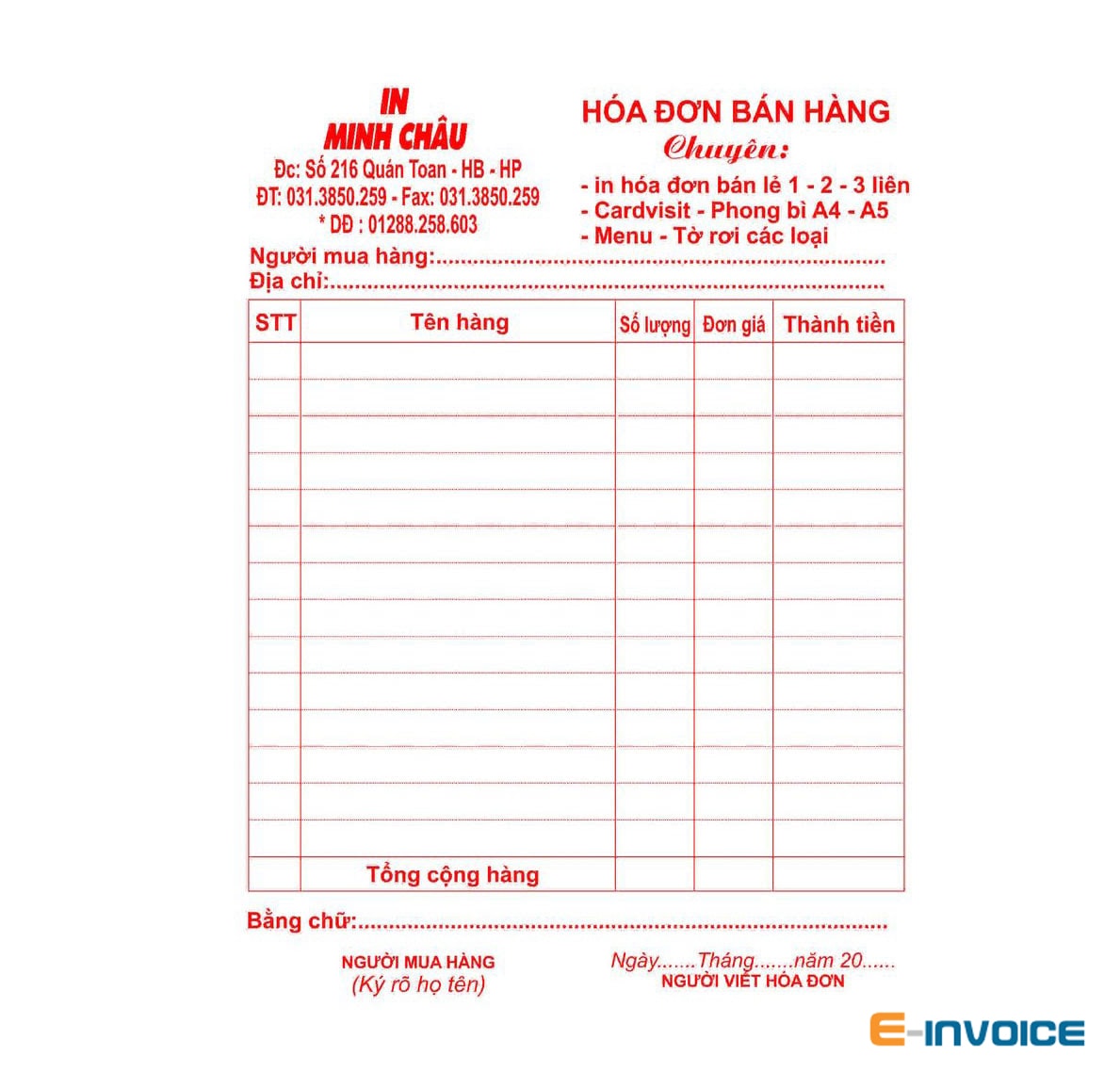
g) For internal warehouse transfer and transportation slips, the slip must show information related to the internal dispatch order, the consignee, the sender, the warehouse of origin, the receiving location, and the means of transport. Specifically: the buyer's name represents the consignee, and the buyer's address represents the receiving warehouse; the seller's name represents the sender, and the seller's address represents the warehouse of origin and the means of transport; it does not show the tax amount, tax rate, or total payment amount.
For consignment sales invoices, the invoice includes information such as the economic contract, carrier, means of transport, location of the sending warehouse, location of the receiving warehouse, product name, unit of measurement, quantity, unit price, and total amount. Specifically: the number and date of the economic contract signed between the organization or individual; the name of the carrier, the transport contract (if any), and the seller's address showing the location of the sending warehouse.
Based on the above regulations, when selling goods or providing services, the company must issue an invoice to the buyer. The invoice must contain all the information as prescribed in Article 10 of Decree No. 123/2020/ND-CP. If the buyer does not have a tax identification number, the invoice does not need to show the buyer's tax identification number. In some cases, electronic invoices do not necessarily have to contain all the information prescribed in Clause 14, Article 10 of Decree No. 123/2020/ND-CP.
The company will act in accordance with the law based on the actual situation and the regulations mentioned above.
The Nghe An Provincial Tax Department provides this response for the company's information and compliance./.


