
Coffee prices today, September 10, 2025: Turning around and rising sharply.
Coffee prices on September 10th were at 114,500 - 115,600 VND/kg. Prices reversed course and increased sharply by 2,300 to 2,500 VND/kg. Inventory is tight, and there are concerns about coffee supply from the US.
Domestic coffee prices today
Domestic coffee prices in the Central Highlands region today, September 10, 2025, reversed course and increased by 2300-2500 VND/kg, fluctuating between 114,500 and 115,600 VND/kg.
Accordingly, traders in the former Dak Nong region are buying coffee at the highest price of 115,600 VND/kg, an increase of 2,300 VND/kg compared to yesterday.
Similarly, the price of coffee in Dak Lak province is 115,500 VND/kg, an increase of 2,300 VND/kg compared to yesterday.
Coffee prices in Gia Lai province increased by 2500 VND/kg compared to yesterday and are trading at 115,300 VND/kg.
In Lam Dong province, the price of coffee increased by 2500 VND/kg compared to yesterday, reaching 114,500 VND/kg.

Coffee prices surged due to expectations of a Fed interest rate cut and new moves from the White House regarding import tariffs. Market expert Nguyen Quang Binh stated that the main factor was the expectation that the US Federal Reserve (Fed) would significantly cut interest rates. This move would reduce capital costs, encouraging large capital flows into commodity markets, including coffee.
Another notable move comes from Washington. President Donald Trump has just issued an executive order allowing the administration more flexibility in bilateral trade agreements. This order aims to reduce or eliminate tariffs on certain specific goods.
Coffee falls under this category as the US imports up to 99% of its processing and consumption needs. This opens up the possibility that import tariffs on this commodity will be considered in the near future.
Currently, the import tax on coffee into the US is 50%, much higher than in some other countries. Vietnam has a tax of 20%, while Indonesia has a tax of 19%. If the US eases its tax on coffee, this would be a positive signal for exporting countries, including Vietnam.
World coffee prices today
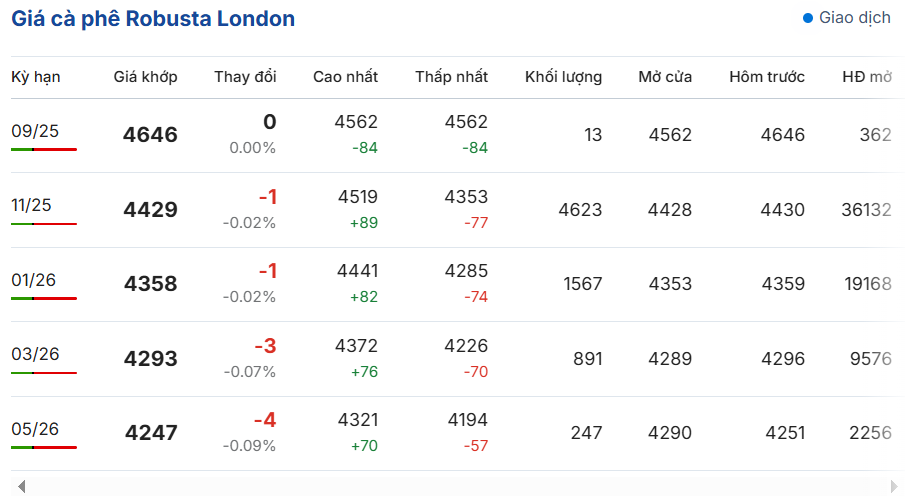
On the London exchange, the online price of robusta coffee futures for September 2025 delivery reached $4646 per ton, unchanged from yesterday. The November 2025 futures contract fell 0.02% ($1 per ton) to $4429 per ton.
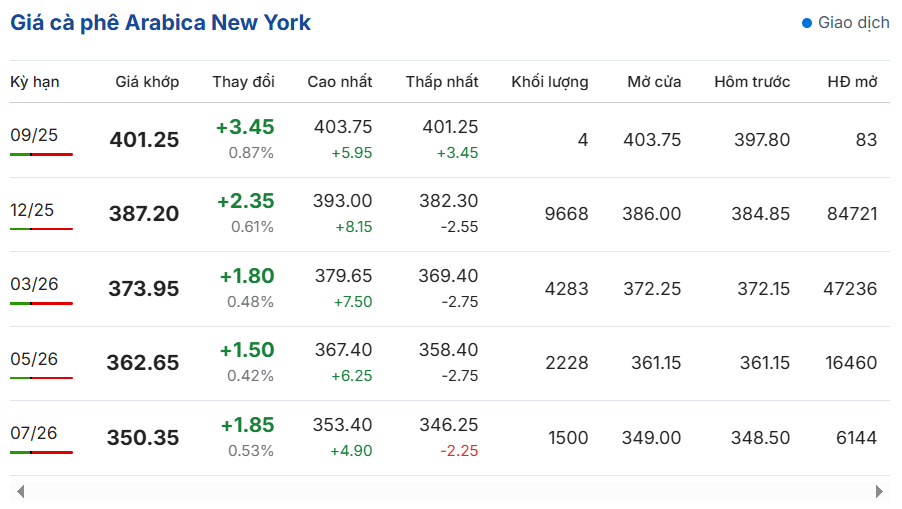
On the New York Stock Exchange, the price of Arabica coffee for September 2025 delivery rose 0.87% (3.45 US cents/pound) compared to yesterday, reaching 401.25 US cents/pound. The December 2025 contract increased 0.61% (2.35 US cents/pound), reaching 387.2 US cents/pound.
World coffee prices continue to rise sharply due to drought in Brazil, reduced supply, and trade tensions in the US market. In the Minas Gerais region, the main arabica growing area, there was almost no rain in the week ending September 6th. The prolonged drought poses a significant risk to the flowering stage, which determines the yield of the entire crop.
Previously, Conab had lowered its forecast for arabica production in 2025 to 35.2 million bags, a decrease of nearly 5% compared to the forecast in May. Brazil's total coffee production was also slightly revised downwards to 55.2 million bags.
The International Coffee Organization (ICO) reported that global coffee exports in July fell 1.6% year-on-year to just 11.6 million bags. Cumulatively over the first 10 months, this figure also represents a slight decrease of 0.3%, indicating a tightening supply on the world market.
The upward pressure on coffee prices is further exacerbated by the very low coffee inventories monitored by the ICE exchange. Arabica inventories have fallen to only about 695,884 bags, nearly reaching their lowest level in the past 1.25 years. Robusta inventories are also hovering around a 1.5-month low of 6,644 lots.
Another significant factor is the US imposition of a 50% tariff on coffee imports from Brazil. This decision has forced many US importers to cancel new contracts, further tightening supply in a major consumer market and adding further pressure to push prices higher.


