
Vietnamese Family: Tradition and Modernity
The traditional Vietnamese family is considered by researchers to be a type of family containing many seemingly immutable elements, with little change, originating from the cradle of indigenous culture, preserved and passed down from generation to generation.
The traditional family is considered a large extended family where members are linked by blood relations, potentially living together for three or more generations: grandparents, parents, and children—commonly known as "three, four, or five generations living together." This type of family is quite common and most concentrated in rural areas, its origin and existence stemming from a small-scale agricultural economy.
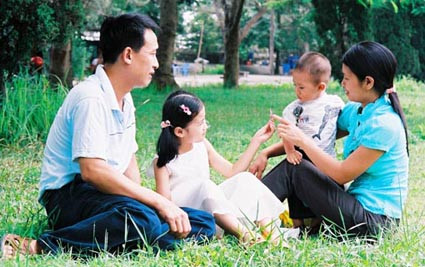 |
The nuclear family (consisting of father, mother, and child) is a fairly common type of family. |
The advantages of the traditional family include strong emotional bonds based on blood relations, preservation of cultural traditions, customs, and rituals, and the promotion of family values and values. Family members have the opportunity to support each other materially and spiritually, care for the elderly, and educate the younger generation. These are fundamental values of family culture that we need to inherit and promote. However, the disadvantages of this type of family are that while preserving good traditions, outdated and backward customs and practices also exist. Furthermore, differences in psychology, age, lifestyle, and habits inevitably lead to conflicts between generations: between grandparents and grandchildren; between mother-in-law and daughter-in-law, etc. Besides maintaining a sense of community, the traditional family also somewhat restricts the free development of each individual.
Single-family, or nuclear, families are becoming increasingly common in both urban and rural areas, replacing the traditional family structure that once played a dominant role. Most Vietnamese families today are nuclear families, consisting of only a married couple (parents) and their children. The trend towards nuclear family formation in Vietnam is on the rise due to its many advantages and benefits.
First and foremost, the nuclear family exists as an independent, compact, flexible unit capable of quickly adapting to social changes. Nuclear families are independent in economic relations. This type of family provides each member with a relatively large space for personal development. Individual roles are highly valued. However, nuclear families also have certain weaknesses. For example, due to reduced bonding and spatial separation between families, the ability to support each other materially and spiritually is limited. The reduced influence between generations also diminishes the ability to inherit and promote traditional cultural values within the family. Furthermore, because nuclear families have fewer children and grandchildren, the time and opportunity for children and grandchildren to care for and show affection to their parents and grandparents are less. This becomes even more apparent as society develops and there are more opportunities for support and care for the elderly, thus widening the gap in family emotional bonds. Nevertheless, the nuclear family remains quite common in our country today, and it is also the prevailing family type in developed industrial and urban societies.
The Prime Minister's viewpoint and objectives on the Strategy for Building Vietnamese Families in the period 2005-2010, as stated on May 16th, clearly define: The family is one of the important factors determining the sustainable development of society, the success of the country's industrialization and modernization, and the building of socialism. Building Vietnamese families with fewer children (each couple having one or two children), who are prosperous, progressive, equal, and happy, is the driving force of the socio-economic development strategy during the period of industrialization and modernization of the country.
In the context of increasingly strong integration and development, strengthening education to preserve and promote the values of traditional families, while simultaneously absorbing the essence of civilized and progressive family culture from around the world, is an important task that contributes to sustainable socio-economic development.
Nguyen Ngan Ha


