
Low acacia prices are causing difficulties for farmers.
Following reports of extremely low prices for raw acacia wood on the market, which have discouraged acacia farmers, we conducted a field survey in several localities in the North Central region, such as Thanh Hoa, Nghe An, and Ha Tinh, to determine the specific prices and profit margins for farmers per hectare of acacia plantation.
(Baonghean)Following reports of extremely low prices for raw acacia wood on the market, which have discouraged acacia farmers, we conducted a field survey in several localities in the North Central region, such as Thanh Hoa, Nghe An, and Ha Tinh, to determine the specific prices and profit margins for farmers per hectare of acacia plantation.
In some mountainous districts of Thanh Hoa province, many acacia farmers report that the price per hectare of 5-6 year old acacia trees, if sold to traders, is only around 30 million VND. Even after harvesting and loading, traders only pay around 500 VND per kilogram; and compensation for 2-3 year old acacia plantations, when cleared for businesses, is only 4-5 million VND per hectare.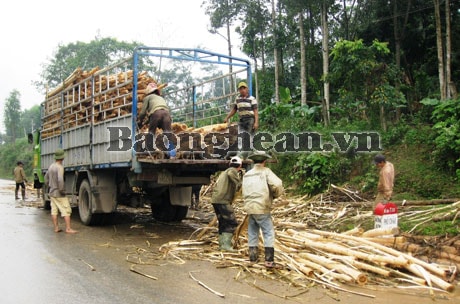
Buying acacia wood in Hoi Son commune (Anh Son district).
In Ha Tinh, according to Mr. Han Duy Anh, Head of the Forestry Department, there is no fixed price for raw acacia wood. When conditions are favorable, some factories buy from farmers at slightly higher prices. However, when farmers cultivate acacia on a large scale, or when there are problems with the distribution channels, the purchase price from factories and middlemen fluctuates erratically, sometimes even dropping to less than half of the normal price. Therefore, traders only buy a hectare of six-year-old acacia trees for 25-30 million VND. Considering the investment costs for planting, caring for, and protecting the trees over six years, that amount of money is insufficient to cover expenses. This is why farmers struggle to make a living from acacia cultivation.
To understand the ups and downs of acacia cultivation more clearly, we investigated several mountainous districts in Nghe An province, a region with widespread acacia planting, to see if farmers there are more prosperous than those in other provinces. Mr. Le Ngoc Cuong, from Hamlet 13, Thanh Huong commune (Thanh Chuong district), said: "One hectare can accommodate about 1,600 acacia trees. After 6-7 years, they can be harvested, with each tree yielding an average of 35-40 kg. The purchase price at the farm is 400 VND/kg, so on average, farmers earn about 20-25 million VND per hectare, not including costs. If farmers hire people to cut down, strip the bark, and transport it to the factory in Vinh City, the price is 930 VND/kg."
Mr. Pham Viet Hung, from Hamlet 6, Cao Son Commune (Anh Son District), said: “The investment cost for one hectare of acacia trees from planting to harvesting is about 10 million VND. I planted a few hectares of acacia because the land is poor and I don't know what else to plant. To be honest, planting acacia trees only yields a small profit, not a substantial return.” In Hoi Son Commune (Anh Son District), a resident of Hamlet 4 said: “Here, we sell acacia trees in bulk; traders buy them in plots. Generally, one hectare of acacia trees might bring in about twenty million VND, and if anyone wants to buy both the land and the acacia trees, we sell them to them.”
Confirming this information, Ms. Vo Thi Hong Lam, Chairwoman of the Anh Son District People's Committee, said: "The market price of acacia wood is too low. At the current price, people only earn about 3 million VND per year, not including expenses and labor costs. We are very concerned about the lives of the people and hope that the province will have a policy to guide the locality in developing effective key economic crops to help farmers escape poverty and not be stuck with acacia trees as they are now."
Through field surveys in several other areas of Thanh Chuong, Anh Son, and Que Phong districts, we received similar results. In Que Phong district, due to the remoteness from the purchasing area, the price of acacia wood is very low because of the high transportation costs. Mr. Vi Van Trung, from Tien Phong commune (Que Phong), said: "Nobody here is interested in acacia wood because the transportation costs are several times higher than the purchase price of the raw material."
I believe that to alleviate poverty for farmers, we must find the right path that benefits them. If we just let them "grope around" following trends like planting acacia trees without long-term development guidance, who will ultimately protect them when acacia prices plummet?!
Quang Dai Binh


