
Rice prices today, January 8, 2025: What to do to stop the decline in rice prices?
Rice prices today, January 8, 2025: Domestic and export rice prices are at their lowest levels in the past two years. Today's rice prices have seen a sharp decrease of 200-600 VND/kg for paddy rice.
Domestic rice prices
Today, January 8th, rice prices in the Mekong Delta region showed slight fluctuations, with some rice varieties experiencing sharp declines compared to the end of last week.
Observations in many localities today indicate that rice trading has stalled due to constantly fluctuating rice prices. In Soc Trang, demand is low, and many traders have forfeited their deposits. In Bac Lieu, the market is sluggish, transactions have come to a standstill, and there are no new buyers.
In Long An, supply is scarce, transactions have stalled, and prices continue to fall. In Dong Thap, farmers are offering their produce at reduced prices, but there are few buyers. In Soc Trang, transactions have stalled, and there are few buyers.
According to the Department of Agriculture and Rural Development of An Giang province, domestic rice and paddy prices today saw a slight decrease in some varieties. Specifically, the purchase price of fresh Dai Thom 8 and OM18 paddy decreased by another 200 VND/kg compared to the previous day, down to 7,800 – 8,000 VND/kg. In addition, OM 5451 paddy also decreased by 200 VND/kg to 7,600 – 7,800 VND/kg, and IR 50404 paddy decreased by 100 VND/kg, down to only 7,200 – 7,300 VND/kg.
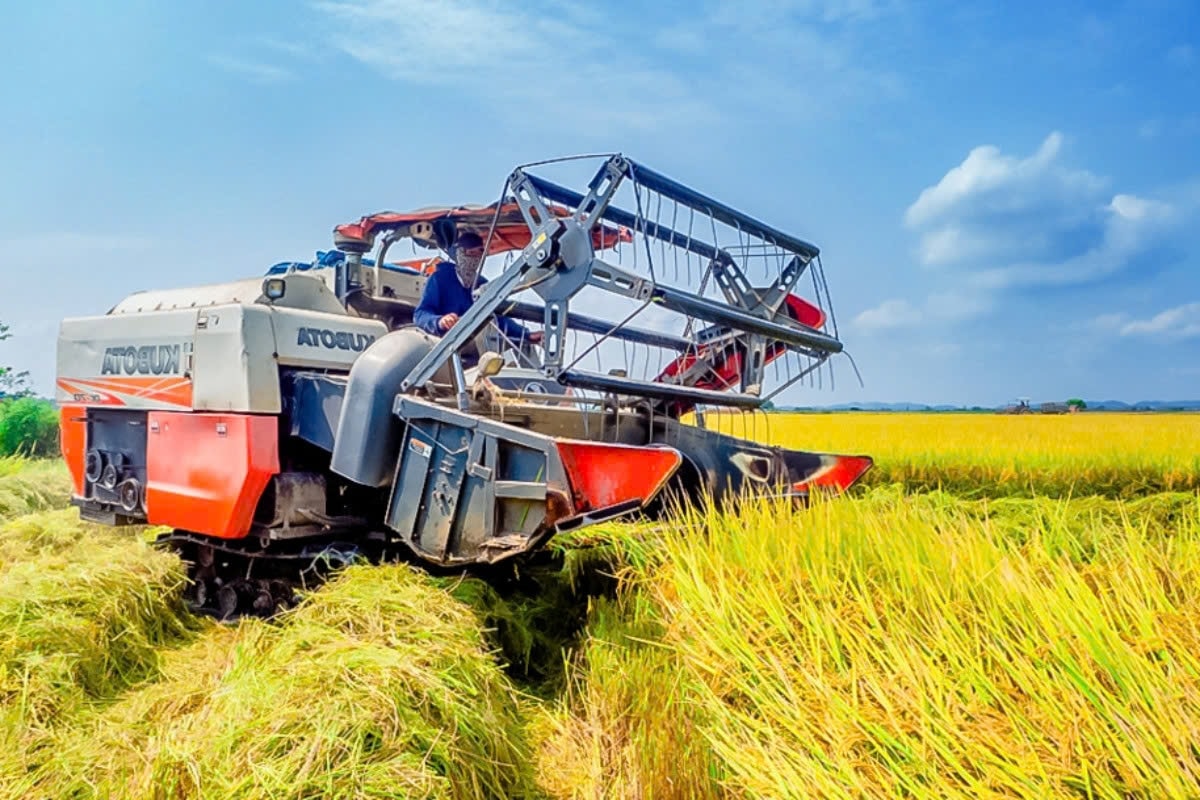
Similarly, regarding rice, according to updates from the Department of Agriculture and Rural Development of An Giang province, the price of IR 504 raw rice is currently fluctuating at 7,500 - 7,600 VND/kg; finished IR 504 rice has decreased by 200 VND/kg, fluctuating at 9,800 - 10,100 VND/kg.
According to reports from various localities today, while the volume of transactions is relatively high, new transactions have decreased. In Lap Vo - Vam Cong (Dong Thap), transactions are weak, prices have fallen sharply, and warehouses are slow to buy, resulting in low prices for all types of goods. In Sa Dec (Dong Thap), the volume is sporadic, and warehouse prices have decreased slightly for all types of goods.
At Sa Dec market (Dong Thap province), the supply is low, rice warehouses are slow to buy, and prices of all types of rice have decreased. In An Cu (Cai Be district, Tien Giang province), the supply is sporadic, there are few buyers, and prices of all types of rice have fallen.
At retail markets, rice prices remained relatively stable compared to yesterday. Regular rice prices fluctuated between 16,000 and 17,000 VND/kg. Currently, Nang Nhen rice has the highest listed price at 28,000 VND/kg; fragrant rice is offered at higher prices ranging from 20,000 to 22,000 VND/kg; Jasmine rice at 18,000 to 20,000 VND/kg; Nang Hoa rice at 21,500 VND/kg; long-grain Thai fragrant rice at 20,000 to 22,000 VND/kg; Huong Lai rice at 22,000 VND/kg; common white rice at 17,500 VND/kg; Taiwanese fragrant rice at 21,000 VND/kg; regular Soc rice at 18,500 VND/kg; Soc Thai rice at 21,000 VND/kg; and Japanese rice at 22,500 VND/kg.
Regarding by-products, the price of fragrant rice bran in localities decreased by 200 VND/kg compared to the previous day and was traded at 7,200 – 7,400 VND/kg, while the price of dry rice bran remained stable at around 5,950 – 6,050 VND/kg.
Export rice prices
On the export market, Vietnam's rice export prices today decreased slightly compared to the end of last week. According to the Vietnam Food Association (VFA), the current price of 5% broken rice is 467 USD/ton; 25% broken rice is 437 USD/ton; and 100% broken rice is 327 USD/ton.
While rice prices have been rising for the past two Lunar New Year seasons, bringing joy to farmers, this year the opposite is true, with prices continuously falling. Mr. Nguyen Thanh An, a farmer from Tan Tuyen commune (Tri Ton district, An Giang province), said: "Currently, it's only the beginning of the winter-spring crop season, but rice prices are continuously decreasing, now only around 7,000 - 7,200 VND/kg. The current price is also about 1,500 VND/kg lower than last year's winter-spring crop."
Mr. Nguyen Vinh Trong, Business Director of Viet Hung Co., Ltd. (Tien Giang), confirmed: Many of Vietnam's key export rice products, such as OM 5451, which previously cost 640-650 USD/ton, will only cost around 560 USD/ton by the end of 2024 and are currently priced at around 540 USD/ton.
Similarly, the price of DT8 rice, which was previously between 660 and 670 USD/ton, decreased to 570 USD/ton by the end of 2024 and is currently around 550 USD/ton.
According to Mr. Nguyen Van Thanh, Director of Phuoc Thanh IV Co., Ltd., the price of rice has fallen because major markets such as the Philippines, Indonesia, and China have not shown any signs of buying, leading to a lack of buyers. This forces sellers to lower prices to increase supply, creating a vicious cycle that further reduces prices.
This vicious cycle is strongly influenced by the abundant supply from the Indian market after more than a year of export restrictions.
Notably, at present, not only are exports facing difficulties, but domestic consumption is also slowing down, as many businesses had already prepared their goods for the Lunar New Year.
For India, the world's largest rice exporter, they dominate the African market with low prices, making it difficult for Vietnamese rice to compete. India also has a trade agreement for 1 million tons of non-basmati rice with Indonesia. "Most of the current market information for rice is favorable to buyers."
Mr. Do Ha Nam, Vice Chairman of the VFA, noted that global rice demand will remain high in 2025, especially in the Philippines, but financial support policies are needed for businesses to purchase and stockpile rice. At the same time, it is necessary to improve quality and build brands to reduce dependence on a few markets.
"In the past, policies supporting capital and interest rates required businesses to have contracts for both input and output. This is a difficult point that needs to be addressed. Besides that, we must also face the reality that we are dependent on a few markets. In the long term, we need to improve quality and build rice brands to diversify markets," Mr. Do Ha Nam stated.


