
'Rescuing' bananas and the lessons in plant breeding.
While many "rescue" efforts are underway to help banana farmers in Dong Nai and other southern provinces due to unsold bananas, at Pham Nang Thanh's banana plantation (Khoai Chau district, Hung Yen province), one of the largest in the North, there is "no bananas to sell".
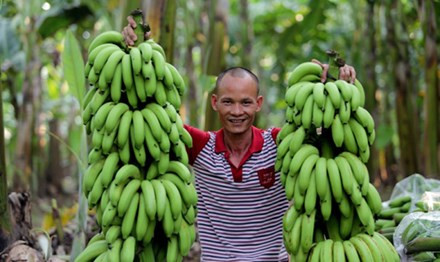 |
| The "Banana King" of Northern Vietnam said that even though bananas are unsaleable in the South, he doesn't have any to sell in the North. |
Dubbed the "banana king" of Northern Vietnam, Mr. Thanh said that he currently owns over 60 hectares of banana plantations in Hung Yen (not including areas under contract), with an annual production of 3-4 thousand tons. The price of bananas in the North has been around 10,000 VND/kg since the middle of last year, and there are almost no bananas available for sale.
According to Mr. Thanh, his pink banana plantation is mainly for domestic consumption in supermarkets and markets, with a portion exported to Russia, South Korea, and a few Middle Eastern countries, and he "almost doesn't care whether China buys or not" and how that might affect his banana crop.
According to Mr. Thanh, the reason why bananas from Dong Nai farmers are unsaleable is because they are Cavendish bananas (also known as South American Cavendish bananas), which are mainly grown for export to China. So when China stopped buying, naturally, they became unsaleable.
Although it's still a type of banana, if farmers grow pink bananas, it will be much safer, the price will be up to three times higher, and the market is very large, especially domestically where demand is very high.
According to Mr. Thanh, if farmers in Dong Nai grow pink Cavendish bananas, with his current distribution network in the North, he could support them by purchasing one 20-ton container daily for domestic sale, as demand is very high. However, that South American Cavendish banana variety is indeed very difficult to sell.
"The South American Cavendish banana variety has a higher yield than the pink Cavendish banana, and a shorter harvesting time, but the quality is not as good; it tastes blander. Sometimes the bananas are so big, with bunches weighing up to 50-70 kg, that people are sometimes hesitant to buy them," said Mr. Thanh.
According to him, with the banana varieties that farmers in the South are growing in large quantities, exporting them requires cooperative farming with someone in charge. In particular, they must be grown in concentrated areas, with a period of time between crop use and pesticide application, and mass production ensures attractive packaging for export. Doing it the way farmers in Trang Bom (Dong Nai) do makes exporting very difficult.”
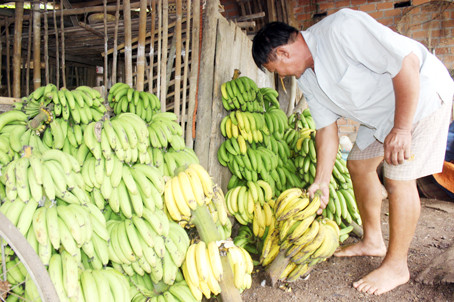 |
| Residents of Thong Nhat and Trang Bom districts (Dong Nai province) are facing difficulties as traders are forcing down prices and refusing to buy bananas. |
According to the "banana king" of Northern Vietnam, if farmers continue to grow bananas haphazardly and without concentration, they won't be able to export them. This isn't just true for bananas; many other fruits are the same, leading to a situation where there's always a shortage and an oversupply.
Therefore, farmers must form cooperatives, cultivate on a large scale, use the same variety, and keep clear records of when to spray pesticides and when to fertilize. A quarantine period is necessary after harvesting; we cannot be careless with our practices compared to foreign countries.
According to the "banana king" of Northern Vietnam, even he has to cooperate with cooperatives and businesses that purchase his produce. He said: "The important thing is the technique; we take care of the inputs and outputs. One or two months before harvest, we sign contracts and put down deposits with farmers, buying at market prices so they can rest assured. You can't just make empty promises. Once we've signed a contract to secure the output, I'm responsible for the price, regardless of whether it's expensive or cheap."
According to TPO


