
Rescuing the Thai football team: Media heavily criticized.
(Baonghean.vn) - In a race to be the first to report and share photos of the rescue operation of 12 boys and their coach from Tham Luang cave in Mae Sai district, Chiang Rai province, Thailand, some media outlets went beyond acceptable limits when gathering information.
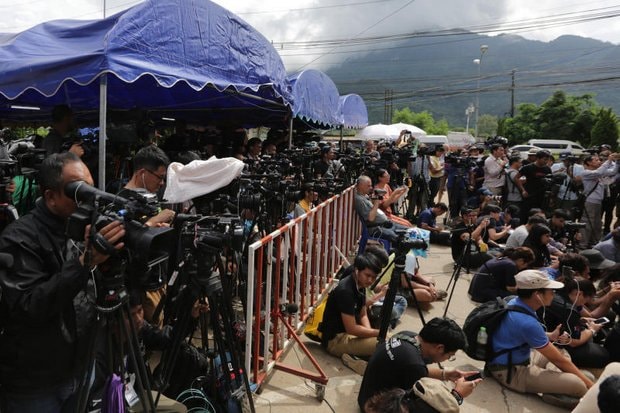 |
| Media gathered at the press conference of rescue operation coordinator Narongsak Osottanakorn. Photo: Bangkokpost |
This has led to public criticism of the journalists involved and raised questions about the ethical values and professionalism of the channels and publications.
In particular, on July 8th, two instances of media abuse of power occurred, igniting public anger: they used drones to approach helicopters carrying out rescue operations and interfered with radio communications of those on duty.
The third rescue operation for the Thai football team has begun, with efforts to save the remaining five members.
(Baonghean.vn) - Divers and rescue workers in Thailand have begun what may be their last effort to rescue four boys and their football coach still trapped in a cave in the northern part of the country. This information was provided by a Thai Navy official familiar with the operation.
A news channel, in an attempt to photograph the first four boys rescued from the flooded cave, flew its drone close to the helicopter used to transport the boys to a hospital in Chiang Rai. The drone operator claimed to have obtained permission from an air force officer, but the Royal Thai Air Force (RTAF) later denied this.
RTAF is cooperating with the Civil Aviation Authority of Thailand (CAAT) to further investigate the incident.
Another incident that caused a stir involved a television news channel broadcasting a conversation between officers involved in the operation, which was obtained by interfering with their radio signals.
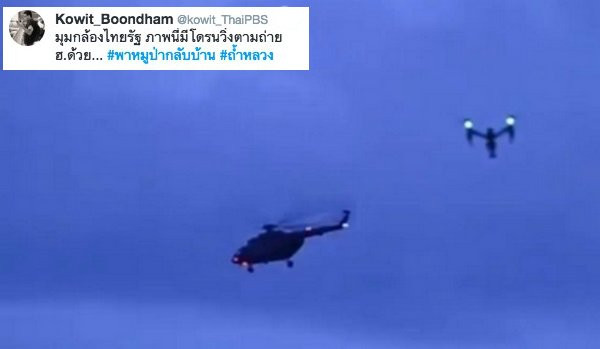 |
| A news channel's use of a drone to approach a helicopter on a mission on July 9th has drawn strong criticism from the public. (Photo: Facebook) |
Major General Churat Pan-ngao, deputy commander of the 5th Regional Police of Chiang Rai province, who oversaw the media team stationed in the cave, ordered them on July 9 to stop trying to gather information using the aforementioned methods.
Major General Churat stated that if they continue to do so, he will consider whether their actions are illegal. If they are illegal, he will seek to prosecute those media outlets.
Banyong Suwanpong, a member of the ethics committee of the Thai Journalists Association (TJA), argues that the media needs to maintain professional and consistent ethical values when reporting, no matter how breaking the news may be.
“They must respect the officers and work in a way that does not interfere with the rescue operation or those involved. They must also respect the rights and privacy of individuals, especially teenagers and their relatives,” Banyong said, referring to the latest media reports from Tham Luang cave.
Furthermore, he argued that journalists have a responsibility not only to their media organizations but also to the Thai community, and should not focus solely on being the first to get the information.
He added that to prevent the media from overstepping its boundaries, the owners and operators of each news channel need to establish clear policies and regulations for reporters to follow. “Competition is normal; I understand everyone wants to make a profit. But it doesn’t have to be selfish. The right methods are needed, not infringement on the rights of others.”
"It's not necessary to compete to be the fastest."
Regarding questions about the order in which the boys were rescued, Dr. Boonruang Triruangworawat, Director-General of the Department of Mental Health at the Thai Ministry of Public Health, affirmed that the families had never questioned the rescue plan at any point. Dr. Boonruang stated that the order was determined based on each boy's physical condition, and those requiring the most medical care were prioritized.


