
Unraveling the mystery of the origin of the giant pile of pebbles in Morocco.
The origin of a massive pile of boulders in Morocco, upon which a small village sits precariously, has long been a mystery to scientists.
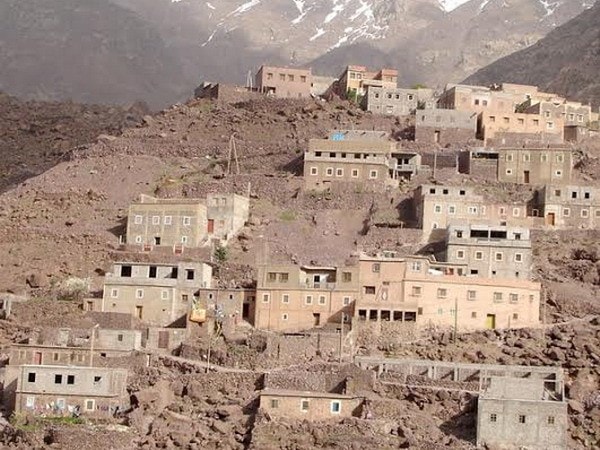 |
| The village sits atop the Arroumd landslide area in the Atlas Mountains of Morocco. (Source: livescience.com) |
But now, the mystery has been solved: this pile of rocks is the result of a catastrophic landslide that occurred 4,500 years ago in the high mountains of the Atlas Mountains.
Scientists have analyzed the remains of one of the largest rubble sites in North America, the Arroumd landslide site northwest of Aksoual, a 3,912-meter-high mountain in the Atlas Mountains of Morocco.
A village is currently situated atop this rocky outcrop at an altitude of approximately 2,000 meters.
The origin and age of Arroumd have puzzled scientists for over 135 years. Previously, researchers believed the rock formation was part of an glacial deposit—rocks and sediments from a glacier.
Conversely, the study's lead author, Philip Hughes, a geomorphologist from the University of Manchester (UK), hypothesizes that Arroumd is the result of a rockslide that occurred after the glacier flowing through the valley melted.
To unravel the mystery of Arroumd, Hughes and his colleagues dated the rocks there. They examined the isotopic content of beryllium-10, a substance often produced when cosmic rays strike quartz on the surface of rocks.
The isotopic content will indicate when these rocks were exposed to the air, as well as when the sediments were formed.
The inspection results were surprising: the rockslide occurred after the glacier melted.
"The glacier melted 11,700 years ago at the end of the last ice age. However, the cliffs only collapsed about 4,500 years ago, so the rockslide wasn't caused by the glacier melting itself."
Instead, scientists suspect the rockslide was caused by geological activity because it is located very close to an area prone to tectonic activity.
“I didn’t expect the rockslide to happen so late. But I’m always ready to take on challenges and look back, and hopefully improve on my previous research. That’s science,” Hughes shared.
Glacial erosion may have made the cliffs steeper, creating conditions for rockslides. “It’s possible that valleys once had glaciers flowing through them collapsed due to an earthquake, heavy rain, or both. In the European Alps, there is evidence of a similar series of landslides occurring around the same time, and a recent study also indicated that the landslides were caused by extremely heavy rainfall,” Hughes added.
Arroumd is a very difficult place to work, Hughes said. “There have been a few minor accidents in the research area, and some people who have gone there have mysteriously fallen ill. I often joke with people about a ‘curse’ in Arroumd.”
This year we encountered several tornadoes upon entering the valley, just days after the study was published. We couldn't stand because the wind was so strong, which is very unusual considering this area has a warm and temperate climate.
According to VNA


