
Solutions to improve the quality of Party branches in commune and ward offices.
(Baonghean) - Having been selected as a pilot location for establishing Party branches in commune, ward, and town offices according to Guidance No. 10-HD/BTCTW dated October 10, 2007, of the Central Organization Committee, the Party branches in commune and ward offices in Vinh City have effectively promoted positive results and successfully fulfilled their role as the political nucleus at the grassroots level.
Comrade Dang To Duyet, Deputy Head of the Vinh City Party Committee's Organization Department, said that before the issuance of Guidance No. 10 by the Central Organization Department, Party members working in commune and ward offices in the city all participated in activities at the Party branches in their residential areas.
Party activities in residential areas facilitate Party members' engagement with reality, understanding the thoughts and aspirations of the people, and gathering information from the grassroots to support leadership work. However, Party members who are commune and ward officials and civil servants also face difficulties when participating in Party activities in their residential areas. Party branches in hamlets and villages only manage Party activities and do not directly assign tasks to Party members who are commune and ward officials and civil servants; they cannot inspect or supervise these Party members at their workplaces. At the end of the year, when evaluating and ranking Party members, Party branches face difficulties because they do not have a clear understanding of the progress and training of these Party members who are commune and ward officials and civil servants. When these Party members commit violations in their professional duties, the Party branches in hamlets and villages also lack the specific information to handle the situation.
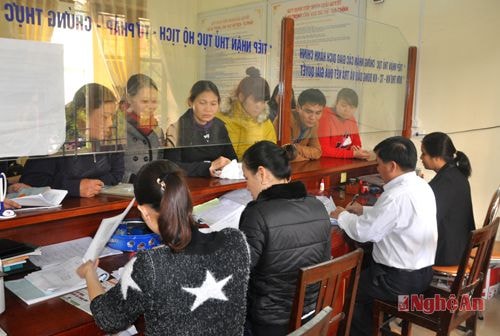 |
| Transactions at the one-stop service center in Ha Huy Tap ward (Vinh City). Photo: Thanh Le |
To address these shortcomings, following guidance from the Central Organizing Committee, the City Party Committee directed all communes and wards to establish Party branches in their respective agencies. To date, 23 out of 25 commune and ward Party committees have established agency Party branches, managing 568 Party members out of a total of 16,072 Party members in these communes and wards. Sixteen of these agency Party branches have also established mass organizations: veterans' associations, youth unions, women's associations, and grassroots trade unions. The agency Party branches in communes and wards have played a leading role in advising the Party committees on the effective implementation of local political tasks. Since the establishment of agency Party branches, Party members working in communes and wards have been more closely managed, assigned more specific tasks, and their year-end evaluations and rankings have been more accurate.
The Party cell of the Le Mao ward's administrative office, established in 1995, currently has 26 party members. It is a model cell that actively advises the Party Committee on the development of Le Mao ward. Party Secretary Hoang Thi Thanh explained: “The Party cell of the administrative office is the leading unit advising the ward's Party Committee on the issuance and implementation of resolutions, and is the place where tasks are assigned and party members are most closely monitored… During this process, the cell also assigns party members to regularly stay close to the grassroots to understand the situation and provide timely advice in the ward's leadership and management.” Based on the resolutions of the Party Committee and the Party cell, specific tasks are assigned to each party member according to their responsibilities; from the secretary and chairman to every official and employee of the ward, all strictly implement the Party cell's resolutions. Over 20 years of operation, the Party cell of the ward's administrative office has become increasingly effective.
At the Hung Dong Commune Party Committee, thanks to the exemplary role of 23 Party members in the commune's Party branch, the commune has successfully led the people in implementing the new rural development campaign, placing it among the top communes in the province in achieving all 19 criteria for new rural development. Comrade Tran Duc Dinh, Deputy Secretary of the Commune Party Committee, stated: “The fundamental measure to improve the quality of the commune's Party branch activities is to promote the exemplary role of Party members, especially those holding leadership positions. Under the close supervision of the Party branch, Party members who are officials and civil servants of Hung Dong commune not only perform their duties well at their workplaces but also demonstrate exemplary roles in their residential areas.”
The role of the Party branch in the agency is also evident in the Le Loi Ward Party Committee, which has achieved the title of "clean and strong" for six consecutive years, with a significant contribution from the 21 Party members in the agency's Party branch. Comrade Vo Dinh Than, Member of the Standing Committee of the Party Committee, Chairman of the Fatherland Front, and Secretary of the Le Loi Ward Agency Party Branch, said: "To promote the role of the agency's Party branch, every month we review the work done by each Party member in the previous month, clearly assessing strengths and weaknesses, and on that basis assigning tasks for the next month. For Party members who are leaders, if there are any unsatisfactory tasks, the Party branch reminds them, and any unclear issues must be explained to the Party branch. With this approach, Party branch meetings are very lively, and Party members enthusiastically participate."
However, surveys have revealed that alongside effective Party branches in commune and ward offices, some branches are still facing difficulties. Some branches are struggling with issuing resolutions, failing to concretize Party committee resolutions into branch resolutions; some Party members working in these offices are detached from reality, not connected to the grassroots, and even bureaucratic and distant from the people. Some weak Party branches have had to be dissolved.
For example, the Party Branches of Nghi Kim and Nghi An communes. The Nghi Kim commune Party Branch, established in October 2007, was dissolved in December 2012. According to Nguyen Van Khiem, Deputy Secretary of the commune Party Committee, Party members in the commune Party branch easily become detached from the grassroots, failing to grasp information from practical situations, and the branch's resolutions often blindly follow the Party Committee's resolutions. Faced with this reality, the Nghi Kim commune Party Committee decided to dissolve the commune Party branch and transfer its members to their residential areas to strengthen the village Party branches. This included two weak branches where the Youth Union Secretary and the Head of the commune's security force were appointed as secretaries. Similarly, the Nghi An commune Party Branch, established in October 2010, was dissolved in February 2013.
The reason for the dissolution was explained by the Party Secretary of the commune, Nguyen Van Thanh: “The branch's resolutions often simply copied the content of the Party Committee's resolutions. During branch meetings, party members didn't know what to say beyond the opinions already discussed at meetings of the Party Committee, government, and mass organizations that had been implementing tasks since the beginning of the month. Party members' activities were concentrated at the office, thus distancing them from the grassroots, while the village branches lacked core cadres, resulting in low-quality meetings.” The experience of Nghi Kim and Nghi An communes shows that maintaining effective operation of the office branch requires strengthening and building the branch at the block and village levels.
In a discussion with us about the effectiveness of Party branches in commune and ward offices in Vinh City, the Deputy Secretary of the Vinh City Party Committee, Comrade Nguyen Hoai An, frankly stated: “The reality proves that the establishment of Party branches in commune and ward offices is completely correct and appropriate to the current conditions. However, the dissolution of Party branches that are ineffective after establishment is problematic. Weak Party branches in offices are due to weak Party organizations, not due to regulations on organizational structure. The City Party Committee will focus on strengthening these weak branches to build increasingly strong Party branches in commune and ward offices.”
Recently, the Central Organizing Committee issued Guidance No. 28-HD/BTCTW, replacing Guidance No. 10 of 2007, regulating the organization and operation of Party branches in commune, ward, and town offices. Accordingly, each commune, ward, and town shall establish a Party branch in its office, provided that each residential area has a Party branch in its block or hamlet, and each branch has at least 9 Party members; the deputy secretary or a member of the Party Standing Committee of the Party Committee serves as the secretary of the Party branch in the commune, ward, or town office; Party members participating in the Party branch in the commune, ward, or town office must be cadres or civil servants, not part-time cadres; Party members working in the commune, ward, or town office must maintain regular contact with the Party branch in their block or hamlet and set a good example in fulfilling their civic duties in their place of residence. Strict adherence to these regulations will ensure that the Party branches in commune, ward, and town offices both effectively fulfill their leadership role within the office and maintain close ties with the grassroots…
Tran Hong Co


