
Lowering lending interest rates to support businesses.
At the State Bank of Vietnam's (SBV) press conference on monetary policy direction for the remaining months of the year, held on the afternoon of August 11th, Ms. Nguyen Thi Hong, Deputy Governor of the SBV, stated that the regulatory body will strive to reduce lending interest rates to support businesses.
Interest rates are relatively stable.
Mr. Nguyen Duc Long, Deputy Director of the Monetary Policy Department (State Bank of Vietnam), stated: To implement the policy of reducing interest rates and alleviating difficulties for businesses, since the end of May 2016, the State Bank of Vietnam has required credit institutions to balance their mobilized and utilized capital, reduce operating costs, and improve business efficiency to create conditions for reducing lending interest rates. The State Bank of Vietnam has also issued a circular amending regulations on safety ratio limits in the operations of credit institutions, which gradually reduces the ratio of short-term capital used for medium and long-term lending according to a roadmap to limit liquidity risk, contributing to reducing interest rate pressure on credit institutions from now until the end of the year.
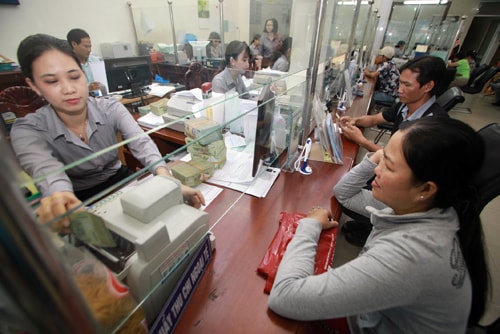
Customers conducting transactions at the bank. Photo: Tran Viet/TTXVN |
Therefore, according to Mr. Long, the lending interest rates of credit institutions have remained relatively stable so far. Since the end of April 2016, state-owned commercial banks and some joint-stock commercial banks have reduced short-term lending interest rates by 0.5% per year and brought medium and long-term lending interest rates down to a maximum of 10% per year for customers borrowing capital for production and business purposes.
“This is a testament to the banking sector's efforts because, since the beginning of the year, many economic experts as well as the State Bank of Vietnam (SBV) have predicted that inflation would rise again, making stable interest rates an extremely difficult task. Meanwhile, at the beginning of the year, some banks even increased deposit interest rates due to concerns about implementing Circular 36 with its new regulations on limits and safety ratios in the operations of credit institutions and branches of foreign banks. Subsequently, the SBV issued amendments to Circular 36, helping to alleviate concerns and pressure regarding interest rates,” Deputy Governor Nguyen Thi Hong assessed.
To implement the government's policy of continuing to remove difficulties for businesses and striving to reduce lending interest rates, the State Bank of Vietnam has also implemented appropriate money supply and withdrawal policies to ensure reasonable liquidity. In the interbank market, interest rates are also managed at an appropriate level to prevent banks from pushing interest rates up.
According to the State Bank of Vietnam's report, the prevailing VND lending interest rate for priority sectors is 6-7% per year for short-term loans. State-owned commercial banks apply common interest rates of 9-10% per year for medium and long-term loans to priority sectors. Interest rates for loans to general production and business sectors are 6.8-9% per year for short-term loans and 9.3-11% per year for medium and long-term loans. For good customers with sound and transparent financial situations, short-term lending interest rates are 5-6% per year. USD lending interest rates are commonly 2.8-6.2% per year; with short-term rates at 2.8-5.2% per year and medium- and long-term rates at 5.1-6.2% per year.
However, some argue that, with the aforementioned lending interest rate framework, businesses will still face difficulties due to fluctuating and rising input costs and reduced profit margins. Therefore, the business community still expects further reductions in lending interest rates from now until the end of the year.
Non-performing loans decreased to 2.58%.
According to the State Bank of Vietnam (SBV), by the end of June 2016, the non-performing loan (NPL) ratio of the entire banking system was 2.58%, a decrease compared to 2.78% in May 2016. According to data reported by the Vietnam Asset Management Company (VAMC), the total amount of non-performing loans processed in the first six months of the year reached VND 59.71 trillion, a decrease of 14.55% compared to the same period last year. Of this amount, VND 8.88 trillion was sold to VAMC, VND 30.98 trillion was repaid by customers, and VND 7.24 trillion was used to handle bad debts.
However, Mr. Doan Van Thang, Deputy General Director of VAMC, affirmed that the biggest obstacle in VAMC's handling of bad debts currently lies in the bad debt trading market. According to regulations, the sale of bad debts by state-owned enterprises can only be carried out with units that have the function of trading bad debts. This is a limitation for VAMC.
Mr. Thang explained that currently, the debt trading market is mainly dominated by VAMC, the Vietnam Debt Trading Company (DATC), and about 28 asset management companies (AMCs) of commercial banks. However, the AMCs of credit institutions still have many limitations in their operations. Thus, the buying and selling of bad debts in the market is mainly handled by VAMC and DATC.
“The government has just issued Decree 69/2016/ND-CP regulating the conditions for conducting debt trading services. Hopefully, in the future, when this Decree comes into effect, businesses with the function of trading bad debts will develop,” said Mr. Doan Van Thang.
According to Minh Phuong/baotintuc


