
Minimize customs fees for businesses.
National Assembly Vice Chairwoman Nguyen Thi Kim Ngan wants the draft Law on Customs (amended) to help minimize customs compliance costs for businesses when importing and exporting goods.
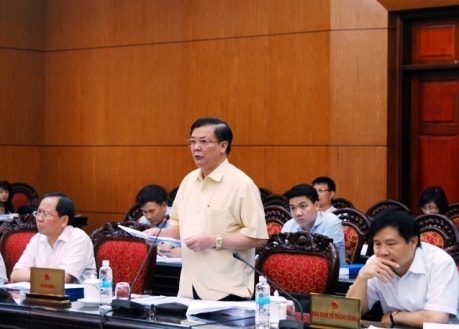
Minister Dinh Tien Dung presents the draft Customs Law. Photo: VGP/Thanh Chung
Minister Dinh Tien Dung presents the draft Customs Law. Photo: VGP/Thanh Chung. On the morning of August 15, the Standing Committee of the National Assembly gave its opinion on the draft Customs Law (amended), presented by Minister of Finance Dinh Tien Dung on behalf of the Prime Minister.
Over the years, customs administrative procedures have been clearly defined, transparent, simplified, and streamlined, facilitating the clearance of goods and means of transport with significantly reduced time and costs, contributing to enhancing the competitiveness of businesses.
From 2009 to the present, the Customs sector has completed the review, systematization, and public disclosure of 239 procedures. Subsequently, further review, simplification, abolition, and consolidation have been carried out, resulting in 179 administrative procedures remaining, estimated to reduce compliance costs by hundreds of billions of VND each year.
To further facilitate businesses in carrying out customs procedures, the draft revised Customs Law clearly stipulates that customs officers must examine customs documents within a maximum of 2 working hours; reduce the time for physical inspection of goods to 8 hours; and, if necessary, extend the period for a maximum of 2 working days.
At the same time, to reduce unnecessary paperwork for individuals and organizations, the draft Law has introduced a general regulation stating that customs documents, including the customs declaration form, are mandatory. For other documents in the customs dossier, the submission and presentation of these documents will depend on the specific case.
In fact, over the past period, administrative reforms in the customs sector, coupled with the application of modern customs management methods, have helped total import and export turnover increase rapidly over the years (import and export turnover in 2010 reached US$157 billion, an increase of 23.6%; in 2011 it reached US$203.1 billion, an increase of 29.7%; and in 2012 it reached US$228.3 billion, an increase of 12.1% compared to the previous year). Minister Dinh Tien Dung believes that amending the current Customs Law will continue to strongly promote import and export activities in the coming time.
Regarding this issue, National Assembly Vice Chairwoman Nguyen Thi Kim Ngan expressed her hope that the draft law would minimize customs procedure costs. At the same time, she requested that the draft law maximize transparency in customs procedures while still ensuring effective state management and building a friendly image of customs for businesses involved in import and export of goods.
Commenting on the draft, members of the National Assembly Standing Committee also requested the Ministry of Finance to continue reviewing and supplementing the provisions of the draft Law to conform with international treaties, especially the Trans-Pacific Partnership Agreement (TPP) that Vietnam is currently negotiating, in order to avoid having to amend the law later to comply with the Agreement.
One noteworthy point is that the draft proposal allows customs control forces to pursue vehicles carrying smuggled or illegally transported goods across the border if there is evidence to suggest that the vehicle is moving from within the customs operational area to outside the customs operational area. Simultaneously, customs forces are also permitted to employ reconnaissance, patrol, and the use of weapons and support tools to prevent and combat smuggling.
Regarding this issue, Deputy Speaker of the National Assembly Huynh Ngoc Son suggested amending the Ordinance on the Management of Weapons and Explosives to allow customs officials to exercise this right. At the same time, Mr. Son argued that "it is necessary to specifically regulate who authorizes customs officials to fire their weapons, and to what extent and at what level the pursuit of vehicles transporting smuggled goods should be carried out to avoid overlapping with the duties of other forces."
Regarding the customs apparatus, the members of the Standing Committee of the National Assembly agreed with the Ministry of Finance on organizing it at the following levels: General Department of Customs; Customs Department; Customs Sub-department and equivalent units. This organizational system does not depend on administrative boundaries but on the requirements of the work; the scale and nature of import and export activities; the specific characteristics of the area, and socio-economic conditions.
Essentially, the Customs Department has a regional character, encompassing the territories of multiple provinces; in exceptional cases, to suit mission requirements and international practices, two Customs Departments may be located within the territory of a single province or centrally-administered city.
According to Chinhphu.vn - LT


