
If we reduce the number of official vehicles, what will happen to the surplus drivers?
After reducing the number of official vehicles, the surplus drivers need to be retrained and reassigned; if they are unable to perform their jobs, they must be laid off.
The Prime Minister has just issued Directive No. 31/CT-TTg on strengthening management and improving the efficiency of public asset utilization.
One of the contents of the Directive is to request the Ministry of Finance to urgently submit to the Prime Minister amendments and supplements to Decision No. 32/2015/QD-TTg dated August 4, 2015, of the Prime Minister, in which the unit price for the allocation of funds for the use of automobiles should be revised to suit each group of positions with standards for use and the quota of automobiles for general work; striving to reduce the number of automobiles for general work currently equipped for ministries, sectors, and localities by about 30% - 50% by 2020, except for units in mountainous areas, islands, and areas with special difficulties.
Simultaneously, determine the roadmap for implementing the system of fixed allowances for the use of automobiles applicable to the positions of deputy ministers and equivalent, and automobiles used for general work.
Speaking to the press, National Assembly representative Luu Binh Nhuong - Standing Member of the National Assembly's Committee on Social Affairs - expressed his full support for the Prime Minister's directive, as the current use of official vehicles is still wasteful.
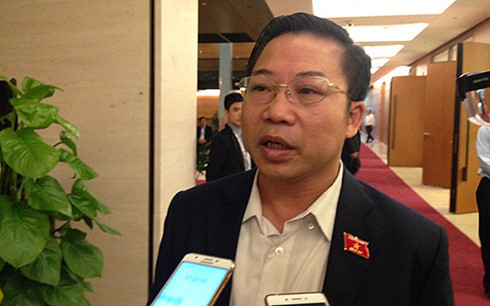 |
| National Assembly representative Luu Binh Nhuong |
According to the plan, the Prime Minister has assigned the Ministry of Finance to coordinate with other ministries and agencies to develop a project that must reassess the current state of government vehicle usage, as well as address issues related to labor, social security, and especially job creation for the current drivers of ministries, central government agencies, and local authorities.
“Regarding the issue of reducing the number of government vehicles, we could consider auctioning off the surplus vehicles. In my opinion, the important issue is providing employment for the surplus drivers currently working in state agencies. We need to carefully study the specific characteristics of this group of drivers to retrain them for reassignment; if they cannot meet the requirements, we will implement downsizing,” Mr. Nhuong stated.
Representative Pham Tat Thang, Deputy Chairman of the National Assembly's Committee on Culture, Education, Youth, and Children, also emphasized two factors related to this issue: means of transportation and labor.
Regarding vehicles, according to Mr. Thang, after reviewing and calculating the usage needs of each agency, the number of vehicles that need to be reduced will be auctioned off to recover a portion of the assets for the state.
Furthermore, it is necessary to study appropriate methods for contracting out the use of official vehicles to encourage those who meet the criteria to use official vehicles to do so. In addition, strict regulations on the procurement of official vehicles are needed to prevent an increase in the number of official vehicles in the future.
In particular, reducing the number of official vehicles will lead to a surplus of drivers, therefore reorganizing the workforce is crucial. The National Assembly representative from Vinh Long province suggested that drivers with long years of service and older age should be encouraged to retire early. For drivers with remaining years of service, training programs should be implemented to facilitate career changes or reassignment to other jobs. If they cannot meet the requirements, agencies and units should decisively terminate their contracts to streamline staffing.
"To implement the Prime Minister's Directive by 2020, there are only a little over three years left. Therefore, a very strong political will is needed from management agencies such as the Ministry of Finance, the Ministry of Planning and Investment, and the Ministry of Interior. They must soon provide guidance and a specific roadmap outlining how many vehicles and people will be reduced each year in order to achieve the set goals," emphasized delegate Pham Tat Thang.
According to VOV


