
The arduous journey to the "Gateway to Heaven"
During our business trips to the western districts of Nghe An province, we mostly traveled on local buses. This is also the choice of many passengers because of its affordable price compared to motorbike taxis, and because they don't have to struggle with the mud and potholes of unfinished roads. However, given the challenging terrain and weather conditions, these bus routes actually pose significant dangers.
(Baonghean.vn) -During our business trips to the western districts of Nghe An province, we mostly traveled on local buses. This is also the choice of many passengers because of its affordable price compared to motorbike taxis, and because they don't have to struggle with the mud and potholes of unfinished roads. However, given the challenging terrain and weather conditions, these bus routes actually pose significant dangers.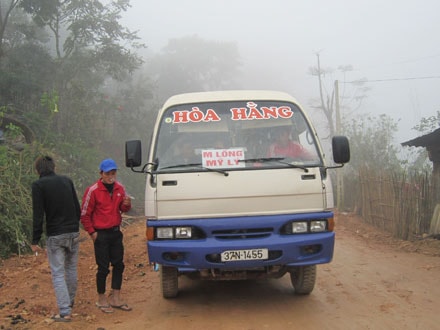
The passenger bus prepared for its journey through the thick fog.
Some typical routes include National Highway 48C connecting Tuong Duong and Quy Hop districts with dozens of landslide points; and the Kim Son-Tri Le (Que Phong) route crossing Bu Chong Cha, shrouded in fog with dozens of hairpin bends. But when it comes to difficulty and danger, the Muong Xen-Muong Long-My Ly route certainly deserves the "first prize".
At the end of the year, tasked with writing a feature on "Spring on the Border" for the Spring issue of the newspaper in the year of the Dragon (2012), we decided to go to My Ly (Ky Son), a commune located at the headwaters of the Nam Non River and boasting the longest border in the province (over 40 km). Upon arriving in Muong Xen town, we borrowed a motorbike from a friend and intended to ride it alone to enjoy the scenery of the border region as spring began to arrive. However, another friend strongly discouraged us: "I just came back from there yesterday afternoon. The road to My Ly is muddy, slippery, and covered in fog; you're not familiar with the terrain and probably won't be able to make it. It's best to go by bus; it's warmer and you won't have to worry about slippery roads and fog."
Following the advice, we left our motorbike behind and boarded a passenger bus displaying a sign that read Muong Long - My Ly, which was picking up passengers on National Highway 7A. We boarded just as all the seats were occupied. At this point, most passengers were already bundled up in warm coats, scarves, masks, and gloves. Seeing that we weren't prepared, an elderly Khmu man from Bac Ly commune reminded us: "You won't be able to withstand the biting cold in Muong Long, the 'gateway to heaven,' dressed like that!"
After crossing the Huồi Lội bridge, upon reaching Piêng Phô village (Phà Đánh commune), the road began to bounce and jolt due to potholes and ruts. The route from Mường Xén town to the northwestern communes of Kỳ Sơn district, such as Keng Đu (70 km), Mỹ Lý (60 km), Bắc Lý (50 km), Mường Lống (45 km), and Huồi Tụ (30 km), despite being expanded and upgraded, remains difficult and challenging to travel on. This stems from several reasons: delays in construction by contractors, landslides caused by heavy rains and floods, and rugged terrain. Therefore, except for some sections that have been paved and are relatively easy to travel on, most of the road remains muddy and slippery.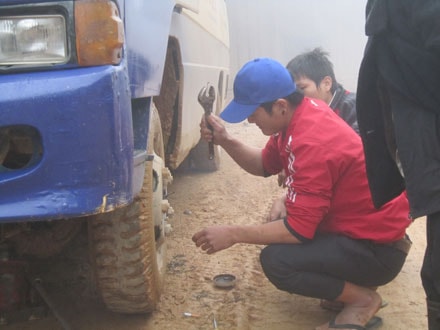
Stopped at the top of Huoi Dun slope to adjust the brakes.
From the area of Pha Danh commune, passengers could already sense the vehicle beginning to ascend. The road became steeper, more winding, and more treacherous, with increasingly dense fog and mist. Approaching the border between Pha Danh and Huoi Tu communes, the number of unfinished road construction sections increased, making the young driver of Hoa Hang bus company (Muong Xen town) work harder than ever. Mostly influenced by the climate of neighboring Laos, Ky Son district is currently in the dry season. However, this doesn't mean the air here is completely dry. During this season, Ky Son is always covered in thick fog, with some villages even shrouded in mist all day long. The dense fog forms droplets that fall on the rooftops like a persistent rain. These "fog rains" cause dampness and make the air even colder, making the dirt roads muddy and slippery. Not to mention the thick fog that obscures visibility, making driving even more difficult, arduous, and dangerous for all types of drivers.
As the bus reached the foot of Huồi Đun slope (Huồi Tụ commune), the driver suddenly stopped and turned off the engine. Occasionally, motorbikes passed by, their riders covered in mud. Passengers disembarked, shivering from the cold, their breath turning into white plumes like a strong farmer exhaling a puff of tobacco after plowing a field. While we were wondering why the bus had stopped, the driver and his assistant took down several long, thick chains, as thick as a little finger, and busily wrapped them around the wheels. Seeing our wide-eyed surprise, the assistant explained: "This slope is slippery and very dangerous; we have to wrap the chains around the wheels to increase friction and ensure safety." After the chains were carefully wrapped around the tires, the engine was restarted to continue the journey.
The sticky yellow soil on the Huồi Đun slope seemed to have a thin layer of amaranth resin added to it, so even with chains on the tires, the vehicle still skidded and slid. The car was in gear, almost revving its engine before emitting thick black smoke. Sitting by the window, we noticed the entire vehicle swaying to the right. Looking down through the glass, we saw a deep, gaping crack in the embankment, left behind by the historic flash flood in June, with a bottomless abyss of clouds below. The wheels continued to slide towards the embankment. Fortunately, the right wheels stopped just about 10 cm from the edge, where there was a fairly deep groove, the mark left by cars driving on the road. We were truly terrified. But most of the passengers seemed quite calm in the face of such a situation, perhaps they were quite used to it.
The driver said: "Going uphill isn't actually as difficult or dangerous as going downhill. Going uphill, the road is slippery, but with the help of the engine, you can still maintain control. Going downhill, if you brake hard, the car might roll freely. And the most worrying thing is the car breaking down along the way."
The car trudged slowly for quite a while before finally reaching the top of the slope. Now the worry was descending, as this side was just as slippery. As we were cautiously making our way down, the car suddenly stopped, and the driver exclaimed, "The brakes are malfunctioning!" After some effort, the driver finally found a solution to fix the faulty brakes. The car then continued its arduous descent through the hazy mist.
At the junction near the "heaven's gate," the bus stopped to allow passengers heading to Muong Long to disembark. At an altitude of around 1,700 meters above sea level, our ears were almost completely deafened, and icy winds whipped against our faces. The landscape was a uniform, thick white of mist and clouds, making it difficult to distinguish between the mountain pass, the dense forest, and the deep ravine. The bus continued moving towards My Ly commune. To be honest, at that moment I felt like the bus was floating in the fog rather than driving on a mountain pass. My ears were ringing so much I couldn't hear the engine, and the fog was so dense it felt like it was swallowing the entire vehicle. Even with the windshield wipers working at full power, they couldn't clear away the layers of fog.
The car slowly "drifted" past Pha Xac village. As the altitude decreased, the fog began to thin out, and visibility improved. The car weaved through the bumpy road between the Pha Mo and Pha Lech mountain ranges, past Xop Tu village, and then Xieng Tam village (the center of My Ly commune) to complete the arduous 60-kilometer journey. It was now past noon. The journey had lasted over four hours. And only then did I truly believe I had arrived safely.
Two days later, after the basic research for the article was complete, and with no bus returning, we had to call Muong Xen. The bus driver replied, "Since yesterday, the road through Muong Long and Huoi Tu has been too muddy and slippery to get through. Please wait a few more days." The same answer came again for the next two days. With the deadline approaching and insufficient power from the mini-hydroelectric plants to even power our laptops, we had no choice but to hire a motorboat to travel down the Nam Non River, crossing the Ban Ve hydroelectric reservoir to get back. Even now, upon arriving in Vinh City, we are still haunted by the perilous bus journey.
Text and photos: Cong Kien


