
Professor Phong Le: 'We need to correctly recognize the characteristics and personality of the people of Nghe An'
(Baonghean) - As people get older, they increasingly seek ways to understand the successes and failures of their lives, especially to comprehend and summarize the factors and causes that have made their lives unique. These are the sentiments that Professor Phong Le, former Director of the Institute of Literature, shared with reporters when speaking about his homeland and his life. In addition, he also shared some very interesting insights about the people of Nghe An and their character.
PV:As a native of Nghe An province who left his hometown over 60 years ago, he always cherishes his memories of home. Could you please share some insights about your hometown and family during the time you are currently living there?
Professor Phong Le:I was born in Son Tra commune, Huong Son district, Ha Tinh province, a poor rural area, not located in the central region. The people in the commune mainly live by agriculture, but due to the many hills surrounding it, arable land is limited. Compared to other communes in Huong Son district, my commune doesn't have a strong tradition of academic achievement. Everything here is unremarkable; it's just a quiet place amidst the peaceful scenery of rivers and mountains.
My paternal grandfather was a ninth-rank mandarin, so my father received some education in Confucianism and Western studies and worked as a village teacher. My mother also came from a well-off family in the village, so she also received a good education. Because we were descendants of families whose ancestors were landlords and wealthy farmers, even though my parents weren't from that class, we still faced many difficulties during the land reform. I was fortunate to be born into a family of teachers, so I received a good education from a young age and had the opportunity to pursue higher education.
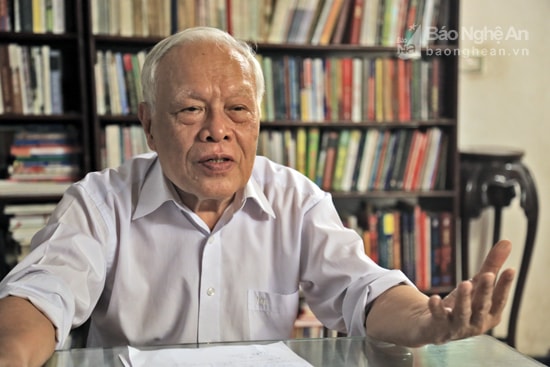 |
| Professor Phong Lê. |
PV:People often talk a lot about the people of Nghe An, about their unique and distinctive characteristics. This story has been around for decades, but it never ends because everyone already has an answer within them. For you, what is the most distinctive and unique characteristic of the people of Nghe An that sets them apart from people of other regions?
Professor Phong Le:When people talk about the people of Nghe An in general, they think of their unwavering revolutionary spirit, courage, and refusal to back down in the face of the enemy. The people of Nghe An are also known for their diligence, hard work, and love of learning. However, when speaking of the people of Nghe An, one also thinks of the image of the "eccentric scholar," referring to the more elite class of Nghe An.
The image of the wooden fish in Nghe An symbolizes the studious spirit and also represents stubbornness. I think stubbornness isn't something bad; it's a characteristic trait of the people of Nghe An, the arrogance of scholars and educated people. Despite their stubbornness, people from Nghe An are well-liked because they are also honest, straightforward, and often generous, not calculating for their own benefit.
Generally speaking, people from Nghe An have many distinctive traits such as resilience, courage, patriotism, a strong revolutionary spirit, diligence, hard work, generosity, honesty, and loyalty... But if I had to choose, I think the most characteristic traits of people from Nghe An are their studiousness, their eccentricity, and their unconventionality, all based on talent and kindness, which are highly valued by people from other regions.
PV:Nghe An is a culturally distinct region, encompassing Nghe An and Ha Tinh provinces. In your opinion, are there differences between these two sub-regions? And if so, what are those differences?
Professor Phong Le:While the aforementioned common characteristics of the people of Nghe An province are noteworthy, a narrower perspective reveals differences between the people of Nghe An and Ha Tinh provinces. The most significant difference is that the people of Nghe An are more resilient, strong, and straightforward, sometimes easily falling into extremism and rigidity. This trait is a strength in revolutions where people are willing to sacrifice for the cause, but it becomes a challenge in the process of national reconstruction, which requires perseverance and patience.
Therefore, people from Nghe An are better at revolution and have produced more revolutionary leaders. Meanwhile, people from Ha Tinh are more gentle, soft-spoken, and flexible. They persevere on their chosen path, but their methods are more skillful, which is why people from Ha Tinh are better at cultural fields and have more successful individuals in cultural, literary, and artistic activities.
If we were to choose a figure who could be considered typical of the people of Nghe An, someone who embodies the qualities of both provinces, it would be Nguyen Cong Tru: talented, arrogant, but also gentle, adaptable, and able to accept the ups and downs of life...
PV:He has repeatedly stated that his homeland and family shaped him. So, what is the greatest influence of his homeland and family on his life and his literary research and criticism career?
Professor Phong Le:Born and raised in Nghe An province, I believe I possess some of the characteristic qualities of the people of Nghe An, such as diligence, a thirst for knowledge, resilience, and a desire to break free from conventional norms. However, these qualities could have led me in a different direction if I hadn't been born into a family where my father was a teacher and had loved literature and read extensively since childhood.
One important factor that greatly influenced my literary research career was the impact of my teachers and senior colleagues in the field I pursued. When I entered the first cohort of Literature students at Hanoi University, I had the opportunity to study under many excellent teachers who were from Nghe An province, such as Professor Cao Xuan Huy, Professor Dang Thai Mai, and researcher Hoai Thanh...
Upon graduation, by chance, I became the only student at the time to be accepted to work at the Institute of Literature, led by Professors Dang Thai Mai and Hoai Thanh. These teachers inspired me to pursue research on modern Vietnamese literature. Every step of my journey has been supported by my teachers and colleagues from Nghe An. The directors of the Institute of Literature, successively from Professor Dang Thai Mai, to the poet Hoang Trung Thong, then Professor Hoang Trinh, and finally myself, have all been from Nghe An. And recently, when the Association for the Study of the Overseas Vietnamese was established, I joined its Executive Board.
For the past two years, I have been entrusted with the responsibility of chairing the Association to continue researching the cultural figure Nguyen Du and the Tale of Kieu. Looking back at the age of 80, I realize that although I didn't live in my hometown for long, everything I've been passionate about throughout my life reflects the spirit of Nghe An province and its people.
PV:He was referring to the positive impact of his hometown traditions and the people of Nghe An on his life. However, not everyone can tolerate or accept the eccentricity and stubbornness of the Nghe An scholars. So, sir, has your Nghe An personality ever created difficulties in your work?
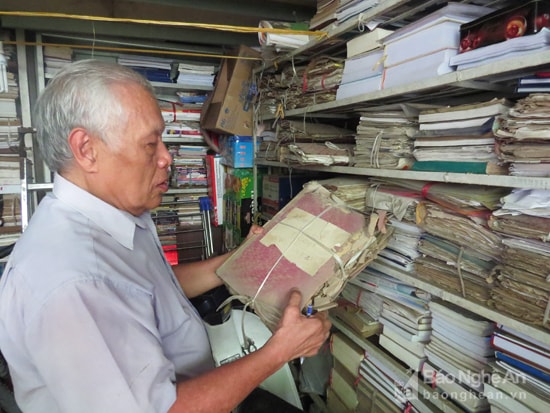 |
| Despite his advanced age, Professor Phong Lê remains dedicated to writing and research. Photo: Thien Trang |
Professor Phong Le:That's just how life is. When there are people who like you, there will also be people who hate you; some will accept you, while others won't. Those who appreciate people from Nghe An also possess a certain straightforwardness, a bit of the same eccentricity as the people of Nghe An. I think everyone, everywhere, will have people who like and dislike them. What's important is how you behave and live to feel comfortable, while still maintaining your own qualities and doing your job well. People from Nghe An are always brave, wanting to be at the forefront, even in dangerous and difficult situations. They don't shy away from their responsibilities and are ready to take responsibility for their actions. But in everything, you need to know your limits to achieve the best results. I always think that way about my work. And that's also part of who I am, not being too extreme in everything I do.
PV:According to him, should we continue to preserve and promote the unique characteristics of the people of Nghe An in this era of integration? And how should we promote them?
Professor Phong Le:Local and regional characteristics are something that are not easily abandoned. And this is especially true for the characteristics of the people of Nghe An, which possess many positive traits such as a studious spirit, diligence, hard work, resilience, courage, and fortitude. However, everything has a downside, and the downside of the people of Nghe An is their tendency towards extremism and factionalism based on regionalism. Integration means participating in a larger playing field, accepting common rules and norms, and thus adjusting one's own individuality accordingly. We should express our individuality in moderation so that many sides accept each other. If we are too rigid and extreme, we will easily isolate ourselves from the crowd, and then it will be difficult to accomplish anything. We must re-evaluate the characteristics and personality of the people of Nghe An, thereby promoting their positive aspects while minimizing their negative ones in order to develop. We need to integrate in order to develop, to enrich our homeland and our country, but in that process of development, we must also preserve the fine qualities of the people of Nghe An.
PV:Thank you very much, Professor!
Thien Trang
(Perform)
| RELATED NEWS |
|---|


